

Cannabis Storage Laws: What Businesses and Consumers Must Know
Across U.S. jurisdictions, cannabis storage laws require licensed operations to keep product in secure, locked locations with restricted access, documented controls, and functioning alarm systems. That’s the baseline. For consumers, the expectation is simpler: keep cannabis in locked, child-resistant containers, out of sight and reach of children and pets. Where you start depends on your state. The most reliable first step is your state’s cannabis control board or department of health portal. Three good anchors: New York’s 9 NYCRR §125.3, Connecticut’s secure-area guidance, and Colorado’s Safe Storage page.
- Licensed businesses: secure locked location, alarm system, access logs, and return-to-secure-location at end of day.
- Consumers: locked container, child-resistant packaging, original labeling when possible.
- Both: keep product away from minors, pets, and unauthorized adults.
Key Takeaways
Cannabis storage laws in the U.S. require licensed businesses to maintain secure, alarmed, access-controlled locations with documented procedures, while consumers must keep product locked and out of reach of children and pets.
| Point | Details |
|---|---|
| Secure location is defined by law | Regulators recognize vaults, alarmed safes, and caged enclosures with specific construction specs like 10-gauge mesh. |
| Access logs are as important as locks | Time-of-access records and return-to-secure-location procedures are active compliance duties inspectors check first. |
| Quarantine workflows prevent violations | Damaged or expired product must be segregated immediately and documented until destruction. |
| Consumers need locked, child-resistant storage | Colorado and other states recommend retaining original child-resistant packaging and using a locked container at home. |
| Treelockbox products fit both consumer and small-operator needs | Lockable boxes with durable construction and label-friendly surfaces align with regulatory “secure location” language and home safety expectations. |
Table of Contents
- What cannabis storage laws require from licensed businesses
- State-by-state examples worth reading closely
- How to build a compliance checklist your business can actually use
- What the law expects from you as a consumer
- Penalties, incident reporting, and what triggers an inspection
- How to find your state’s actual storage rules
- Secure-storage features that actually satisfy regulatory requirements
- Insurance requirements tied to cannabis storage security
- Employee training on storage compliance and security protocols
- The case for taking storage compliance seriously from day one
- Treelockbox products built for compliant, secure storage
- Sources
- FAQ
What cannabis storage laws require from licensed businesses
Every state with a legal cannabis program has its own regulatory language, but the core requirements cluster around the same five areas. Understanding them helps you map your state’s specific rules to a compliance framework you can actually act on.
Secure-location definitions. Regulators recognize three main physical forms: an approved vault, an approved safe with a separate electrical alarm circuit, or a fully enclosed locked caged area. Connecticut’s guidance is among the most detailed in the country, specifying 10-gauge wire mesh, reinforced steel posts, and specific ceiling and roofing expectations for caged enclosures. That level of specificity is the upper bound of what regulators can require. Most states sit somewhere below it, but the direction is always the same: physical barriers plus electronics.
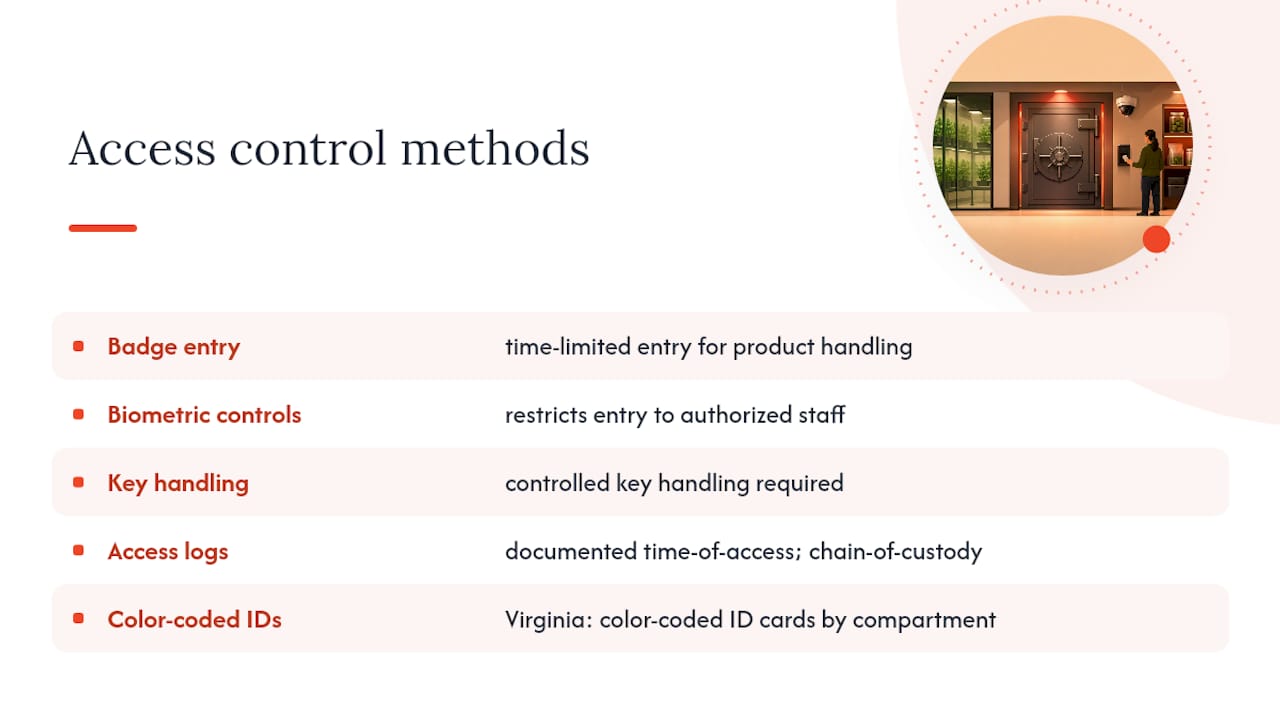
Access control. Only authorized staff may enter a secure location, and access must be time-limited to the actual moment of removing or replacing product. Badge or biometric controls, controlled key handling, and documented access logs are standard expectations. Virginia’s rules go further, requiring color-coded ID cards by compartment so it’s immediately visible who is authorized for which area.
Security systems. Cameras must cover safes and vaults, not just entry points. Alarm circuits for secure enclosures are typically required to be separate from the building’s general alarm. Regulators expect documented testing and inspection schedules, not just installed equipment.
Inventory and recordkeeping. Access logs, chain-of-custody records, and return-to-secure-location procedures are active duties, not paperwork formalities. Damaged, expired, or breached product must be segregated in a quarantined area and documented until destruction. Reconciliation between physical inventory and records is a standard inspection checkpoint.
Environmental and physical separation. California’s rules require storage to be separated from bathrooms and break rooms by solid walls from floor to ceiling, with no outdoor storage permitted. Temperature and humidity controls are not always explicitly mandated, but regulators expect storage conditions that prevent physical, chemical, and microbial contamination.
Regulators treat inventory security as an active duty. Documented procedures, time-of-access logs, and regular security equipment testing carry as much weight as the physical locks themselves.
Pro Tip: When reviewing your state’s rules, search for the phrase “return to secure location” in the regulation text. That phrase almost always triggers a chain of related requirements: end-of-day procedures, transfer documentation, and quarantine workflows.
State-by-state examples worth reading closely
The table below captures the core storage requirement for each featured state. Use it as a starting point, then read the actual regulation text for your jurisdiction.
| State | Key Storage Requirement | Source |
|---|---|---|
| New York | Locked safe, vault, or approved location; cameras on safes/vaults; incident reporting required | 9 NYCRR §125.3 |
| Connecticut | Approved vault, alarmed safe, or caged area with 10-gauge mesh and reinforced posts | CT Secure-Area Guidance |
| Virginia | Compartmentalized areas, written SOPs, quarantine for damaged/expired product, end-of-day return | 3VAC10-40-210 |
| Missouri | Approved facility or written-approval warehouse; no shared warehouse space; transport security rules | 19 CSR 100-1-140 |
| Minnesota | Products stored stored raised above the floor; clean, well-maintained storage areas | MN Rules 9810.1104 |
| Colorado | Child-resistant packaging, locked, labeled, out of sight and reach of children and pets | CO Safe Storage |
New York requires licensees to keep storage areas locked except for the actual moment of removing or replacing product. Cameras must be directed at safes and vaults specifically, and incident reporting timelines are spelled out in the regulation.
Connecticut is the state to study if you’re building a caged enclosure. The guidance document details construction specs that most operators haven’t seen before: 10-gauge wire mesh, steel post reinforcement, and ceiling requirements that prevent climbing over the structure. The document also advises consulting your assigned regulator for site-specific questions.
Virginia stands out for its compartmentalization requirement. Different staff get access to different compartments, tracked by color-coded ID cards. Written SOPs for security, storage, and inventory are mandatory, and the quarantine requirement for damaged or expired product is explicit.
Missouri is the state to watch for multi-site operators. Storage is only permitted at designated approved locations or warehouses approved in writing by the department. Warehouses cannot share space with other licensees, and all transfers must follow department transport-security rules. Failure to get written warehouse approval is one of the most common regulatory traps in the state.
Minnesota Administrative Rule 9810.1104 includes a detail that surprises operators: products must be stored stored raised above the floor. It sounds minor until an inspector flags a pallet sitting directly on concrete.
Colorado directs its guidance primarily at consumers, recommending child-resistant packaging, clear labeling, locked storage, and placement out of sight and reach of children and pets. County pages often add local implementation tips on top of the state guidance.
How to build a compliance checklist your business can actually use
A compliance checklist is only useful if it’s sequenced. Here’s the order that matches how regulators actually inspect.
- Confirm your secure-location type. Determine whether your jurisdiction accepts a vault, an alarmed safe, or a caged enclosure. Pull the exact regulatory definition and match your physical space to it before anything else.
- Verify construction specs. If you’re using a caged area, check gauge requirements, post specifications, and ceiling/roofing expectations. Connecticut’s 10-gauge mesh standard is a useful benchmark even if your state doesn’t cite it explicitly.
- Install and test alarm systems. Secure enclosures need separate alarm circuits, not just a connection to the building system. Document the installation, test date, and technician credentials.
- Set up camera coverage. Cameras must cover safes and vaults directly. Document placement, angle, and retention period. Most states require footage retention of at least 30 days; check your state’s specific requirement.
- Draft your SOPs. Three documents to write first: an End-of-Day Secure Return Procedure, a Quarantine and Destruction Flow, and an Access Authorization Matrix. These are the three documents inspectors ask for most often.
- Train staff and document it. Every authorized employee needs documented training on access procedures, return-to-secure-location requirements, and quarantine protocols. Keep training records with dates and signatures.
- Establish quarantine and disposal workflows. Damaged, expired, or breached product goes into a clearly labeled quarantine area immediately. Document the date of quarantine, reason, and destruction method.
- Schedule inventory audits. Reconcile physical inventory against records on a documented schedule. Gaps between physical count and records are a primary inspection trigger.
- Log every access event. Time-of-access logs are not optional. Every entry and exit from a secure location should be recorded with employee ID, time, and purpose.
- Review and update regularly. Regulations change. Set a calendar reminder to check your state regulator’s page quarterly.
Pro Tip: Inspectors typically check three things first: whether safes or vaults were left unlocked during off-hours (check your camera footage logs), whether time-of-access records have gaps, and whether quarantined product is mixed with sellable inventory. Address those three before anything else.
For a deeper look at inventory documentation and reconciliation practices, Treelockbox’s inventory management guide covers the recordkeeping side in detail.
What the law expects from you as a consumer
Most commercial storage rules don’t bind home users. But that doesn’t mean there are no expectations. Every state with a legal cannabis program expects consumers to keep product away from minors and unauthorized adults. The practical translation of that principle is consistent across states: locked containers, child-resistant packaging, and out-of-sight placement.
- Keep original packaging when possible. Child-resistant packaging is required at point of sale for a reason. Colorado’s guidance explicitly recommends retaining it rather than transferring product to a different container.
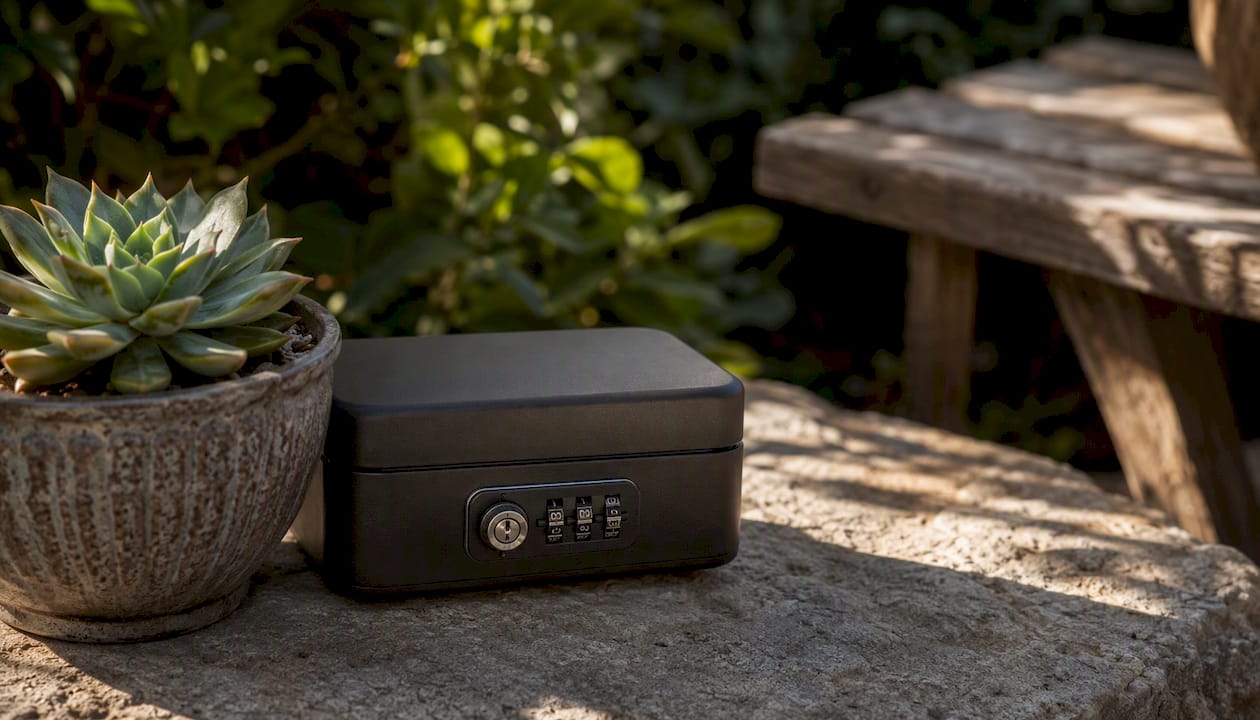
- Use a locked container. A locked box is the single most effective barrier between cannabis and a child or unauthorized adult. It doesn’t need to be a commercial safe.
- Store out of sight. Visibility matters. Products that look like food or candy are a documented hazard, particularly for children and pets.
- Keep it cool, dark, and dry. For product freshness, aim for temperatures below 77°F and relative humidity between 59% and 63%. Opaque, airtight containers slow degradation significantly. A mason jar works for short-term storage, but for anything beyond a few weeks, an opaque container in a cool, dark location is a better choice. For a full breakdown of cannabis shelf life and preservation, the conditions that matter most are light, heat, and oxygen exposure.
- Label your containers. Even at home, labeling helps you track strain, purchase date, and potency. It also reduces the risk of accidental consumption by someone else in the household.
- Dispose of expired or unwanted product properly. Don’t flush cannabis. Many states have specific disposal guidance; check your local health department or county page for instructions.
Colorado’s consumer guidance warns that cannabis products can be mistaken for food or candy. That’s not a hypothetical. Edibles in particular are a documented source of accidental pediatric exposure. A locked, opaque container is the simplest fix.
Medical patients have additional considerations. If you use cannabis daily, a consistent storage routine reduces the risk of accidental exposure and helps you track your supply accurately. Treelockbox’s patient-focused storage guide covers practical routines for daily users.
For parents specifically, childproof cannabis storage requires more than a high shelf. A locked box with a key or combination that children cannot access is the standard regulators and safety advocates consistently recommend.
Penalties, incident reporting, and what triggers an inspection
Enforcement in cannabis is not random. Inspectors follow patterns, and most violations fall into a short list of categories.
Common enforcement triggers:
- Unlocked safes or vaults during off-hours or outside active use
- Missing or incomplete time-of-access logs
- Quarantined product mixed with sellable inventory
- Failed or untested alarm systems
- Inventory discrepancies between physical count and records
- Inadequate camera coverage of secure locations
Typical consequences range from written warnings and fines to license suspension or revocation, depending on the severity and whether the violation is a first offense. Fines vary widely by state and violation type. Repeated or willful violations, particularly those involving diversion or missing product, carry the highest risk of license action.
Incident reporting timelines are state-specific, but the general expectation is immediate notification to your regulator when theft, loss, or diversion is discovered, followed by a written report within 24 hours in many jurisdictions. New York’s §125.3 spells out incident reporting requirements alongside its storage rules.
When something goes wrong, the first 24 hours determine whether you’re a licensee who had an incident or one who had a violation. Save camera footage immediately, pull access logs, isolate any affected inventory, and call your regulator before they call you.
Evidence preservation steps:
- Pull and save camera footage covering the relevant time window before it overwrites
- Print or export time-of-access logs for the relevant period
- Isolate and label any affected inventory as quarantined
- Document chain-of-custody for any product that moved
- Write a contemporaneous incident summary with timestamps
How to find your state’s actual storage rules
Finding the binding rule text is faster than most operators expect, once you know where to look.
- Start with your state cannabis control board’s website. Search “[your state] cannabis control board” or “[your state] marijuana enforcement division.” Most boards publish their administrative rules directly on their site or link to the state administrative code.
- Use the Legal Information Institute (LII) at Cornell Law. LII consolidates state administrative regulations and is often more current than a Google search. Search “LII [state] cannabis storage” to find the relevant code section.
- Check the state department of health or department of agriculture. Medical cannabis programs are often regulated by health or agriculture agencies rather than a standalone cannabis board. If your state has both medical and adult-use programs, check both agencies.
- Look for the specific terms that trigger storage requirements. In the regulation text, search for: “secure location,” “approved vault,” “quarantined storage,” “return to secure location,” and “approved safe.” Those phrases almost always appear in the binding storage rule.
- Confirm the rule version and effective date. Administrative codes are amended regularly. Look for the “effective date” or “last amended” notation at the top of the rule section. If you’re relying on a PDF, check when it was last updated.
- Contact your assigned regulator for site-specific questions. Construction exceptions, warehouse approvals, and questions about whether a specific enclosure meets the “secure location” definition require a direct conversation. Have your floor plan, equipment specs, and proposed SOP ready before you call.
- Bookmark county and local health department pages. As Monterey County’s cannabis education page illustrates, local health departments often publish accessible safe-storage materials that supplement state rules with practical implementation tips.
Secure-storage features that actually satisfy regulatory requirements
Regulators care about specific physical and electronic characteristics, not brand names. When you’re selecting a storage product, match its features to the regulatory language in your state.
- Lock type. Key locks, combination locks, and biometric locks are all used in compliant setups. The question is whether the lock mechanism meets your state’s definition of “secure.” Biometric locks add an access-log function that key locks don’t, which is useful for documentation.
- Construction material and rating. Steel construction is the baseline expectation for commercial applications. For caged enclosures, gauge matters: Connecticut specifies 10-gauge mesh as a minimum. Consumer-grade lockboxes don’t need to meet commercial specs, but durable construction is still the right call.
- Alarm integration capability. Commercial secure locations typically need a separate alarm circuit. If you’re using a safe rather than a vault, confirm it can be connected to a dedicated alarm system, not just the building’s general alarm.
- Ability to be secured inside a larger approved location. A lockable box inside a locked room is a layered-security approach. For small operators, a quality lockbox placed inside a locked, alarmed room can satisfy the “secure location” requirement in many jurisdictions.
- Opaque design. Visibility reduction matters for both compliance and safety. An opaque container prevents casual identification of contents.
- Labelability. For inventory control, the exterior surface of a storage container needs to accept labels clearly. This is a practical requirement that’s easy to overlook when selecting products.
Treelockbox’s secure storage features checklist maps product features to the regulatory phrases inspectors use, which makes it easier to verify compliance before an inspection rather than after.
Pro Tip: When a regulation calls for an “approved safe,” look for two things beyond the lock: an alarm circuit connection point and a method to physically anchor the safe to a wall or floor. An unanchored safe fails the “approved” test in several states even if the lock is solid.
Insurance requirements tied to cannabis storage security
Cannabis businesses face a coverage gap that most general commercial insurers won’t fill. Standard commercial property policies often exclude cannabis inventory entirely, which means a theft or loss event that triggers a regulatory incident report can also leave you with no insurance recovery.
Cannabis-specific insurers, including carriers like Cannasure, Next Insurance, and a growing number of specialty lines through Lloyd’s of London syndicates, underwrite policies that cover cannabis inventory, product liability, and business interruption. The security requirements in those policies closely mirror what regulators require: alarmed secure locations, camera systems with documented retention, access controls, and inventory reconciliation records. In practice, the compliance documentation you build for your regulator is the same documentation your insurer will request after a loss.
A few points worth knowing before you shop for coverage:
- Security system documentation is required at underwriting. Insurers want proof of alarm installation, camera coverage, and testing schedules before binding a policy, not after a claim.
- Inventory reconciliation records affect claim settlements. If your physical inventory records don’t match your point-of-sale system at the time of a loss, the insurer has grounds to dispute the claim amount.
- Policy limits for cannabis inventory are often lower than operators expect. Review sublimits for cannabis product specifically, not just the overall property limit.
- Some policies require specific vault or safe ratings. Underwriters may specify a UL-rated safe or a particular construction standard for caged areas. Confirm your physical setup meets the policy’s requirements before binding.
The overlap between regulatory compliance and insurance eligibility is not coincidental. Both systems are trying to reduce the same risk: diversion, theft, and product loss.
Employee training on storage compliance and security protocols
Training is where most cannabis compliance programs fall apart. Operators build solid physical infrastructure, write the SOPs, and then deliver a one-time orientation that employees forget within a month.
Effective training on storage compliance has three components: initial certification, documented refreshers, and scenario-based practice.
Initial certification should cover the physical layout of secure locations, the access authorization matrix (who can enter which area and when), the end-of-day return-to-secure-location procedure, and the quarantine workflow for damaged or expired product. Every employee who touches cannabis inventory needs this training before their first shift, with a signed acknowledgment on file.
Documented refreshers matter because regulations change and staff turn over. A quarterly review of any regulatory updates, combined with a sign-off that employees have read the current SOP version, creates the paper trail that protects you during an inspection. If your state has updated its storage rules since your last training cycle, that update needs to reach every authorized employee before the next inspection.
Scenario-based practice is the piece most operators skip. Walk employees through what to do when they find a damaged product on the shelf, when a safe alarm triggers during a shift, or when inventory counts don’t reconcile at end of day. Employees who have rehearsed those scenarios respond correctly under pressure. Employees who have only read a policy document often don’t.
A few practical training standards worth building into your program:
- Document every training session with date, attendees, trainer name, and topics covered.
- Keep a separate training log for storage and security topics, distinct from general onboarding records.
- Test employees on access procedures and quarantine workflows, not just general cannabis knowledge.
- Include a clear escalation path: who to call when something goes wrong, in what order, and what information to have ready.
Regulators treat inadequate training as a compliance failure in its own right, separate from any physical violation it may have contributed to.
The case for taking storage compliance seriously from day one
There’s a tendency in the cannabis industry to treat storage compliance as a box-checking exercise, something you address before your first inspection and then mostly ignore. That’s the wrong frame, and it’s the reason so many operators get caught off guard.
The physical infrastructure, the alarm systems, the access logs, the quarantine workflows: these aren’t bureaucratic requirements invented to make operations harder. They exist because cannabis is a high-value, theft-targeted product in a cash-heavy industry, and because diversion into unregulated markets is a real, documented problem regulators are actively trying to prevent. When you build a genuine compliance program, you’re also building the documentation that protects your license when something goes wrong, the evidence trail that supports an insurance claim, and the operational discipline that keeps your inventory accurate.
What Treelockbox has seen consistently, working with consumers and small operators on storage solutions, is that the gap between compliant and non-compliant storage is almost never about money. It’s about not knowing what the regulation actually requires. A quality lockable box placed inside a locked, alarmed room satisfies the layered-security expectation in most jurisdictions. The product selection is straightforward once you know what phrase to match in your state’s rules.
The legal definition of a “secure location” varies by state, and Connecticut’s detailed construction specs represent the upper bound of what regulators can require. But the underlying principle is consistent everywhere: physical barriers, electronic monitoring, documented access, and a clear chain of custody from receipt to sale or disposal.
Treelockbox products built for compliant, secure storage
Compliant storage doesn’t require a commercial vault for every use case. For consumers and small operators, a well-built lockable box with the right features covers the regulatory and safety bases that matter most.
Treelockbox’s lockable stash boxes combine durable steel construction, secure key or combination locks, and label-friendly exterior surfaces that work with inventory control systems. The opaque design keeps contents out of sight, and the American-made build quality holds up to the daily use that compliance requires. For consumers, the same features that satisfy a regulator’s “secure location” language also keep product away from children and pets.
Browse the full selection at the Treelockbox shop, or work through the product FAQ and storage guide to match a specific product to your state’s regulatory requirements.
This article is general information, not a substitute for advice from a qualified lawyer. Consult a qualified legal professional about your own circumstances before acting on anything here.
Sources
These are the primary sources for cannabis storage requirements across the featured states. Check each one for the current effective date before relying on it for compliance decisions.
FAQ
What does a “secure location” mean under cannabis storage laws?
A secure location is defined by state regulation as an approved vault, an alarmed safe with a separate electrical alarm circuit, or a fully enclosed locked caged area built to specific construction standards. Connecticut’s guidance, for example, requires 10-gauge wire mesh and reinforced steel posts for caged enclosures.
How long does cannabis stay fresh in a mason jar?
A mason jar works for short-term storage of a few weeks, but for longer periods, an opaque, airtight container in a cool, dark location below 77°F with relative humidity between 59% and 63% preserves product quality significantly better.
Do home consumers have to follow the same storage rules as licensed businesses?
No. Commercial storage regulations apply to licensed operators, not home users. Consumers are generally expected to keep cannabis in locked, child-resistant containers out of reach of minors and pets, which aligns with Colorado’s consumer safe-storage guidance.
What happens if a licensed business fails a cannabis storage inspection?
Consequences range from written warnings and fines to license suspension or revocation, depending on the severity and whether the violation is a first offense. Missing inventory, unlocked secure locations, and inadequate recordkeeping are the most common triggers for serious enforcement action.
Which states have the strictest cannabis storage requirements?
Connecticut publishes the most detailed construction specifications for secure enclosures, including 10-gauge wire mesh and reinforced post requirements. Virginia’s compartmentalization rules and color-coded access system are also among the more specific in the country. New York’s §125.3 combines physical storage requirements with explicit camera placement and incident reporting obligations.