

Childproof Cannabis Storage: A Parent's Safety Guide
Childproof cannabis storage is a layered safety system that combines certified child-resistant containers with locked, out-of-reach placement to prevent children from accessing cannabis products. The industry term is “child-resistant storage,” and it covers far more than the packaging your product arrives in. Parents who rely on the original container alone are missing half the picture. This guide explains what the standards actually require, where most home setups fail, and how to build a storage system that holds up in real life.
What is childproof cannabis storage and how does it work?
Child-resistant (CR) packaging is defined by federal testing protocols, specifically 16 CFR 1700.20 and ASTM F1272, which require that a container prevent opening by at least 85% of children aged 42 to 51 months within a five-to-ten-minute window, while remaining openable by adults. That number tells you something critical: up to 15% of children in that age range can open a certified container. No packaging is impenetrable, which is exactly why the term “childproof” is technically inaccurate. The industry uses “child-resistant” for a reason.
Common CR container formats include push-and-turn jars, squeeze-and-lift tins, pinch-and-slide tubes, and heat-sealed Mylar bags. Each format is tested against child panels before certification is granted. Health Canada’s packaging regulations for cannabis products require CR containers and plain labeling to reduce youth appeal, which mirrors the approach taken by U.S. state regulators. The underlying logic is consistent across borders: packaging is the first barrier, not the only one.
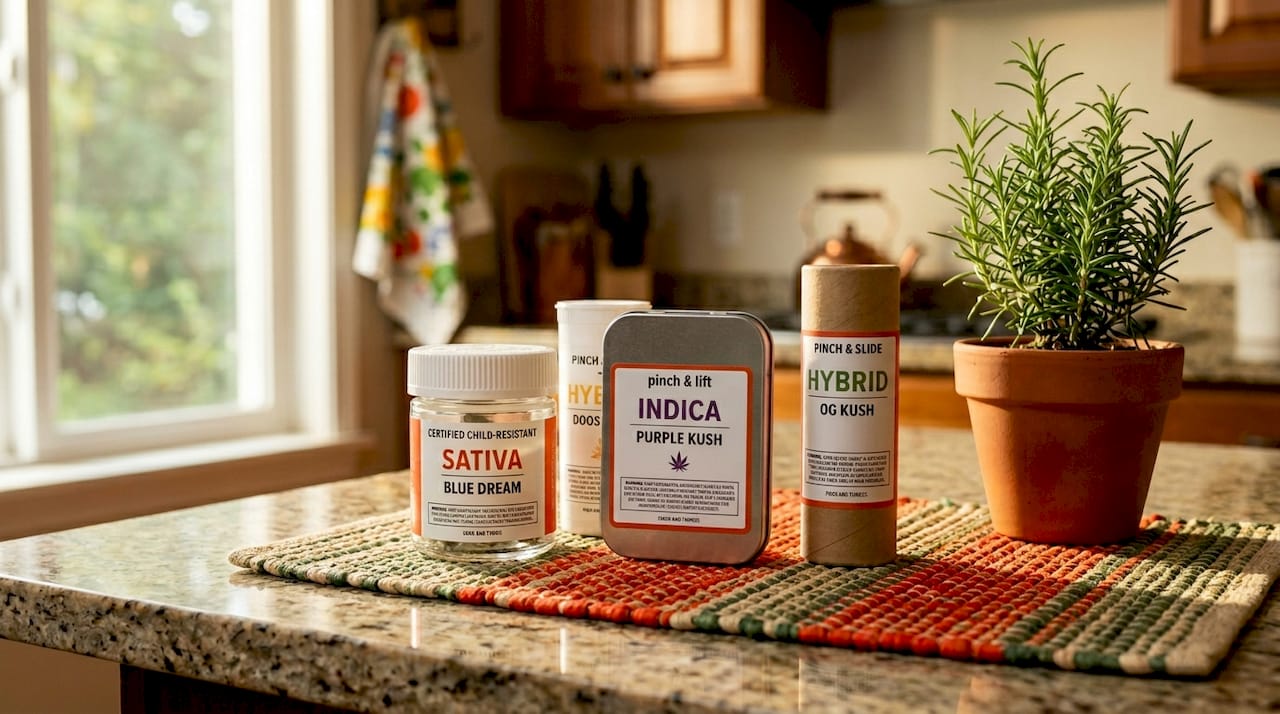
When you purchase a container marketed as child-resistant, you should request documentation. Certified CR containers require documented results from third-party panel testing with both child and adult groups. A visual design or a manufacturer’s self-claim does not constitute certification. This distinction matters because the market includes many products that look secure but have never been formally tested.
Pro Tip: Ask your dispensary or packaging supplier for the specific test standard their containers meet. If they cannot name 16 CFR 1700.20 or ASTM F1272, treat the container as unverified.
Why child-resistant packaging alone isn’t enough
Pediatric cannabis exposures have risen sharply, with Ohio data showing ingestions climbing from 313 cases in 2018 to 1,417 in 2024, driven almost entirely by edible products that resemble candy in shape and texture. Gummies are the primary culprit. A child who finds a gummy bear in a bag does not register it as medicine or a controlled substance. They register it as food.
The American College of Medical Toxicology’s 2025 position statement advocates a multi-layered storage approach that combines locked placement with child-resistant containers, keeping products out of sight and stored up high. This is not a suggestion to be cautious. It is the expert consensus on what actually prevents exposure. A CR container sitting on a kitchen counter is a failure of the system, regardless of how well the container itself is designed.
The most common parent-reported failure modes are not dramatic. They are mundane:
- Transferring edibles into unlabeled food containers, such as a zip-lock bag or a candy dish
- Leaving CR packaging open or unsealed after use
- Storing cannabis in a purse, backpack, or nightstand drawer that children can access
- Assuming a locked room is sufficient without a dedicated locked container inside it
- Giving guests or other household members access to storage areas without briefing them on the rules
“Parents often defeat the child-resistant system entirely by moving edibles to plain jars or leaving packages open, which increases accidental access risk significantly.” — cannabisetiquette.org
The pattern here is behavioral, not mechanical. The container works. The habits around it do not.
Comparing childproof cannabis storage options for home use
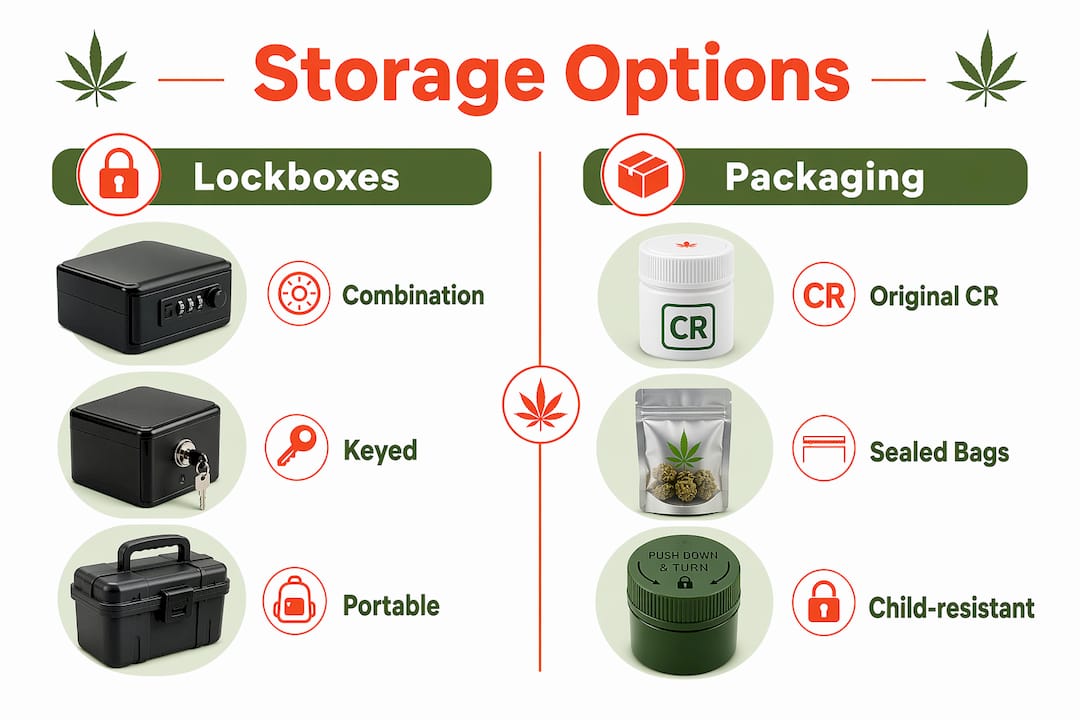
Not all secure cannabis storage options are built for the same situation. A single adult in an apartment has different needs than a parent of three in a house with curious kids and visiting grandchildren. The table below compares the most common approaches.
| Storage method | Security level | Best for | Key limitation |
|---|---|---|---|
| Original CR packaging only | Low to medium | Temporary or single-use | No secondary lock; easily left open |
| Lockable tin or stash box | Medium | Flower, small quantities | Key management is critical |
| Combination lockbox | High | Edibles, concentrates, mixed products | Combination must be memorized by adults only |
| Locked cabinet or drawer | High | Large quantities, multiple product types | Requires dedicated furniture; less portable |
| Biometric lockbox | Very high | Households with older children | Higher cost; battery dependent |
For most families, a combination lockbox or a keyed lockbox represents the best balance of security and practicality. These lockable storage boxes are purpose-built to hold cannabis products in their original packaging, which means you get two layers of protection without any extra effort. The original CR container stays sealed inside a locked box. A child who somehow reaches the box still cannot open the container inside.
Edibles require the strictest storage because they pose the highest ingestion risk. Concentrates and vape cartridges are less likely to be mistaken for food but are still toxic in small amounts. Flower is the lowest acute risk but should still be stored locked to prevent access and to control odor in shared living spaces.
Pro Tip: Choose a lockbox with enough interior space to hold products in their original packaging. A box that forces you to repackage products defeats the purpose of CR containers.
How to set up and maintain a childproof cannabis storage system
A well-designed child-resistant cannabis storage system does not require expensive hardware. It requires consistent habits applied to a clear structure. Follow these steps to build one that holds up over time.
-
Keep all products in original CR packaging. Never transfer edibles, concentrates, or flower into unlabeled containers. The original CR packaging is your first line of defense and should stay intact until the product is consumed.
-
Place all CR packaging inside a locked container. A lockbox, locked cabinet, or locked drawer adds the second layer. This is non-negotiable if children live in or regularly visit your home.
-
Manage keys and combinations strictly. The key or combination for your lockbox must be stored somewhere children cannot reach and cannot stumble upon. A key left on a hook at child height negates the entire system.
-
Store the locked container out of sight and up high. The ACMT recommends placement that is both locked and physically inaccessible. A locked box on a high shelf in a closed closet is significantly safer than a locked box on a coffee table.
-
Never transfer edibles into food-like containers. This is the single most common failure point. A gummy in a sandwich bag looks identical to candy. A gummy in its original labeled CR packaging inside a locked box does not.
-
Audit your storage regularly. Check monthly that locks function, that products are in original packaging, and that no cannabis has migrated to a purse, car, or jacket pocket where children could find it.
-
Brief every adult in the household. Babysitters, partners, and visiting family members need to know the rules. One person who does not follow the system can undo everything you have built. Healthcare providers also recommend regular counseling on safe storage for all cannabis users in households with children.
For a broader look at how different storage types compare for home use, the secure home storage guide from Treelockbox covers the full range of options, including solutions for liquid CBD products and portable use.
Key takeaways
Effective childproof cannabis storage requires original CR packaging, a locked secondary container, and strict key management practiced consistently by every adult in the household.
| Point | Details |
|---|---|
| CR packaging has limits | Up to 15% of children aged 42 to 51 months can open certified child-resistant containers. |
| Edibles are the highest risk | Gummy-style edibles resemble candy and account for the sharpest rise in pediatric ingestion cases. |
| Layered storage is the standard | ACMT recommends locked placement combined with CR containers, not one or the other. |
| Behavior defeats hardware | Most failures come from transferring products to unlabeled containers or leaving packages open. |
| Key management is non-negotiable | A lockbox key accessible to children provides no meaningful protection. |
What we have learned building storage solutions for parents
At Treelockbox, we talk to a lot of parents who come to us after a near-miss. Not a tragedy, thankfully, but a moment where a child picked up something they should never have reached. What strikes me every time is that the container was usually fine. The system around it was not.
The most persistent misconception I encounter is that buying a lockbox solves the problem. It does not. A lockbox solves the hardware problem. The behavioral problem, which is where almost every failure actually originates, requires a different kind of attention. You have to build habits that are as automatic as locking your front door. You do not think about locking your door. You just do it. Cannabis storage needs to reach that same level of reflex.
I also think people underestimate how much consistency matters across everyone in the household. One adult who treats the rules as optional is a genuine vulnerability. I have seen setups that were excellent in every mechanical sense, undone by a guest who left an edible on the counter. The conversation with every adult who enters your home is not optional. It is part of the system.
The other thing I would push back on is the idea that perfect hardware compensates for imperfect habits. It does not work that way. A biometric lockbox with a dead battery is less secure than a simple keyed box that gets locked every single time. Prioritize consistency over sophistication. The best child-resistant cannabis storage system is the one you actually use correctly, every day.
— Tree Lock Box
Storage solutions built for families who take safety seriously
Treelockbox designs lockable cannabis storage boxes specifically for households where security is not optional. The Tree Lock Box combines a secure lock mechanism with interior space sized to hold products in their original CR packaging, so you never have to choose between convenience and the two-layer protection system that experts recommend. It is built in America, ships fast, and is designed to be used daily without frustration. If you want a storage setup that matches the guidance in this article, the complete cannabis storage guide on the Treelockbox site walks through every product type and storage scenario in detail.
FAQ
What does child-resistant mean on cannabis packaging?
Child-resistant means the container has passed formal testing under 16 CFR 1700.20 or ASTM F1272, confirming that at least 85% of children aged 42 to 51 months cannot open it within five to ten minutes. It does not mean the container is impossible for a child to open.
Are child-resistant containers enough to keep cannabis away from kids?
No. Child-resistant containers are the first layer of protection, not the complete solution. Pediatric and toxicology experts recommend storing cannabis locked, out of sight, and up high in addition to using CR packaging.
What type of cannabis product poses the greatest risk to children?
Edibles, particularly gummies, pose the greatest risk because they resemble candy in shape, color, and texture. Pediatric ingestion cases in Ohio rose from 313 in 2018 to 1,417 in 2024, with edibles as the primary source.
What is the safest way to store cannabis edibles at home?
Keep edibles in their original labeled CR packaging, place that packaging inside a locked box or cabinet, store the locked container out of reach and out of sight, and keep the key or combination inaccessible to children.
How do I know if a child-resistant container is genuinely certified?
Ask for documentation of third-party panel testing results. A certified container will have documented proof of passing tests with both child and adult panels. Visual design or a manufacturer’s self-claim without documentation does not confirm certification.