

Secure Home Cannabis Storage Types: Your Safety Guide
Whether you use cannabis recreationally or medicinally, how you store it at home matters far more than most people realize. The wrong setup puts children, pets, and product quality at risk simultaneously. This guide covers every major secure home cannabis storage type, from airtight glass jars to biometric lockboxes, so you can make an informed decision based on your household, your habits, and your budget. No fluff. Just what you actually need to know.
Table of Contents
- Key takeaways
- 1. Secure home cannabis storage types: the key criteria
- 2. Airtight glass jars with humidity control
- 3. Lockable stash boxes and dedicated cannabis safes
- 4. Stainless steel, silicone, and wooden humidors
- 5. Head-to-head comparison and situational recommendations
- My honest take on where most people get this wrong
- Protect what matters with the right storage solution
- FAQ
Key takeaways
| Point | Details |
|---|---|
| Locked containers are non-negotiable | Child-resistant packaging is not childproof once opened; a locked secondary container is required. |
| Glass plus humidity packs is the gold standard | Airtight UV-protected glass with 62% RH humidity packs preserves potency and prevents mold. |
| Match the lock type to your lifestyle | Combination locks beat key locks for daily-access users who risk losing keys. |
| Edibles need separate, labeled storage | Never store edibles near food; they require their own locked, opaque, clearly labeled container. |
| Layer your storage for best results | Combining an airtight glass jar inside a locked box gives you both quality preservation and security. |
1. Secure home cannabis storage types: the key criteria
Before you buy anything, you need a clear framework for what “secure” actually means. The word gets used loosely, but good storage has to satisfy at least four conditions at once: it prevents unauthorized access, it preserves product quality, it controls odor, and it fits your real-world usage pattern.
Security features are the first filter. Lock types matter. Combination locks, keyed padlocks, and biometric fingerprint locks each have different trade-offs in speed, reliability, and cost. Combination locks are preferred for home cannabis lockboxes because there are no keys to lose and access remains fast for the primary user.
Material is the second filter. Glass preserves terpene profiles better than plastic. Stainless steel resists odor absorption. Wood offers natural humidity buffering but requires maintenance. Silicone is non-stick and flexible, which makes it ideal for concentrates, but it is not a long-term preservation option for flower.
Environmental controls are often overlooked. Optimal storage conditions are 60 to 70°F with 55 to 65% relative humidity. Without these conditions, cannabis degrades faster regardless of how secure the container is.
Odor control protects your privacy and discourages curious children and pets from investigating a container they might otherwise ignore. Scent-proof seals and activated carbon linings both work, but they require intact gaskets to function.
- Lock type: combination, key, or biometric
- Material: glass, steel, wood, or silicone
- Environmental controls: humidity packs, UV protection, temperature
- Odor proofing: airtight gaskets, carbon liners
- Practicality: size, daily access speed, portability
Pro Tip: Before buying, write down how often you access your storage daily, whether children or pets are in the home, and how much product you typically store at once. Those three answers will narrow your choices faster than any spec sheet.
2. Airtight glass jars with humidity control
Glass mason jars have been the preferred storage solution for serious cannabis users for decades, and the reasoning holds up. Glass is chemically inert, which means it does not leach any compounds into your product. It does not absorb odors over time the way plastic does. And with a proper airtight seal, it keeps oxygen and moisture at stable levels.
The biggest upgrade you can make to a standard glass jar setup is adding a 62% RH humidity pack inside the jar. These small packets, often called Boveda packs, absorb or release moisture automatically to maintain the ideal humidity range. The result is flower that stays at peak potency for months instead of weeks.
UV-protected or opaque glass takes this further by blocking light, which degrades cannabinoids faster than most people expect. If you are using clear glass, store the jar in a dark drawer or cabinet.
- Use UV-protected or amber glass when possible
- Add a 62% RH humidity pack sized for your jar volume
- Store in a cool, dark location away from heat sources
- Replace humidity packs when they harden completely
- For added security, place the jar inside a locked box
The one limitation of glass jars alone is that they offer zero security against children or pets. A curious toddler can open a mason jar lid. Pets are attracted by scent even through low-odor containers, and THC toxicity in dogs requires immediate veterinary care with no home antidote. Glass jars belong inside a locked container, not on a shelf by themselves.
3. Lockable stash boxes and dedicated cannabis safes
This is the category most users should build their setup around. A lockable stash box combines a secure outer shell with enough interior space for a jar, your accessories, and sometimes built-in humidity control trays. These boxes range from simple wood boxes with combination padlocks to sophisticated metal safes with biometric access.
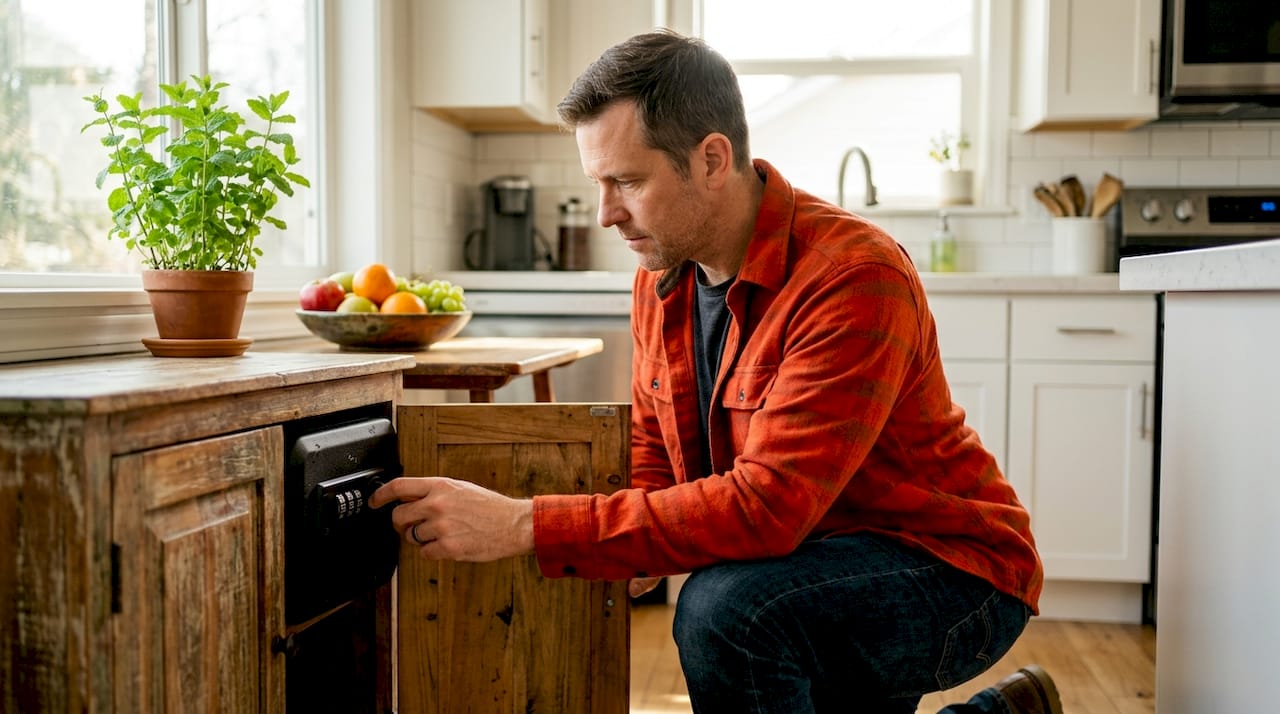
Stash boxes typically cost between $68 and $100 for solid mid-range options, with premium models exceeding $249. That spread reflects real differences in materials, lock quality, and interior design. A $70 wood box with a three-digit combination lock handles most household needs. A $250-plus metal safe with a biometric lock is more appropriate for medical patients storing large quantities or for households with older children who can crack a simple combination.
| Storage type | Lock mechanism | Price range | Best for |
|---|---|---|---|
| Wood stash box | Combination or key | $50 to $100 | General home use, daily access |
| Metal lockbox | Key or combination | $80 to $150 | Heavier security needs |
| Biometric safe | Fingerprint scanner | $150 to $300+ | Medical users, high-value storage |
| Cannabis humidor | Key lock | $100 to $250 | Enthusiasts, long-term storage |
Only 22% of pet owners use locked storage despite real exposure risks, which means the majority of households are relying on shelf height or drawer placement alone. 40% of pet owners store cannabis in drawers or nightstands, which both children and pets can access with minimal effort.
Pro Tip: Test your combination lock monthly. If the mechanism sticks or skips, replace it before it fails at an inconvenient moment. A jammed lock is a security gap, not just an inconvenience.
4. Stainless steel, silicone, and wooden humidors
These three material categories each fill a specific role in a well-organized home storage system. None of them replace a primary locked stash box, but each solves a problem the others do not.
Stainless steel containers are the best option for travel and portability. They are impact-resistant, do not absorb odors over time, and look discreet enough to pass as a coffee canister. Many models include rubber-gasketed lids that create a reliable scent seal. For users who move between locations, a steel travel container inside a locked bag is a practical setup.
Silicone containers are purpose-built for concentrates. Wax, shatter, and live resin stick to almost every other material, but they release cleanly from silicone. These containers are inexpensive, flexible, and easy to clean. They are not suitable for long-term flower storage because they are not fully airtight and silicone can allow very slow vapor exchange over time.
Wooden humidors bring genuine aesthetic value and natural humidity buffering to cannabis storage. Spanish cedar, the traditional wood used in cigar humidors, absorbs and releases moisture in a way that helps maintain the interior humidity without any additional packs. The trade-off is that humidity control performance depends entirely on how well you maintain stable environmental conditions. A beautiful wooden humidor in a hot garage will perform worse than a plain glass jar in a cool closet.
- Steel: use for travel, portability, and scent discretion
- Silicone: use exclusively for concentrates and short-term storage
- Wood humidors: use for home display and enthusiast collections with proper climate control
5. Head-to-head comparison and situational recommendations
Now that you understand each category, here is a direct comparison to help you match a storage type to your actual circumstances.
| Storage type | Security | Preservation | Price | Portability | Best situation |
|---|---|---|---|---|---|
| Airtight glass jar | Low (alone) | Excellent | $10 to $30 | Poor | Inside a locked box for best results |
| Lockable wood stash box | Good | Good | $50 to $100 | Moderate | Households with children or pets |
| Metal safe or biometric | Excellent | Moderate | $150 to $300+ | Poor | Medical users, large quantities |
| Stainless steel container | Moderate | Good | $20 to $60 | Excellent | Travel, on-the-go use |
| Silicone container | Low | Fair | $5 to $20 | Excellent | Concentrates only |
| Wooden humidor | Good | Very good | $80 to $250 | Poor | Enthusiasts, display-worthy home setups |
The clearest recommendation for most households is a layered approach. Use an airtight glass jar with a humidity pack as your inner container, placed inside a lockable wood or metal box. This gives you preservation quality at the glass layer and access control at the outer layer. Edibles must always be stored separately from food items and in their own locked, labeled container. Treating them like a high-risk medication is the right mental model.
For medical users who need frequent access without fumbling with locks, a biometric safe is worth the investment. Fingerprint access takes under a second and still keeps the container completely inaccessible to anyone else in the home.
Pro Tip: Label every container clearly with the contents and the date stored. This is especially useful for households with multiple products and prevents any accidental confusion between edibles and regular food.
Use this checklist to evaluate your current setup:
- Is your primary container locked with a mechanism children cannot defeat?
- Are edibles stored separately from all food items?
- Is humidity maintained between 55 and 65% inside the container?
- Is the storage location cool, dark, and away from heat sources?
- Are pets physically unable to access the storage location?
- Do all household members know the storage rules?
Parents should educate all household members about cannabis safety, not just physically secure the product. A locked box combined with a household conversation is more effective than either one alone.
My honest take on where most people get this wrong
I’ve spent a lot of time looking at how cannabis users actually store their products at home, not how they think they do. The gap is significant.
Most people believe that putting something on a high shelf or in a locked drawer constitutes secure storage. It does not. Child-resistant packaging is the first line of defense, not the last. Once you open a package and transfer product to a jar or container, that original packaging is irrelevant. What matters is the secondary container you put it in.
I’ve also seen a real tension with medical users. When you need access to your medication multiple times a day, the friction of a combination lock feels like too much. I understand that. But a biometric lock solves this completely. A fingerprint read is faster than twisting a cap. Medical users who hesitate to lock their storage because of access speed are solving the wrong problem.
The most overlooked issue I keep coming back to is edibles. Cannabis edibles stored near food create serious poisoning risks, particularly for children who cannot distinguish a cannabis gummy from a regular one. The storage protocol for edibles should match what you would do with a prescription painkiller. Separate, locked, and labeled.
My final thought: the technology is not the hard part. The habit is. The best lockbox in the world does nothing if you leave it open on the counter.
— Bujify Team
Protect what matters with the right storage solution
You now know exactly what separates good cannabis storage from a setup that puts your household at risk. The next step is getting the right products in place. Treelockbox builds lockable stash boxes and storage kits specifically designed for home cannabis users who take both quality and safety seriously. Each lockable storage box features a secure combination lock, compatibility with humidity control packs, and a compact footprint that fits in any room without drawing attention. If you are ready to move beyond jars on shelves, browse the full storage solutions catalog at Treelockbox and find the option that fits your household.
FAQ
What is the most secure type of home cannabis storage?
A biometric or combination-lock metal safe provides the highest level of access control at home. For most households, a lockable wood or metal stash box with a reliable combination lock offers sufficient security at a much lower price point.
Do glass jars alone keep cannabis safe from children and pets?
No. A glass jar by itself can be opened by a toddler and accessed by a determined pet attracted by scent. Glass jars should always be placed inside a locked container to provide actual security.
How do I store cannabis edibles safely at home?
Store edibles in their own locked, opaque, clearly labeled container, completely separate from regular food. Never place them in snack jars or near candy, and treat access controls the same way you would for prescription medication.
What humidity level should I maintain in my cannabis storage container?
The ideal range is 55 to 65% relative humidity. A 62% RH humidity pack inside an airtight glass jar is the most reliable way to stay within that range without any manual monitoring.
Are combination locks or key locks better for cannabis storage?
Combination locks are generally the better choice for daily-use cannabis storage because there are no keys to lose, and access is quick once you know the code. Key locks are acceptable for lower-frequency access like backup storage.