

The Role of Organized Storage for Cannabis Enthusiasts
Most cannabis consumers think carefully about what they buy. Far fewer think carefully about what happens after they get home. The role of organized storage for cannabis goes well beyond keeping things tidy. Poor storage degrades potency, invites mold, creates genuine safety hazards, and turns a well-curated stash into a guessing game of unlabeled bags and forgotten strains. Whether you keep a small personal supply or stock up in bulk, how you store your cannabis determines what you actually get when you use it.
Table of Contents
- Key takeaways
- The role of organized storage for cannabis starts with the environment
- Safety and accessibility: why organization protects more than your stash
- Organizing by strain and batch to preserve quality and reduce waste
- Common storage mistakes and cannabis organization tips that actually help
- Long-term storage for seeds, bulk flower, and specialty products
- My take on what most people get completely wrong about cannabis storage
- Storage solutions built for the way you actually use cannabis
- FAQ
Key takeaways
| Point | Details |
|---|---|
| Environment controls potency | Staying within 60–70°F and 58–62% humidity prevents trichome damage and mold growth. |
| Organization prevents waste | FIFO labeling and separate strain packaging stop you from burning through your best stock accidentally. |
| Locked storage protects everyone | Secured, opaque containers reduce accidental ingestion risks for children and pets. |
| Containers matter more than location | Glass airtight jars outperform plastic bags by preventing static, oxidation, and trichome loss. |
| Long-term storage needs layers | Vacuum sealing combined with humidity control can extend viable shelf life up to a year or more. |
The role of organized storage for cannabis starts with the environment
You cannot separate organization from environment. The two work together, and neglecting either one means your cannabis is quietly losing quality every day.
The science here is straightforward. Optimal cannabis storage requires a temperature between 60 and 70°F and a relative humidity (RH) between 58 and 62% inside an airtight container. Push the temperature above 77°F and THC begins breaking down faster. Let humidity climb above 65% and you are creating conditions where mold and mildew thrive. Drop below 55% RH and trichomes become brittle, meaning those resin glands that carry cannabinoids and terpenes literally crumble off your flower.
Light exposure is the other silent killer. UV rays accelerate the breakdown of cannabinoids regardless of temperature. A clear glass jar on a sunny windowsill looks attractive but acts like a slow degradation machine. Opaque or UV-blocking containers, stored in a cool dark drawer or cabinet, are the practical fix.
Oxygen matters too. Every time you open a container, fresh air rushes in and begins oxidizing THC. Airtight seals are not optional for quality storage. They are the baseline.
Tracking and controlling your storage conditions
| Condition | Optimal Range | Risk Zone | Consequence |
|---|---|---|---|
| Temperature | 60–70°F | Above 77°F | THC degradation accelerates |
| Humidity (RH) | 58–62% | Above 65% / Below 55% | Mold growth / Brittle trichomes |
| Light exposure | None (dark) | Direct sunlight or UV | Cannabinoid breakdown |
| Oxygen | Minimal (airtight) | Frequent opening | Terpene and potency loss |
The most practical tool for humidity control is a two-way humidity pack. Humidity packs cost around $2 to $3 and last two to four months. Brands like Boveda and Integra Boost are the most recognized options. Drop one inside your airtight glass jar and it actively absorbs or releases moisture to keep RH stable without any monitoring on your part.
Pro Tip: Place a small digital hygrometer inside your main storage container when first setting up your system. Check it after 24 hours to confirm your humidity pack is bringing conditions into the 58–62% range before you trust it long-term.
Safety and accessibility: why organization protects more than your stash
There is a dimension to organized storage that gets less attention than potency preservation. It is the safety dimension, and it matters significantly if you live with other people, especially children or pets.
Locked storage locations reduce accidental ingestion risks, particularly for THC edibles, which can look identical to regular snacks. This is not an edge-case concern. A gummy that looks like candy and smells like fruit is genuinely hazardous in a household with curious kids. Health guidance consistently stresses that secure, locked, opaque storage is the standard adults should hold themselves to. Safe home storage also helps you stay aligned with local regulations, which in many states specifically require cannabis to be stored away from minors.
Organization supports accessibility too, but in a disciplined way. Knowing exactly where each product lives means you are not digging through a drawer of mystery bags at 10 PM. That kind of chaotic searching leads to over-handling, which introduces warmth from your hands and exposes product to air unnecessarily.
Here is what a practical safety-first organization system looks like:
- Locked container as the starting point. Every cannabis product, including flower, edibles, tinctures, and concentrates, lives inside a container that requires a key or combination to open.
- Labeling each product clearly. Strain name, purchase date, and product type (flower, edible, concentrate) should be visible without opening anything.
- Fixed locations for each category. Flower in one dedicated spot, edibles in another. Consistency means you never have to guess, and you eliminate cross-contamination of aromas and flavors.
- Opaque outer storage. Even if individual containers are clear glass, keep them inside an opaque box or bag to block light and provide a second layer of discretion.
Pro Tip: Treat your cannabis storage location the same way you would a medication cabinet. One fixed place, always locked, always labeled. The habit itself becomes the safety system.
Organizing by strain and batch to preserve quality and reduce waste
The benefits of cannabis storage go significantly further when you layer in inventory management principles. This is where most casual consumers leave value on the table.
Think about what happens without a system. You have three strains in similar containers, no dates on any of them, and you tend to grab whichever is on top. The oldest stock gets ignored, loses potency sitting untouched, and eventually gets used when it is well past its peak. This is a waste problem, not just a storage problem.
The fix is FIFO, which stands for first in, first out. Applying FIFO with precise labeling prevents quality loss by keeping older stock moving and limiting unnecessary air exposure. The practice is standard in professional dispensary operations and translates directly to personal storage.
Organized storage bins with fixed SKU and bin locations in dispensaries prevent product mixing and speed up inventory management. The same logic works at home. Assign each strain or product type a specific container and a specific shelf position. Never rotate them.
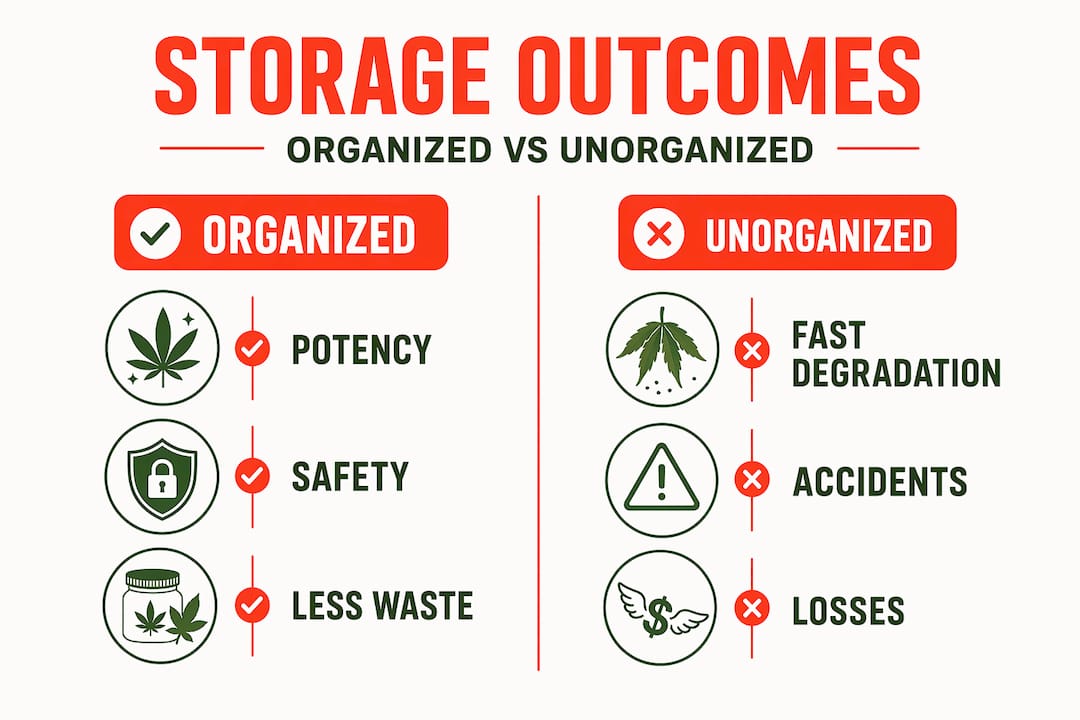
Comparing organized vs. unorganized storage outcomes
| Outcome | Organized Storage | Unorganized Storage |
|---|---|---|
| Potency over time | Maintained longer due to minimal handling | Degrades faster from repeated exposure |
| Strain identification | Instant, labeled clearly | Guesswork, frequent mix-ups |
| Waste from old stock | Low with FIFO rotation | High, oldest stock often forgotten |
| Safety | Locked and inaccessible to others | Open access creates risk |
| Stress of use | Calm and efficient | Frustrating and time-consuming |
For detailed guidance on maintaining freshness through organized approaches, the adult consumer’s freshness guide from Treelockbox covers practical day-to-day habits worth building into your routine.
Common storage mistakes and cannabis organization tips that actually help
Getting storage right is as much about what you stop doing as what you start doing.
- Stop using plastic bags for anything beyond a single session. Plastic causes trichome loss through static and offers no protection against oxygen permeability. Glass jars with airtight seals remain the standard that everything else is measured against.
- Stop reusing dispensary pop-top containers for long-term storage. They are fine for a few days, but they are not airtight and they let in light. Transfer your flower within the first week.
- Minimize how often you open your main container. Every opening introduces fresh oxygen, which accelerates both THC oxidation and terpene loss. Decant a small amount into a secondary, smaller jar for daily use and keep the main supply sealed.
- Reduce container headspace deliberately. If your jar is half empty, consider downsizing to a smaller jar. Excess air inside the container works against you even when sealed.
- Never store cannabis near heat sources. That means away from ovens, electronics, heating vents, and windowsills. A consistent cool temperature matters more than the perfect number.
- Do not refrigerate flower. Temperature fluctuations from opening and closing a refrigerator create humidity swings that accelerate mold risk. A cool, stable cabinet beats a fridge.
Long-term storage for seeds, bulk flower, and specialty products
When you are storing beyond a few weeks, the cannabis organization tips above need to scale up. Seeds and bulk flower have different needs than a weekly supply, and mixing approaches causes problems.
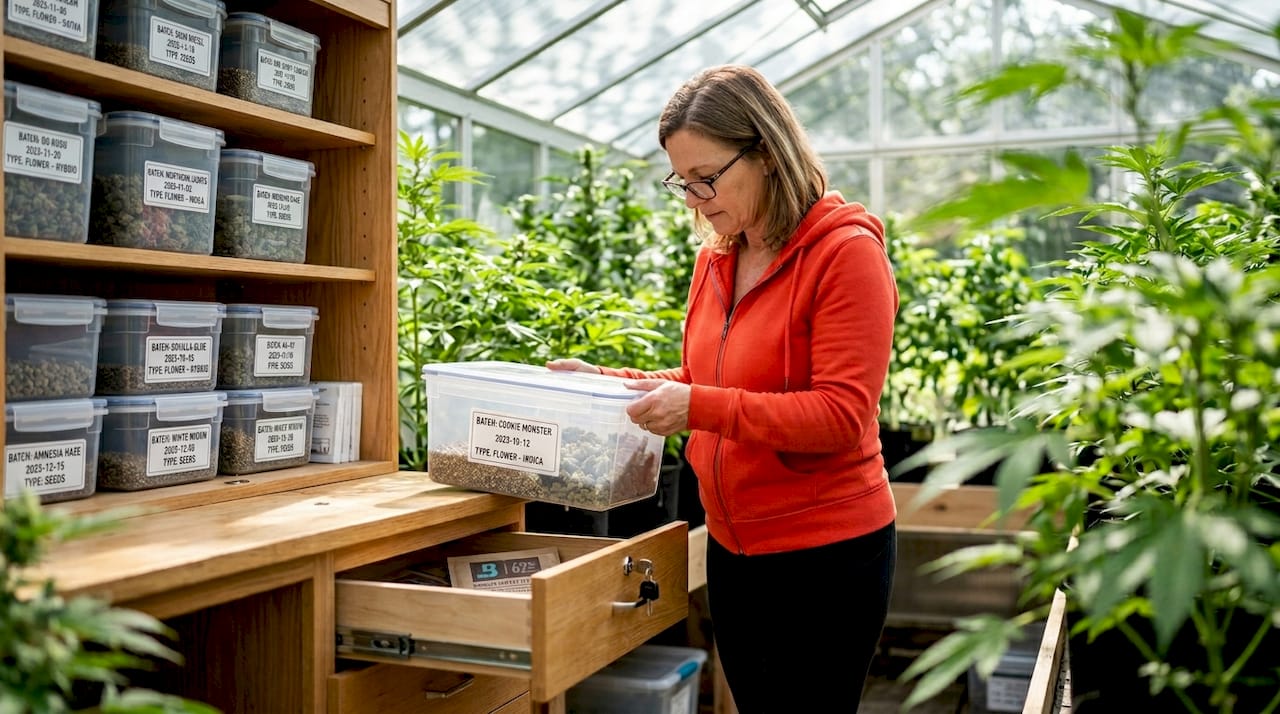
For bulk flower stored over months, vacuum sealing combined with humidity control offers the best solution against oxidation and moisture fluctuations. Mylar pouches with oxygen absorbers work well for this purpose. Store sealed pouches in a cool, dark location and do not open them until you are ready to use that batch.
For seeds specifically:
- Label each variety separately and completely. Strain name, seed bank, and date of acquisition should all be recorded. Seeds stored without labels are practically worthless once you have more than two or three varieties.
- Keep seeds in individual sealed packets. Never combine varieties in one container, regardless of how confident you are in your memory.
- Use silica gel packs rather than two-way humidity packs. Seeds require lower humidity than flower, around 20 to 30% RH, to prevent premature germination or mold.
- Prioritize darkness and cold consistency. A dedicated drawer in a cool room works well. A refrigerator is acceptable for seeds specifically, as long as the temperature remains stable and the container is fully airtight to prevent condensation when removed.
The principle across all long-term storage scenarios is the same. Organization keeps you from making costly mistakes and ensures that when you finally access stored product months later, it is exactly what you expected it to be.
My take on what most people get completely wrong about cannabis storage
I have watched countless cannabis enthusiasts invest real money in quality flower and then store it in a zip-lock bag on their nightstand. The logic seems to be that storage only matters for serious collectors or people with large quantities. That thinking costs people more than they realize.
What I have found is that the payoff from even basic organization shows up faster than expected. Within a month of switching to labeled glass jars with a humidity pack, the difference in flavor and smoothness is noticeable. Terpenes you did not know were there start coming through. Strains that seemed similar become clearly distinct. Organization does not just protect what you have. It helps you actually experience what you paid for.
The safety angle hits differently once you see it applied. A lockable stash box is not paranoia. It is the same logic as keeping cleaning products out of reach. The habit protects people around you without requiring any ongoing effort once the system is set.
My honest advice is to stop treating storage as an afterthought and start treating it as part of the experience itself. The dispensary storage practices that professionals use exist for good reasons. Your personal setup can reflect the same thinking on a smaller scale.
— Bujify
Storage solutions built for the way you actually use cannabis
If you have been making do with whatever container was nearby, this is the practical next step.

Treelockbox designs lockable stash boxes and storage kits specifically for cannabis consumers who care about preservation, safety, and having a system that actually works. The products are built with odor control, airtight seals, and lockable designs that address every major storage concern covered in this article. Whether you need a single secure box for home use or a portable option for travel, the full product catalog covers both. The flagship Tree Lock Box kit includes preparation tools alongside secure storage, so your entire cannabis setup stays organized in one place. American crafted, engravable, and built to last, it is the kind of setup that makes good storage habits effortless.
FAQ
What is the best temperature for storing cannabis?
The optimal temperature range for cannabis storage is 60 to 70°F. Temperatures above 77°F accelerate THC degradation and increase the risk of mold growth.
Why does organized cannabis storage matter for safety?
Locked, labeled storage prevents accidental ingestion by children and pets, particularly with edibles that can resemble regular food. Health guidelines specifically recommend secured, opaque storage containers for all cannabis products.
Can I store cannabis in plastic bags long-term?
No. Plastic bags cause trichome loss through static and do not provide an airtight seal, allowing oxygen to degrade potency. Glass jars with airtight lids are the recommended option for anything beyond immediate use.
What is FIFO and how does it apply to cannabis storage?
FIFO stands for first in, first out. Applied to cannabis, it means using older stock before newer purchases to prevent any batch from sitting untouched long enough to lose potency or develop quality issues.
How long can cannabis stay fresh in storage?
With proper conditions including airtight sealing, humidity control at 58 to 62% RH, and dark cool storage, cannabis flower can maintain quality for six months to a year. Vacuum sealing extends this further for bulk quantities.