

Types of Lockable Personal Storage Boxes Explained
Not all lockable boxes are created equal. Some weigh under five pounds and fit in a backpack. Others top 100 pounds and bolt to the floor. Choosing between the types of lockable personal storage boxes means balancing security, size, portability, and how you actually plan to use the thing. Get it wrong and you either carry around something overkill or protect your valuables with something a determined 12-year-old could pop open. This guide breaks down every major box type, compares them side by side, and helps you find the right fit for your real-life situation.
Table of Contents
- Key takeaways
- 1. Key criteria for choosing a lockable personal storage box
- 2. Portable document chests
- 3. Heavy-duty fireproof and waterproof safes
- 4. Decorative and general-purpose lockable boxes
- 5. Combination lock boxes
- 6. Electronic keypad lock boxes
- 7. Biometric lock boxes
- 8. Modular lockable storage systems
- 9. Comparison of lockable box types
- 10. How to choose the right type for your situation
- What I’ve actually learned from using different lockable boxes
- The right lockable box for your stash starts here
- FAQ
Key takeaways
| Point | Details |
|---|---|
| Lock type defines security tier | Key, combination, electronic, and biometric locks offer very different protection levels. |
| Weight is a security feature | Lightweight boxes under 30 lbs are easy to steal whole; heavier safes deter theft physically. |
| Certifications beat marketing claims | ETL or UL marks on fire and water ratings confirm real protection, not just labeling. |
| Modular beats static long-term | Adaptable, expandable systems let your storage grow with your needs over time. |
| Access management matters as much as the box | Assigning codes and maintaining override keys prevents lockouts and security gaps. |
1. Key criteria for choosing a lockable personal storage box
Before comparing specific lockable box types, you need to know what you’re actually evaluating. The market is full of options that look similar on a product page but perform very differently in practice.
Lock mechanism. This is where most people underinvest. Key locks work for basic, low-stakes storage. Four-digit combination locks add a layer without adding cost. Electronic keypads let you program custom codes up to eight digits. Biometric scanners store up to 30 fingerprints and give you instant access without fumbling. Your security level should match what you’re protecting.
Weight and portability. These two things are almost always in direct opposition. A box light enough to travel with is also light enough to walk away with. Boxes under 30 lbs are portable but offer low theft deterrence. Anything above 75 lbs starts to qualify as a real deterrent, especially when bolted to the floor or a wall.
Material and durability. Steel construction resists prying. ABS plastic is lighter and fine for low-security storage. Fireproof insulation adds weight but protects paper documents and digital media. Waterproofing seals the interior against flooding or fire suppression damage.
- Certifications to look for: ETL or UL marks on the label, not just “fire-resistant” copy in the product description
- Organizational features: Interior trays, removable dividers, and cable pass-throughs matter for everyday usability
- Budget range: Expect $30 to $80 for basic lockboxes, $150 to $400 for mid-tier fireproof models, and $500 and up for biometric or heavy-duty safes
Pro Tip: Never trust a fire or water rating without a third-party certification mark. Generic labels like “fire-resistant” have no standardized meaning unless backed by ETL or UL testing.
2. Portable document chests
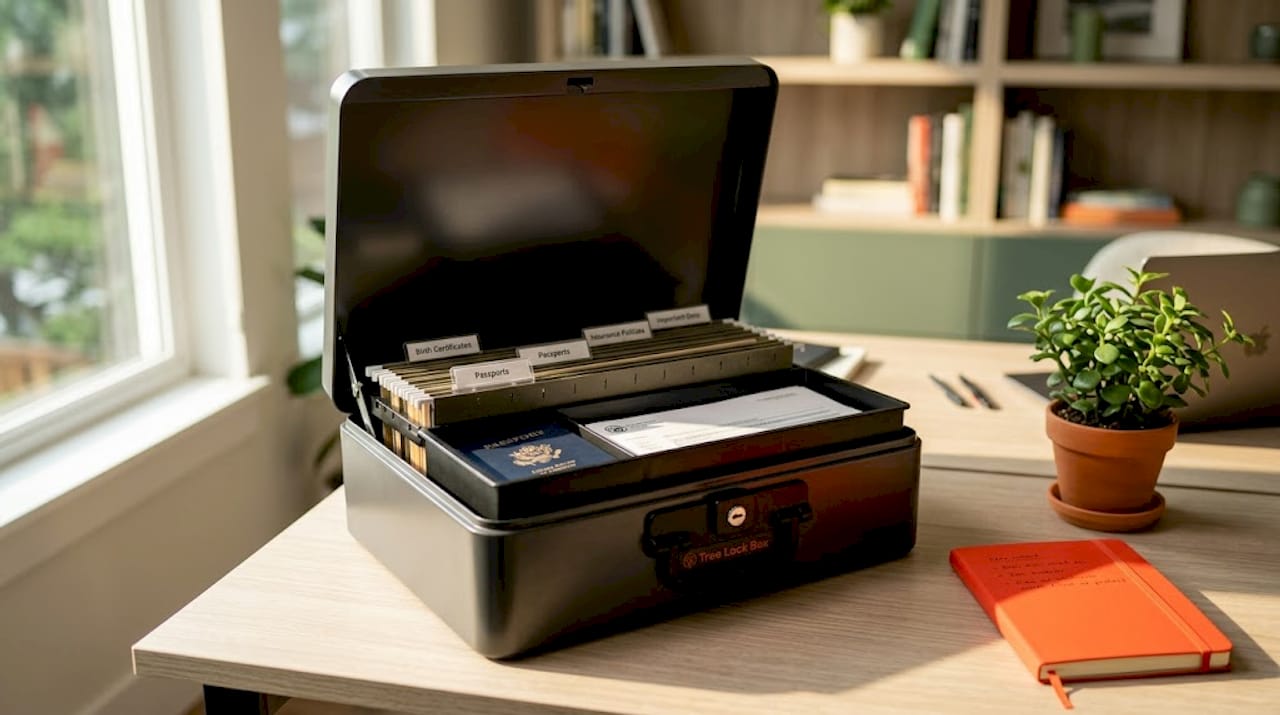
These are the most common entry point into lockable storage solutions. A portable document chest is typically a lightweight metal or reinforced plastic box with a key or combination lock, designed to hold papers, passports, USB drives, and small valuables.
They generally weigh under 30 pounds. That makes them easy to grab and go, which is exactly the problem from a security standpoint. If you leave one visible in a home office or hotel room, it becomes a grab-and-run target. The lock slows down access but does not prevent theft of the whole unit.
Where they genuinely shine is organization. Most come with interior trays, folder rails, and document dividers. For renters, dorm residents, or anyone who needs to organize important papers without drilling into walls, they hit a real practical need.
3. Heavy-duty fireproof and waterproof safes
This category is where secure personal storage gets serious. These units typically exceed 75 pounds, often weigh well over 100, and are designed to be bolted to a floor or wall stud. The weight alone deters casual theft.
The defining feature is environmental protection. Quality models are ETL-certified to withstand water exposure for 24 hours in up to eight inches of water, and they meet fire resistance ratings of 1,150°F for a minimum of 30 minutes. That matters for paper documents, which begin to char at around 450°F.
Lock options in this tier usually include digital keypads, and better models add a physical override key as a backup. This is critical because electronic locks require battery power, and a dead battery without a key override means you’re locked out of your own safe.
Pro Tip: When buying a fireproof safe, check whether the fire rating applies to paper documents specifically. Some ratings only cover electronic media, which has a lower heat threshold.
4. Decorative and general-purpose lockable boxes
Not every secure personal storage solution needs to look industrial. This category includes wooden boxes, metal tins, and molded ABS plastic organizers with small key or combination locks. They prioritize aesthetics and everyday organization over maximum security.
You’ll find these used for medication storage, personal mementos, cannabis accessories, and anything you want accessible but not openly visible. The lock is more of a deterrent than a barrier. A sharp tool or enough leverage defeats most of them quickly.
Their real value is discreet personal storage. A decorative wooden box on a shelf attracts no attention. That low profile provides a form of security that an obvious metal safe sometimes doesn’t, since a visible safe broadcasts that something valuable is inside.
5. Combination lock boxes
These sit in the middle of the security spectrum. A four-digit combination lock eliminates the risk of losing a key, which is a bigger deal than it sounds. Key locks fail when keys disappear. Combination locks fail when you forget the code, but most manufacturers offer reset procedures through proof of ownership.
They’re available across all form factors, from small cash boxes to mid-size document chests. The combination mechanism is inexpensive to produce, which is why this lock type appears on a wide price range of products. At the lower end, the locking hardware itself is often the weak point. A reinforced steel body with a cheap lock is still a cheap lock.
For home storage options where you want a step above a key lock without moving into electronics, a combination lock box delivers solid everyday reliability.
6. Electronic keypad lock boxes
Electronic keypads give you programmable access with a personal code, usually one to eight digits. Many models in this category also allow multiple user codes, making them practical for households or small offices where more than one person needs access.
The trade-off is battery dependence. This is not a minor inconvenience. If the battery dies and your model lacks a physical key override or external battery port, you cannot access your contents without a locksmith or a drill. Physical override keys and external power ports are features worth paying for, not skipping.
Electronic lock boxes span a wide range. Small wall-mount versions hold a single handgun or medication bottle. Larger floor units in this category can hold hanging files and multiple compartments. The keypad itself adds no bulk, so the box dimensions stay compact relative to its capacity.
7. Biometric lock boxes
Biometric locks use fingerprint scanning to grant access. They’re the fastest type to open in a real-time situation and the hardest to defeat through social engineering since you can’t share a fingerprint the way you share a code.
Better biometric models store up to 30 fingerprints, which means you can enroll multiple trusted users without creating a shared code vulnerability. The scanner reads in under a second in most cases. For high-access situations where speed matters, like a bedside gun safe or a medication box for a caregiver, biometric access beats every other method.
The weakness is false rejection. Wet hands, cuts, or worn fingerprints sometimes fail to register. For this reason, a backup PIN or key option is worth verifying before you buy.
8. Modular lockable storage systems
This is the category most consumers overlook, and it’s the one that often ages the best. Modular storage systems let you expand your configuration as your needs change. Inspired by military-grade adaptable designs, they’re built for users who don’t want to repurchase a whole new box every time their storage needs grow.
A modular system might start as a single lockable cabinet with two interior shelves. Add a year’s worth of accumulated items and you attach a secondary unit. The locking system covers the full expanded configuration. This approach beats static boxes for long-term cost efficiency and practical flexibility.
For cannabis accessories specifically, modular options let you keep your stash box, tools, and accessories in one organized, lockable environment that grows with your collection.
9. Comparison of lockable box types
Here’s how the major types stack up across the features that matter most for your decision:
| Box type | Weight | Lock mechanism | Fire/water rating | Portability | Best for |
|---|---|---|---|---|---|
| Portable document chest | Under 30 lbs | Key or combination | Rarely rated | High | Papers, daily access |
| Fireproof/waterproof safe | 75 to 150+ lbs | Electronic or biometric | ETL/UL certified | Low | Critical documents, valuables |
| Decorative lockable box | Under 10 lbs | Key | None | Very high | Discreet home use |
| Combination lock box | 5 to 40 lbs | Combination | Rare | Medium | Everyday home storage |
| Electronic keypad box | 10 to 80 lbs | Electronic keypad | Some models | Medium | Office, shared access |
| Biometric box | 10 to 60 lbs | Fingerprint + backup | Some models | Medium | Fast-access security |
| Modular storage system | Varies | Keypad or biometric | Varies | Low | Growing collections |
A few patterns worth noting from this table. As security level goes up, portability goes down. Every box type has a sweet spot where it performs well and a context where it fails. A decorative box is ideal for discreet daily use but terrible for protecting irreplaceable documents. A fireproof floor safe protects those documents beautifully but does nothing for someone who travels frequently.
The home storage options that get used daily tend to be the ones that balance access speed with security, not the ones that are theoretically the most secure.
10. How to choose the right type for your situation
Security needs, usage frequency, and living situation all shape which box actually works for you. Here’s a practical framework:
- If you need to protect irreplaceable documents like birth certificates, deeds, or passports, invest in a fireproof safe with ETL or UL certification. Weight and floor space are worth it.
- If you travel or move frequently, a portable combination lock box or a compact biometric box under 15 pounds makes sense. Accept the trade-off on theft deterrence.
- If you live in a shared space like a dorm, apartment, or shared household, a decorative or electronic lock box keeps personal items secured without creating friction.
- If your storage needs are likely to grow, a modular system saves money over time. Modular and adaptable designs outlast static boxes for users with expanding collections.
- If fast access in a low-light situation matters, biometric is the only category that delivers consistently without fumbling for a key or memorizing a code.
Pro Tip: Regardless of box type, assigning unique access codes to specific users and auditing who has access is one of the most overlooked security practices. The box is only as secure as who controls it.
One more thing most buyers skip: where you place the box matters almost as much as which box you choose. A lightweight box bolted to a shelf is more secure than a heavy one sitting loose in a closet. Placement, visibility, and anchoring all factor into real-world security outcomes.
What I’ve actually learned from using different lockable boxes
When I started paying attention to lockable storage, I made the same mistake most people make: I treated the lock type as the main decision. Key or combination? Digital or biometric? That framing misses what actually determines whether a box does its job.
The bigger issue is whether the box fits the behavior it’s supposed to support. A fireproof safe you only open twice a year works great for documents. That same safe is a disaster for something you need access to daily because the friction makes you stop using it properly. I’ve watched people leave their “secure” box unlocked consistently because opening it was annoying. An unsecured box is not storage. It’s furniture.
I’m also skeptical of fire and water resistance claims on anything without a certification mark. Marketing copy is not a substitute for ETL or UL testing. Some of the products I’ve seen labeled “fireproof” would likely fail at temperatures a house fire reaches within the first 10 minutes.
My honest recommendation is to treat security as a system, not a product. Managing access effectively means knowing who has codes, maintaining override keys somewhere separate from the box, and checking battery levels on electronic locks quarterly. A great box with sloppy management is still a security gap.
— Bujify
The right lockable box for your stash starts here
If you’re storing cannabis accessories, concentrates, edibles, or prep tools, the stakes around organization and discretion are specific enough that a generic lockbox often falls short.
Treelockbox builds lockable cannabis stash boxes specifically for this use case, with odor control, interior organization, and American craftsmanship built in. Whether you want a single personal kit or you’re outfitting a dispensary, the product lineup covers both. Retailers and serious consumers can explore bulk pricing options that make stocking up practical. The full range of lockable storage and prep tools is available at the Treelockbox shop, with fast shipping and a quality guarantee on every order.
FAQ
What are the main types of lockable personal storage boxes?
The main types include portable document chests, fireproof and waterproof safes, decorative lockable boxes, combination lock boxes, electronic keypad boxes, biometric boxes, and modular storage systems. Each type serves different security levels and use cases.
Are fireproof boxes also waterproof?
Not automatically. Look for products with both fire and water certifications. ETL-certified safes confirm resistance to 24 hours in up to eight inches of water, but this certification must appear on the product, not just in its marketing.
What happens if my electronic lock box battery dies?
If your model lacks a physical key override or external battery port, you may be locked out entirely. Always choose electronic lockboxes that include a physical override key and check battery levels quarterly to prevent access failure.
Which lock type is the hardest to defeat?
Biometric locks are the most resistant to social engineering since access depends on a registered fingerprint rather than a shareable code or key. For physical security, weight and mounting matter more than lock type alone.
How heavy should a lockable box be to deter theft?
Boxes under 30 pounds offer low theft deterrence because they can be carried away easily. Safes over 75 pounds become significantly harder to remove, and bolting any box to a floor or wall stud adds another layer of protection regardless of weight.