

Inventory Management for Cannabis Accessories: 2026 Guide
Inventory management for cannabis accessories is the disciplined process of tracking, organizing, and replenishing stock to protect margins and grow sales. Most dispensary managers treat accessories as an afterthought behind flower, but well-managed accessory programs deliver average margins exceeding 55%, with select premium products reaching 70%. The accessory category’s sales share can grow from roughly 1.5% to over 5% with proper management. That kind of margin lift does not come from buying better products. It comes from disciplined inventory management of cannabis accessories, backed by the right tools and processes.
What tools are essential for cannabis accessory inventory management?
The right technology is the foundation of any effective dispensary inventory solution. Three core systems define modern accessory tracking: barcode scanning, RFID, and integrated cannabis inventory software connected to your point-of-sale platform.
Barcode scanning is the entry point for most dispensaries. It is affordable, widely supported, and accurate enough for stores with fewer than 200 active SKUs. RFID takes accuracy further. RFID and barcode scanning reduce inventory audit labor by up to 80% and save dispensaries over 100 hours weekly on manual data entry by syncing inventory in real time with compliant POS systems. That is not a marginal improvement. It is the difference between a weekly audit and a daily one.

Integrated cannabis POS systems add a compliance layer that standalone spreadsheets cannot match. Automated compliance reporting through integrated POS systems reduces error rates by 40% and cuts labor associated with manual audit tasks. For accessories specifically, this means your grinders, stash boxes, and rolling papers stay reconciled with your digital records without manual intervention.
AI-enabled inventory software adds a third layer: predictive reordering. These platforms flag slow-moving SKUs before they become a markdown problem, and they trigger replenishment based on sales velocity rather than a fixed calendar schedule. That distinction matters more than most managers realize.
| Feature category | Manual tracking | Barcode/RFID scanning | AI-enabled POS integration |
|---|---|---|---|
| Audit speed | Slow, error-prone | Fast, accurate | Automated, continuous |
| Compliance sync | Manual entry | Semi-automated | Fully automated |
| Reorder triggers | Calendar-based | Threshold alerts | Velocity-based AI flags |
| Labor cost | High | Moderate | Low |
Pro Tip: Choose a cannabis inventory software platform that integrates directly with your existing POS. Switching POS systems to accommodate inventory software costs more in retraining and downtime than any efficiency gain.
How to implement a practical inventory process for cannabis accessories
A disciplined process turns technology into results. Without a defined workflow, even the best software produces data that nobody acts on.
Step 1: Audit your current SKU catalog. Pull a full list of every accessory SKU in your system. Flag anything that has not sold in 60 days. This baseline tells you where dead stock already lives before you build any new process around it.
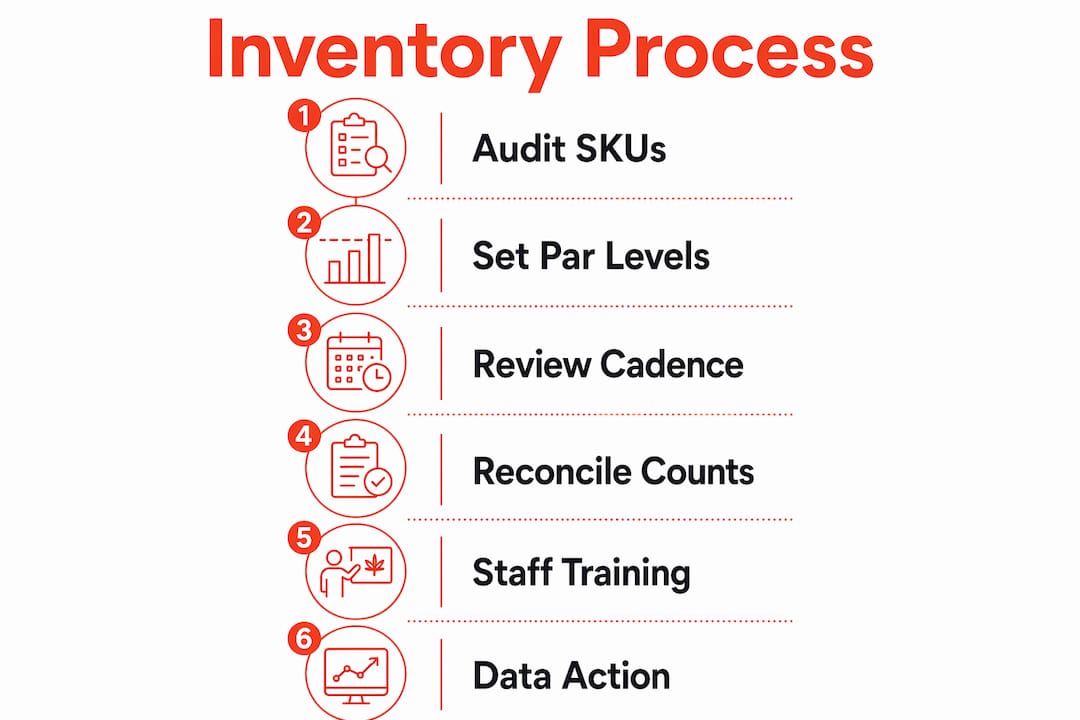
Step 2: Set par levels for every active SKU. A par level is the minimum quantity you hold before triggering a reorder. Set par levels based on your actual sales velocity, not on what your supplier recommends. A grinder that sells 10 units per week needs a different par level than a specialty cone filler that sells 2.
Step 3: Establish a review cadence. Experts recommend weekly SKU reviews for fast movers and a monthly minimum for the rest, with AI tools flagging aging SKUs at 30–45 days to prevent margin-eroding markdowns. Weekly reviews sound like a lot of work. In practice, a well-configured POS dashboard makes this a 15-minute task.
Step 4: Reconcile physical and digital counts. Use barcode or RFID scanning to match your physical shelf count against your POS records. A well-disciplined accessory program reconciles physical and digital inventory within minutes using these tools. Do this weekly for high-velocity items and monthly for the full catalog.
Step 5: Train your staff on the process. Human error is the most common source of inventory discrepancy. Staff who understand why accurate scanning matters make fewer mistakes than staff who see it as a compliance checkbox.
Step 6: Act on the data. Reorder before you hit zero. Markdown aging stock before it sits 60 days. Drop SKUs that consistently underperform. The process only works if someone is accountable for acting on what the data shows.
Pro Tip: Assign one person per shift as the inventory lead for accessories. Shared responsibility usually means no responsibility. A named owner creates accountability and catches discrepancies before they compound.
Good labeling practices also reduce scanning errors significantly. Clear, consistent labels on every storage bin and shelf location cut the time it takes to reconcile counts and reduce the chance of mis-scans during busy shifts.
What are common pitfalls in cannabis accessory inventory?
Most dispensaries lose accessory margin in predictable ways. Knowing the patterns lets you stop them before they cost you.
- Reactive markdowns. Reactive markdowns on aging accessory SKUs erode margins and train customers to expect discounts, which damages future pricing power. The fix is proactive velocity alerts, not deeper discounts.
- Overstocking low-performers. Buying accessories on gut feel or supplier pressure fills your shelves with SKUs that do not move. Inventory visibility through barcode or RFID scanning enables real-time stock monitoring, supporting informed buying decisions and preventing overstock of ineffective SKUs.
- Compliance tunnel vision. Many dispensaries focus so heavily on cannabis flower tracking that they neglect accessory replenishment and management, leading to lost revenue. Accessories do not carry the same regulatory weight as flower, but they carry significant margin weight.
- Poor storage organization. Disorganized back-of-house storage creates phantom inventory, where items show as available in your system but cannot be located on the floor. Structured cannabis accessory storage prevents this problem before it starts.
- No defined ownership. When no one is specifically responsible for accessory inventory, reorders happen late, audits get skipped, and aging stock piles up unnoticed.
Pro Tip: Set automated alerts in your cannabis inventory software for any SKU that has not sold in 30 days. Review those alerts every Monday morning. That single habit catches most aging inventory problems before they require a markdown.
How does merchandising support cannabis accessory inventory control?
Merchandising and inventory management are not separate functions. The way you display accessories directly affects how fast they sell, which determines how often you reorder and how much dead stock you carry.
Open-floor merchandising consistently outperforms locked glass cases for accessory categories. When customers can pick up a grinder or examine a stash box, they engage with the product and buy more often. Locked cases create friction that slows decisions and reduces basket size. Budtender education and open-floor merchandising increase customer engagement and basket size, making accessories feel like an integrated part of the cannabis purchase experience.
Staff training is the other half of this equation. A budtender who knows how to recommend a cone filler alongside a flower purchase increases the average transaction value without any additional marketing spend. That recommendation only works if the right products are in stock, which loops directly back to your inventory process.
Assortment discipline is the third factor. Successful retailers maintain a focused assortment of 40–50 core accessory products suited to their store’s clientele, avoiding SKU bloat and improving sales consistency. Carrying 200 SKUs does not make you a better accessory retailer. It makes your inventory harder to manage and your shelves harder to shop.
Align your assortment with your actual customer base. A dispensary serving medical patients needs different accessories than one serving recreational consumers. Your accessory product mix should reflect what your customers actually buy, not what looks good in a supplier catalog.
Key Takeaways
Disciplined inventory management of cannabis accessories is the single most effective way to grow accessory margins from 1.5% to over 5% of total dispensary revenue.
| Point | Details |
|---|---|
| Accessory margins are high | Well-managed programs deliver margins above 55%, making accessories a top profit category. |
| Technology reduces labor | RFID and barcode scanning cut audit labor by up to 80% and eliminate manual data entry errors. |
| Review cadence matters | Weekly reviews for fast movers and monthly minimums for all SKUs prevent aging stock and reactive markdowns. |
| Assortment discipline drives sales | Limiting your catalog to 40–50 core SKUs reduces overstock and improves sales consistency. |
| Merchandising and inventory connect | Open-floor displays and trained staff increase sell-through rates, which keeps inventory moving and margins healthy. |
The category most dispensaries are still leaving on the table
Treelockbox has watched the cannabis accessories category get treated as a convenience add-on for years. The products sit in a locked case near the register, nobody on staff knows how to talk about them, and the manager checks inventory maybe once a quarter. Then the same manager wonders why accessories contribute less than 2% of revenue.
The uncomfortable truth is that accessories are not a low-margin category. They are a high-margin category managed with low discipline. Treating accessories as structured retail business units with defined replenishment and data-driven buying elevates their revenue impact significantly. That is not a theory. It is what separates dispensaries that grow accessory revenue from those that stagnate.
The operators who get this right do three things consistently. They run weekly SKU reviews. They use their POS data to set par levels based on velocity. And they treat a stash box or a grinder with the same inventory rigor they apply to a premium flower SKU. The category rewards that discipline with margins that flower cannot match.
If you are managing accessories reactively, you are not managing them at all. You are just hoping the shelf does not run out before the next order arrives.
— Tree Lock Box
How Treelockbox supports organized accessory inventory
Treelockbox builds cannabis storage and preparation tools designed for dispensaries that take accessory management seriously. The product line includes lockable stash boxes, portable storage units, cone fillers, grinders, and cleaning multi-tools, all built with American craftsmanship and available with custom engraving for wholesale partners. Every product is designed for organized, repeatable storage that supports the kind of physical inventory discipline this guide describes. Dispensary managers who stock Treelockbox products report that the consistent form factors make shelf organization and physical counts faster and more accurate. Browse the full cannabis accessories shop to see which products fit your accessory assortment, or visit the cannabis tools FAQ for guidance on storage and preparation categories.
FAQ
What margins do cannabis accessories typically deliver?
Well-managed accessory programs deliver average margins exceeding 55%, with select premium products reaching 70%. That makes accessories one of the highest-margin categories in a dispensary.
How often should dispensaries audit accessory inventory?
Experts recommend weekly reviews for fast-moving SKUs and a monthly minimum for the full accessory catalog. AI-enabled cannabis inventory software can automate alerts so audits focus only on flagged items.
What is the right number of accessory SKUs to carry?
Successful retailers limit their assortment to 40–50 core accessory products matched to their store’s customer base. Carrying more SKUs increases overstock risk without proportionally increasing revenue.
How does RFID improve cannabis accessory tracking?
RFID scanning reduces inventory audit labor by up to 80% and syncs stock levels in real time with compliant POS systems. That accuracy prevents both phantom inventory and undetected stockouts.
Why do dispensaries underperform on accessory sales?
Most dispensaries focus compliance and management attention on cannabis flower and neglect accessory replenishment. That compliance tunnel vision leaves significant margin on the table in a category that requires far less regulatory overhead than flower.