

Weed Storage Humidity: Keep Your Cannabis Fresh
The target for weed storage humidity is a moderate relative humidity (RH) range that preserves quality, with a typical everyday default at the higher end of that range for cured flower. Set that up with an airtight glass jar, a two-way humidity pack rated to your chosen RH, a small digital hygrometer inside the container, and cool, dark storage at roughly 60–68°F. That four-piece kit covers the vast majority of home storage situations.
A moisture sorption isotherm on a tested cannabis strain found a stability window of roughly 59–63% RH, which aligns closely with ASTM-referenced water-activity guidance placing the safe zone near 55–65% RH. Treelockbox’s storage guides are built around that same lab-aligned range.
Target RH at a glance: 55–62% RH, with 62% as the daily-use default.
- Airtight glass jar with a tight-sealing lid
- Two-way humidity pack (62% for daily use, 58% for longer storage)
- Mini digital hygrometer placed inside the container
- Cool, dark location at 60–68°F (15–21°C)
Key Takeaways
| Point | Details |
|---|---|
| Target RH range | Keep cured flower at 55–62% RH; use 62% for daily use, 58% for multi-month storage. |
| Mold threshold | RH above ~65% (Aw 0.65) raises mold risk sharply; discard any visibly moldy flower. |
| Pack lifespan | Two-way packs last 2–6 months in sealed jars; replace when the pack goes rigid or the indicator dot changes. |
| Temperature and light | Store at 60–68°F in a dark location; higher heat levels accelerate THC degradation. |
| Treelockbox setup | A lockable Treelockbox storage unit houses jars, packs, and a hygrometer in one organized, low-opening system. |
Table of Contents
- Why does weed storage humidity affect quality and safety?
- What is the ideal RH, and how do you choose between 62%, 58%, and 55%?
- How do you measure RH inside a jar or storage box?
- How do you reach and hold the target RH?
- What should you do when mold appears or buds go too dry?
- How long do humidity packs last, and when should you replace them?
- What does a complete storage setup look like?
- Quick rules to follow every time you store cannabis
- Why Treelockbox prioritizes locked, organized storage
- Treelockbox products that complete your humidity-control setup
- Sources
- FAQ
Why does weed storage humidity affect quality and safety?
Humidity is the single variable that most directly controls whether your flower stays smokable or becomes a health risk. Two failure modes sit on opposite ends of the RH scale, and both are worth understanding before you set up a storage system.
Below a certain moderate humidity threshold, trichomes become brittle and terpenes evaporate faster, which causes the flower to burn hotter, taste harsher, and lose complexity. Some terpene loss is irreversible once it happens, which is why storage conditions directly shape smoke quality.
ASTM-referenced water-activity research places the danger threshold near a water activity (Aw) of 0.65, which maps closely to RH above ~65% inside a sealed container. At that level, mold and microbial growth accelerate sharply. You cannot always see early mold, and inhaling it carries real health consequences.
Safety note: Mold risk rises sharply above ~65% RH (Aw 0.65). Discard any flower with visible mold or a musty smell. Do not attempt to dry it out and smoke it.
- Too dry (below 55%): brittle trichomes, terpene loss, harsh smoke
- Too humid (above 65%): mold growth, microbial contamination, health risk
- Sweet spot (55–65%): stable trichomes, preserved terpenes, no mold pressure
Pro Tip: The RH that matters is headspace RH inside the sealed container, not the ambient RH of the room. Check inside the jar, not the air around it.
What is the ideal RH, and how do you choose between 62%, 58%, and 55%?
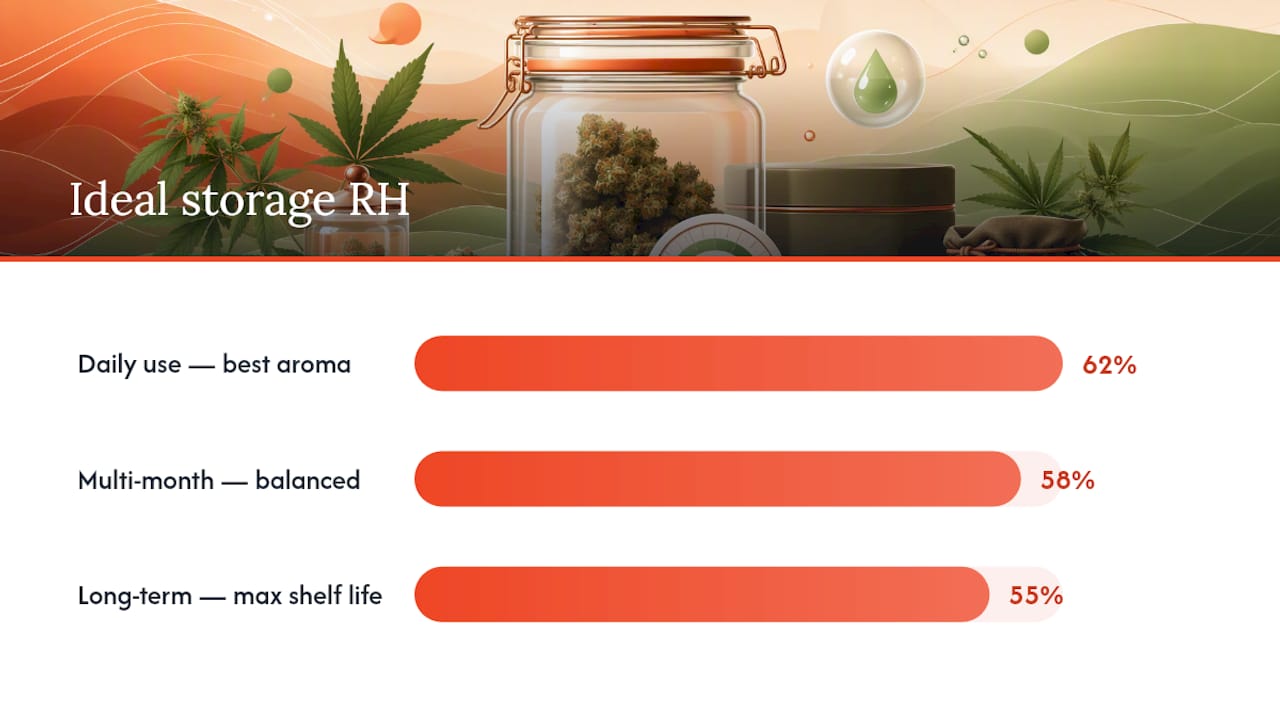
The practical sweet spot across multiple industry guides lands at 58–62% RH, and the choice within that range depends on your use case.
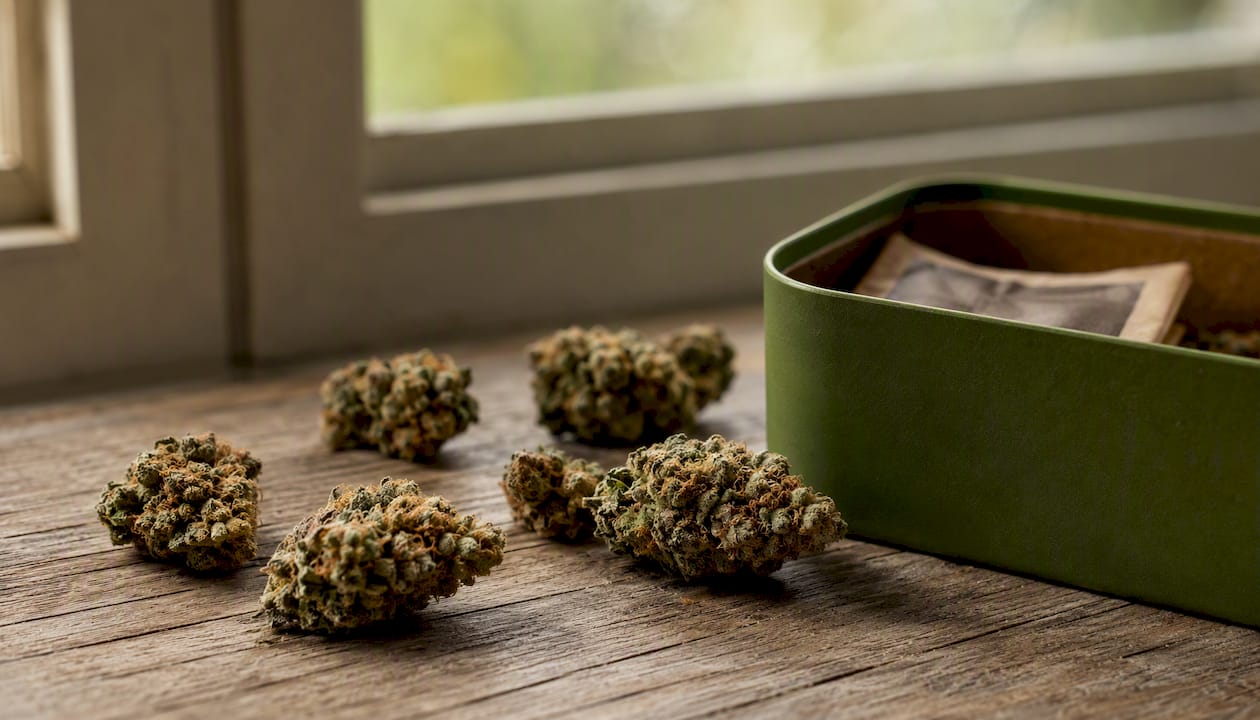
A relative humidity set point near the higher end of the moderate range is commonly used as a default for cured flower intended for use within a few weeks to a couple of months. It keeps buds slightly supple, preserves aroma, and is the most forgiving for everyday handling.
A slightly lower relative humidity value within the moderate range is chosen by some for storage extending multiple months. The slightly lower moisture level gives you more headroom before mold becomes a concern and slows the oxidation that gradually converts THC to CBN. You trade a small amount of tactile freshness for a longer shelf life.
An even lower relative humidity value near the lower end of the moderate range is considered for very long-term storage or humid climates, balancing shelf-life insurance with slight dryness.
Concentrates and extracts follow different rules entirely and generally require lower humidity or specialized containers.
| Target RH | Best Use Case | Trade-offs |
|---|---|---|
| 62% | Daily-use cured flower, short to medium storage | Best aroma and texture; less shelf-life headroom |
| 58% | Multi-month storage, moderate climates | Good balance of freshness and longevity |
| 55% | Long-term storage, humid climates | Maximum shelf life; slightly drier feel |
How do you measure RH inside a jar or storage box?
Getting an accurate headspace reading is the step most people skip, and it’s the one that tells you whether your humidity pack is actually doing its job.
Hygrometer types:
- Mini digital hygrometers are the practical choice for jar storage. They cost around $10, read within seconds, and fit inside a wide-mouth mason jar without touching the flower. Accuracy is typically ±2–3% RH.
- Analog hygrometers are less accurate out of the box and drift over time. They work in larger humidors but are not ideal for small jars.
- Bluetooth-enabled sensors add remote monitoring, useful for a dedicated storage cabinet, but overkill for a single jar.
Where to place it: Set the hygrometer flat on top of the flower, not pressed against the glass wall. The wall reading can differ from the true headspace reading by several percentage points, especially if the jar is cold.
Calibration: The salt test is the standard low-cost method. Seal a small amount of table salt and a few drops of water in a bag with the hygrometer for 8–12 hours. Adjust your mental offset accordingly. Most manufacturers also provide a calibration offset setting in the device menu.
Getting a valid reading after sealing a jar:
- Place the hygrometer and humidity pack inside the jar.
- Seal the lid completely.
- Wait at least 2 hours before reading, ideally overnight.
- Record the reading. If it matches your pack’s rated RH (±2%), the system is working.
- Recheck after 24 hours to confirm stability.
How do you reach and hold the target RH?
Two-way humidity packs are the most reliable home solution by a significant margin. Unlike silica gel or other one-way desiccants, two-way packs reach equilibrium with the headspace: they release moisture when the jar is too dry and absorb it when it’s too wet. They maintain their rated RH within roughly ±1–2% under normal sealed-jar conditions. They cannot fix flower that was sealed while actively wet, and they cannot restore terpenes that have already evaporated.
Container choice matters. Glass with a rubber-gasket lid (wide-mouth mason jars, borosilicate jars) is the preferred option because glass is inert, doesn’t off-gas, and seals reliably. Metal tins can work short-term but are harder to seal consistently. Plastic bags and soft plastic containers are poor choices: they allow gas exchange, can impart odors, and build up static that strips trichomes.
Step-by-step method:
- Measure current headspace RH with your hygrometer before adding a pack.
- Choose your target RH set point (62% for daily use, 58% for longer storage).
- Add a correctly sized pack: a 4-gram pack handles roughly 1 ounce; an 8-gram pack suits a quart jar.
- Seal the jar and wait 24 hours.
- Recheck the hygrometer. Adjust pack size if the reading is off by more than 3%.
- Store in a cool, dark place at 60–68°F (15–21°C).
Method comparison:
| Method | Pros | Cons |
|---|---|---|
| Two-way humidity packs | Precise, passive, low cost | Finite lifespan; can’t fix wet flower |
| Humidity-controlled humidor | Consistent, hands-off for large collections | Higher cost; requires calibration |
| DIY moistening (orange peel, lettuce) | Zero cost | Imprecise, introduces mold risk, short-lived |
Temperature and light are the next variables after RH. Higher heat levels accelerate cannabinoid and terpene degradation, so cooler storage is preferable. UV light degrades THC directly. A drawer, cabinet, or lockable box in a cool room handles both.
What should you do when mold appears or buds go too dry?
Spotting mold vs. normal aging: Mold looks like white, gray, or greenish fuzzy patches that don’t brush off. It often smells musty or like a wet basement. Trichomes, by contrast, are crystalline and shimmer. If you’re unsure, the smell test is decisive: musty equals mold. Normal aging produces a slightly grassy or hay-like scent, not a damp one.
Safety rule: If you see or smell mold, discard the entire affected batch. Do not dry it out, pick off the visible spots, or smoke it. Inhaling mold spores from cannabis carries real respiratory risk, and heat does not neutralize all mycotoxins.
Recovering over-dry buds:
- Add a 62% two-way humidity pack to the jar.
- Seal and wait 24–48 hours.
- Check the hygrometer. Buds should feel less brittle and slightly more pliable.
- Expect texture to improve; do not expect lost terpenes to return. Aroma that has already volatilized is gone.
- If buds don’t respond after 48 hours, the flower may be too old or too degraded to recover meaningfully.
- Remove the lid for 15–30 minutes in a low-humidity room to release excess moisture.
- Check for condensation on the glass interior, which signals the flower was sealed too wet.
- Inspect for mold before resealing.
- If this happens repeatedly, the flower may not have been fully cured before storage.
How long do humidity packs last, and when should you replace them?
In a properly sealed jar, a two-way humidity pack typically lasts 2–6 months. The range is wide because lifespan depends heavily on how often the jar is opened and how well it seals. A jar opened daily depletes a pack far faster than one opened weekly.
Signs a pack is spent:
- The pack feels hard and rigid instead of slightly flexible.
- An indicator dot (present on some brands) changes color.
- Your hygrometer reads consistently outside the target range despite a sealed jar.
Sizing guidance:
- 4-gram pack: up to 1 ounce of flower in a half-pint jar
- 8-gram pack: up to 1 ounce in a quart jar, or 2 ounces in a half-pint
- 67-gram pack: suited for larger collections or humidor-style boxes
Do not attempt to rehydrate a spent pack by adding water. The chemistry is exhausted, not just dry.
What does a complete storage setup look like?
A reliable setup takes about five minutes to assemble and handles itself from there.
Step-by-step:
- Confirm the cure is complete. Flower should feel dry on the outside but not brittle, and the stems should snap rather than bend. Sealing wet flower is the most common storage mistake.
- Choose a wide-mouth glass jar with a rubber-gasket lid. A 16-oz mason jar holds roughly 1 ounce comfortably.
- Place a mini digital hygrometer flat on top of the flower, not touching the glass wall.
- Add the correctly sized two-way pack (4g for a half-pint, 8g for a quart).
- Seal the lid, label the jar with strain name and date, and store in a cool, dark place.
- Check the hygrometer after 24 hours. If it reads within 2% of your target, you’re set.
A lockable outer box adds two things the jar alone can’t provide: it blocks light completely, and it limits access, which means fewer casual openings and a more stable headspace RH. Organizing multiple jars inside a lockable storage box also keeps strains separated and labeled, which matters when you’re managing more than one variety.
What each component does:
- Glass jar: inert, airtight, no off-gassing
- Two-way pack: passive RH regulation to ±1–2%
- Mini hygrometer: confirms the system is working
- Lockable outer box: light block, limited access, organization
Quick rules to follow every time you store cannabis
- Target 55–62% RH; use 62% for daily-use flower and 58% for longer storage.
- Always use glass with a rubber-gasket lid, never soft plastic or zip bags.
- Store at 60–68°F in a dark location; avoid refrigerators for most flower.
- Minimize jar openings once a stable RH is reached. Frequent opening introduces humidity swings and oxygen that accelerate degradation.
- Check the hygrometer every 4–6 weeks and replace packs when they go rigid.
- Keep flower away from direct light, heat sources, and appliances that generate warmth.
Pro Tip: Label every jar with the strain name, pack date, and RH target. When you rotate stock, open the oldest jar first. This keeps you from accidentally leaving a jar sealed for a year and discovering a spent pack too late.
Why Treelockbox prioritizes locked, organized storage
At Treelockbox, the storage philosophy starts with a simple observation: the best humidity pack in the world can’t compensate for a jar that gets opened six times a day. Humidity control and access control are the same problem viewed from different angles.
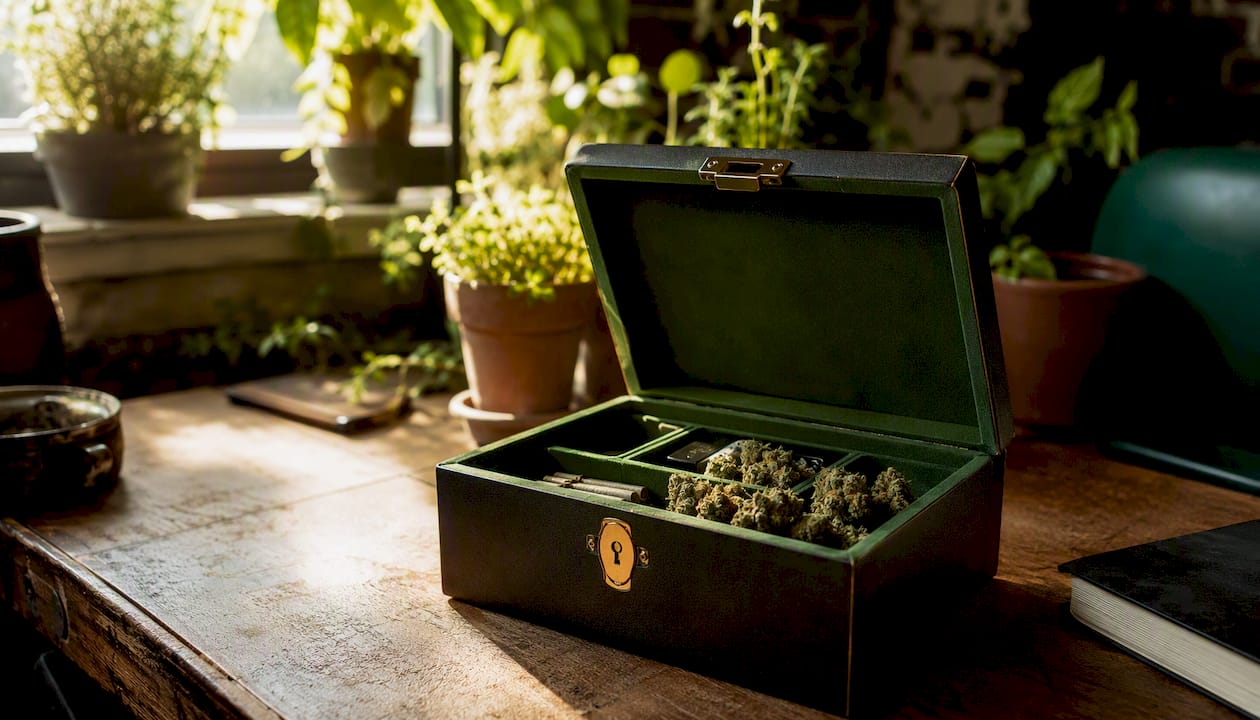
A lockable stash box does more than keep things private. It creates a physical barrier that reduces casual openings, which is one of the most underrated factors in maintaining stable headspace RH. When a jar lives inside a locked, organized box, it gets opened with purpose rather than habit.
Treelockbox’s secure home storage guides and cannabis organization resources are built around this idea: that good storage is a system, not a single container. The lockable outer box, the labeled jars, the hygrometer check every few weeks — these work together in a way that no individual piece does alone.
Treelockbox products that complete your humidity-control setup
The kit this article recommends maps directly to what Treelockbox carries. Lockable stash boxes give your glass jars a permanent, light-blocking home and cut down on the casual openings that drain humidity packs faster. Pair that with an ergonomic herb grinder for prep and a no-touch cone filler for rolling, and your entire workflow from storage to session lives in one organized, secure space.
A practical example: load two or three labeled mason jars into a Treelockbox lockable storage unit alongside your humidity packs and hygrometer. Everything you need is in one place, the box stays shut between sessions, and your RH holds steady without daily intervention. That’s the setup most home consumers and cultivators actually stick with.
Browse the full range of lockable storage boxes and cannabis accessories at Treelockbox, or check the cannabis tools FAQ to match the right products to your storage volume and routine.
Sources
- How Does Humidity Affect Cannabis? - Boveda Humidity Packs
- How to Store Weed Properly: Complete 2026 Guide | Rare Harvest
- How to Store Cannabis Properly | Keep Weed Fresh
FAQ
Will mold grow at 55% humidity?
Is 60% humidity too high for storing weed?
No.
How long do 62% humidity packs last in a sealed jar?
Packs in jars opened daily deplete significantly faster; replace any pack that feels hard and rigid.
What happens if weed gets too dry in storage?
Texture and pliability usually improve, but terpenes that already evaporated cannot be recovered.
Does the storage container type affect humidity control?
Yes. Airtight glass jars with rubber-gasket lids hold headspace RH most reliably. Soft plastic bags allow gas exchange and should be avoided; metal tins can work short-term but seal less consistently than glass.