

Craftsmanship in Storage Products: Quality That Lasts
Craftsmanship in storage products is defined as the deliberate, skill-driven process of constructing and finishing storage items using artisan techniques that prioritize material quality, structural integrity, and long-term function. For cannabis consumers and enthusiasts, this distinction matters more than it might seem. A well-crafted storage box does not just hold your product. It protects potency, resists odor transfer, and survives years of daily use. The role of craftsmanship in storage products separates a box that lasts a decade from one that warps after a season. Treelockbox builds on this principle, applying American craftsmanship to lockable cannabis storage designed for real-world durability.
How does craftsmanship influence the durability of storage products?
Bespoke, high-craftsmanship storage products carry a lifespan of 30+ years, while flat-pack alternatives typically fail within a few years. That gap is not accidental. It comes directly from the construction methods artisans use.
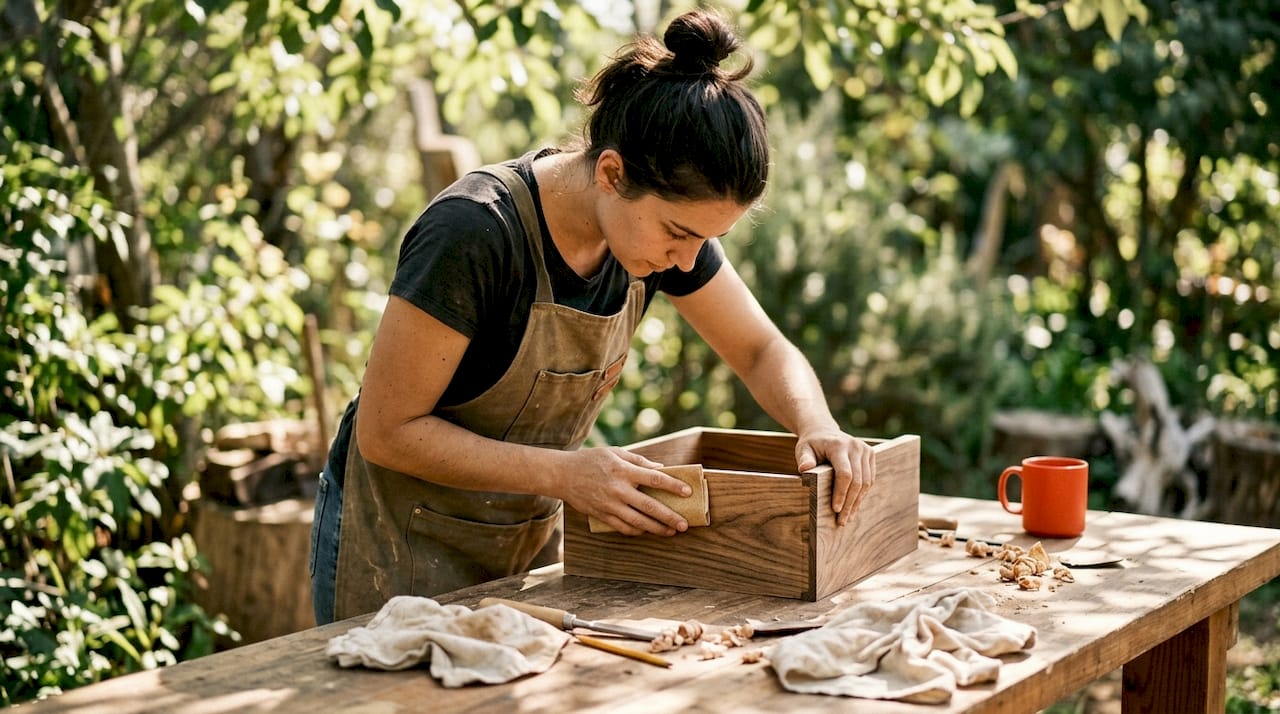
Hand finishing, grain matching, and structural joinery are the three techniques that separate long-lasting storage from disposable alternatives. Grain matching means selecting wood panels so their natural patterns align across surfaces, which reduces internal stress and prevents warping over time. Structural joinery, such as dovetail or mortise-and-tenon joints, distributes load across the piece rather than relying on screws or adhesive alone. Hand finishing seals surfaces in a way that machine sanding cannot replicate, closing grain pores and protecting against moisture.
Life cycle assessments show that environmental impact is heavily determined by product longevity. A storage product that lasts 30 years requires far fewer raw materials over time than three replacements of a cheaper item. That means choosing crafted storage is also an environmental decision, not just a quality one.
Industrial furniture prioritizes speed and flat-pack assembly. Artisan workshops perform hidden labor such as finishing internal edges and hand-selecting veneers, steps that never appear in a product photo but define how the piece holds up after years of use. The difference shows up in how a lid closes, how a hinge holds tension, and whether a joint stays tight after humidity cycles.
Pro Tip: When evaluating storage for durability, open it and look inside. Finished internal edges and tight-fitting joints signal artisan construction. Rough cuts and visible staples signal mass production.
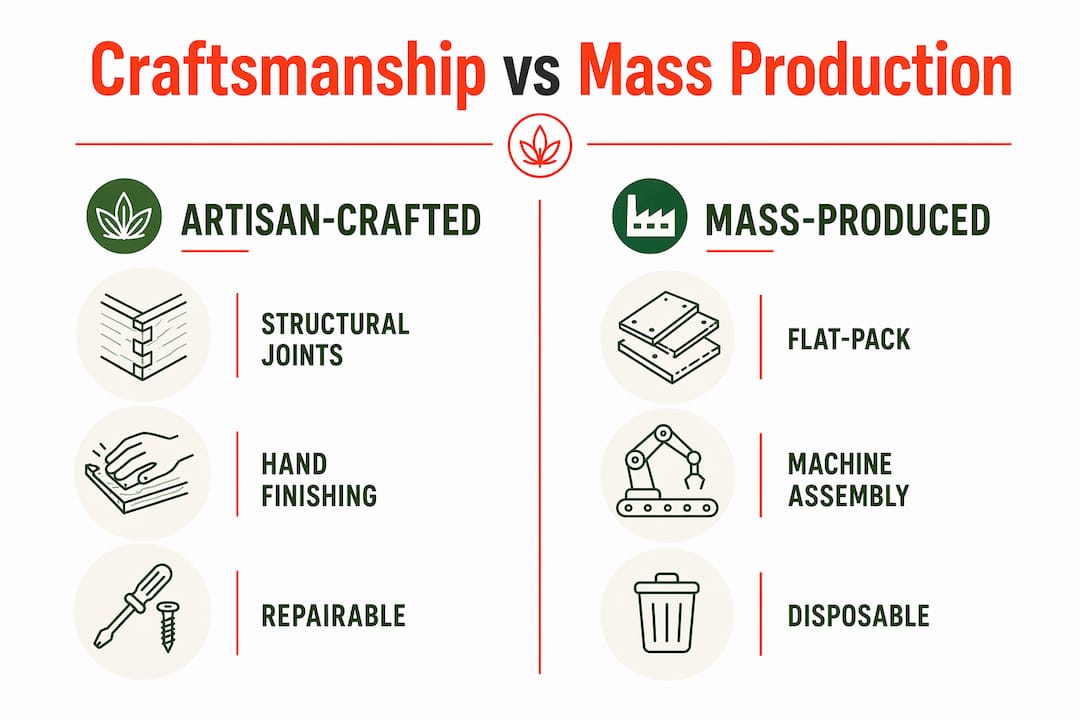
Craftsmanship vs. mass production: what actually differs
| Feature | Artisan-crafted storage | Mass-produced storage |
|---|---|---|
| Joinery method | Structural joints (dovetail, mortise-and-tenon) | Screws, staples, and adhesive |
| Surface finishing | Hand-sanded, grain-sealed, internally finished | Machine-sanded exterior only |
| Material selection | Hand-selected veneers, grain-matched panels | Standardized cuts, no grain consideration |
| Expected lifespan | 30+ years | A few years |
| Environmental footprint | Lower over time due to longevity | Higher due to frequent replacement |
What design qualities set handcrafted storage apart?
Handcrafted storage solves problems that mass production cannot address. Factory lines produce fixed dimensions and standard configurations. Artisan makers resolve each commission individually, adjusting proportions, handle placement, and closure mechanisms to fit the actual use case.
The design qualities that distinguish crafted storage go beyond appearance:
- Sculptural form tailored to function. Artisan makers consider how a lid lifts, how a handle sits in the hand, and how internal compartments organize specific items. These decisions happen before a single cut is made.
- Natural veneers that age with dignity. Craftsmanship involves slow, informed decision-making that allows products to develop patina over time. On natural wood or brass, patina is a positive sign of aging, not damage. It tells the story of the object’s life.
- Wear resistance built into the design. Artisan makers choose materials and finishes based on how a surface will behave after thousands of touches, not just how it looks on day one.
- Thoughtful joint and hinge selection. The weight of a lid, the resistance of a hinge, and the depth of a groove are all deliberate choices. In mass production, these are standardized. In artisan work, they are solved.
“Craftsmanship is not a style. It is a form of advanced problem-solving that incorporates slow decision-making for durability and aging potential. Consumers often mistake it for aesthetics, but practitioners understand it as a discipline of judgment applied to every surface, joint, and finish.”
This distinction matters for cannabis storage specifically. A lid that seals precisely protects against odor and moisture. A hinge that holds tension after repeated use keeps a lockable box secure. These are not decorative features. They are functional outcomes of good design.
Pro Tip: Evaluate artisan storage by looking for visible evidence of thoughtful finishing: flush-fitting lids, consistent gap spacing, and surfaces that feel the same inside as outside.
Why is craftsmanship crucial for cannabis storage products?
Cannabis storage has specific preservation requirements that generic containers cannot meet. Quality craftsmanship protects product potency by integrating durable, odor-resistant, and precisely fitted materials that prevent contamination and moisture ingress. A poorly sealed box allows humidity to fluctuate, which degrades cannabinoids and terpenes faster than almost any other factor.
Artisan construction addresses these needs directly. Here is how craftsmanship serves cannabis storage at each level:
- Material selection for odor resistance. Artisan makers choose materials based on their chemical properties, not just their appearance. Dense hardwoods and treated metals resist odor absorption and transfer, keeping contents discreet and uncontaminated.
- Precision fitting for moisture control. Tight-fitting lids and sealed joints prevent humidity from entering the storage environment. This directly supports cannabis potency preservation by maintaining a stable internal climate.
- Lockable design integrity. A lock is only as reliable as the structure around it. Artisan construction ensures the locking mechanism is supported by solid joinery, not just screwed into a thin panel that can be pried apart.
- Custom organization for enthusiasts. Handmade storage can be configured with compartments sized for specific tools, papers, or accessories. This level of organization is not available in standard mass-produced options.
- Legal compliance through security. Lockable, well-constructed storage supports responsible cannabis use by keeping products secure and out of reach. Craftsmanship ensures the lock and structure work together as a system, not as separate components.
The bespoke furniture sector was valued at $16.1B in 2024 and is projected to exceed $24.3B by 2030. That growth reflects a broader consumer shift toward long-term, quality-first purchases. Cannabis enthusiasts are part of that shift, choosing storage that respects both their product and their investment.
How do artisan techniques add value beyond aesthetics?
The most significant value artisan techniques deliver is invisible. Hidden labor includes meticulous veneer selection, hand sanding between coats, and finishing edges that no one will ever see. This work does not show up in a product photo, but it determines how the piece performs after years of use.
The human intelligence in craftsmanship cannot be replaced by technology. Machines can preserve patterns and repeat cuts, but they cannot judge when a finish is complete, how tight a joint must be for a decade of use, or how a material will respond to seasonal humidity changes. That judgment is embedded in every handmade piece.
Craftsmanship also creates repairability. A well-joined storage box can have its finish restored, its hinge replaced, or its interior refitted without replacing the entire piece. Mass-produced alternatives are typically designed for disposal, not repair. This repairability is a direct economic benefit for the consumer.
| Value dimension | What artisan technique delivers | Why it matters for cannabis storage |
|---|---|---|
| Hidden labor | Internal edge finishing, veneer matching | Prevents moisture ingress and structural failure |
| Judgment in finishing | Knowing when a coat is complete | Ensures seal integrity over years of use |
| Repairability | Replaceable components, refinishable surfaces | Extends product life without full replacement |
| Patina and aging | Natural wear that signals quality | Confirms material authenticity and durability |
Expert designers define craftsmanship as accountability, the refusal to call a piece finished until it dignifies the user. That standard cannot be automated. It requires a maker who cares about the outcome, not just the output.
Craftsmanship is a collective, additive process built on shared knowledge and tradition, but it also adapts over time. Artisan workshops in regions with strong cabinetmaking traditions, such as Lithuania, pass techniques across generations while incorporating new materials and methods. The result is storage that carries both cultural knowledge and modern performance standards.
Pro Tip: Ask any storage maker whether their product is repairable. A confident “yes” with a specific answer signals genuine craftsmanship. A vague response signals mass production.
Key Takeaways
Craftsmanship is the single most reliable predictor of storage product quality, longevity, and functional performance for cannabis consumers.
| Point | Details |
|---|---|
| Durability starts with construction | Artisan joinery and hand finishing produce storage that lasts 30+ years versus a few years for flat-pack alternatives. |
| Design serves function, not just appearance | Handcrafted storage resolves lid fit, hinge tension, and compartment sizing as deliberate decisions, not factory defaults. |
| Cannabis storage has specific needs | Odor resistance, moisture control, and lock integrity require artisan-level material selection and precision fitting. |
| Hidden labor defines long-term quality | Internal edge finishing and veneer selection are invisible but determine how storage performs after years of daily use. |
| Craftsmanship enables repairability | Well-joined storage can be refinished and repaired, making it a long-term investment rather than a disposable purchase. |
Craftsmanship is the standard, not the upgrade
At Treelockbox, we have spent years watching consumers buy cheap storage and replace it repeatedly. The math never works in their favor. A box that warps, a lid that stops sealing, a lock that loosens after six months. These are not bad luck. They are the predictable outcome of mass production that treats storage as a commodity.
What I have come to believe, after working closely with cannabis consumers and enthusiasts, is that craftsmanship is not a premium feature. It is the baseline standard for anything worth owning. The shokunin spirit, the commitment to dignifying the user through the quality of the work, is the only honest way to build a storage product. Everything else is just a container.
The consumers who understand this stop asking “what is the cheapest option?” and start asking “what will still work in ten years?” That shift in thinking is the real value of craftsmanship. It changes how you buy, what you keep, and how much you spend over time. A well-crafted lockable box is not an indulgence. It is the more practical choice.
— Tree Lock Box
Treelockbox: storage built with craftsmanship at its core
Treelockbox applies artisan construction principles to every lockable cannabis storage product in its lineup. Each box is built with durable materials selected for odor resistance, moisture control, and long-term structural integrity. The lockable designs are engineered so the locking mechanism and the surrounding structure work as a single system, not as separate parts. Custom engraving options let you personalize your storage without compromising its function. If you are ready to move from disposable containers to storage that lasts, the Treelockbox shop carries the full lineup of cannabis storage and prep tools built to these standards.
FAQ
What is craftsmanship in storage products?
Craftsmanship in storage products is the deliberate use of artisan techniques, including structural joinery, hand finishing, and material selection, to build storage that prioritizes durability and function over speed and cost.
How long do handcrafted storage products last?
Bespoke, high-craftsmanship storage products last 30+ years, compared to a few years for mass-produced flat-pack alternatives, according to life cycle assessments of product longevity.
Why does craftsmanship matter for cannabis storage specifically?
Cannabis storage requires precise lid sealing, odor-resistant materials, and reliable lock integrity. Artisan construction delivers all three through deliberate material choices and precision fitting that mass production cannot replicate.
Can a well-crafted storage box be repaired?
Yes. Artisan-built storage uses structural joinery and refinishable surfaces, which means hinges, finishes, and fittings can be replaced or restored without replacing the entire piece.
How do I identify quality craftsmanship in a storage product?
Look for finished internal edges, flush-fitting lids, consistent gap spacing, and tight joints. These details signal artisan construction and predict how the product will perform over years of daily use.