

Secure Locking in Medical Storage: 2026 Compliance Guide
Secure locking in medical storage is defined as the use of physical and electronic barriers that restrict access to authorized personnel only, protecting controlled substances and medical supplies from theft, diversion, and unauthorized use. The role of secure locking in medical storage goes beyond physical protection. Federal regulations like 21 CFR Part 1301.75 mandate specific locking standards for controlled substances, and failure to meet them carries real legal consequences. Facility managers who treat locking as a checkbox miss the bigger picture. A well-designed locking system is the foundation of medical inventory protection, regulatory compliance, and staff accountability.
What is the role of secure locking in medical storage?
Secure locking in medical storage serves three functions: it restricts access, creates accountability, and supports regulatory compliance. Under 21 CFR 1301.75, controlled substances must be stored in a securely locked, substantially constructed cabinet with additional controls against diversion. That regulation is not a suggestion. DEA inspectors can and do cite facilities for inadequate locking during routine audits.
The anchoring requirement is one detail many facility managers overlook. Safes under 750 pounds must be physically anchored to prevent removal from the premises. A locked cabinet that can be carried out the door does not meet federal standards. That single gap can trigger a compliance violation even when every other security measure is in place.
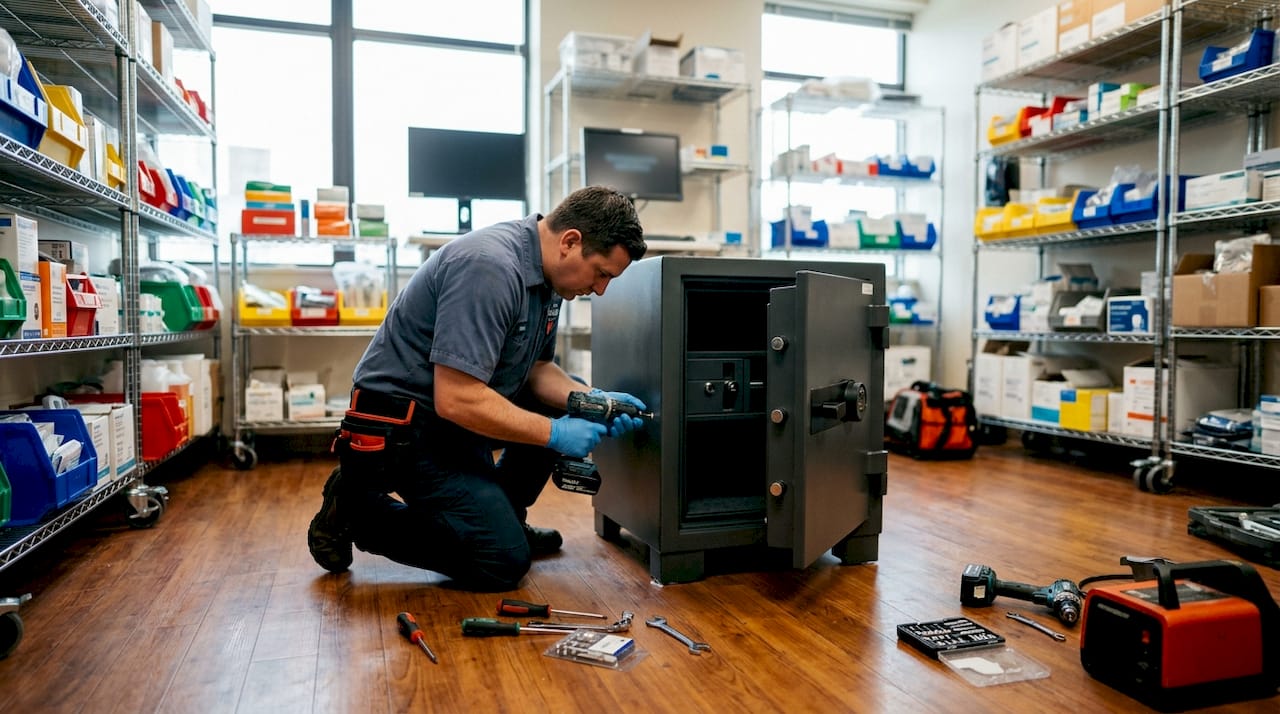
Locking mechanisms in healthcare also protect patient safety. Controlled substances that reach unauthorized hands cause direct harm. A secure cabinet with a functioning lock is the last physical barrier between a high-risk medication and an unauthorized person. No other safeguard replaces it.
Pro Tip: Review your facility’s anchoring documentation annually. Inspectors check both the lock and the physical installation, not just whether the cabinet closes.
- Controlled substances require a securely locked, substantially constructed cabinet per 21 CFR 1301.75.
- Safes under 750 pounds must be anchored to prevent physical removal.
- Access logs and audit trails are reviewed during DEA audits alongside the lock itself.
- Role-based access controls reduce diversion risk by limiting who can open each cabinet.
What types of locking mechanisms work best in healthcare?
Lock choice must align with workflow. Key locks fit small teams with limited access points. Electronic systems suit high-traffic environments where accountability and speed both matter. Choosing the wrong type for your environment creates friction, workarounds, and security gaps.
Mechanical keyed locks
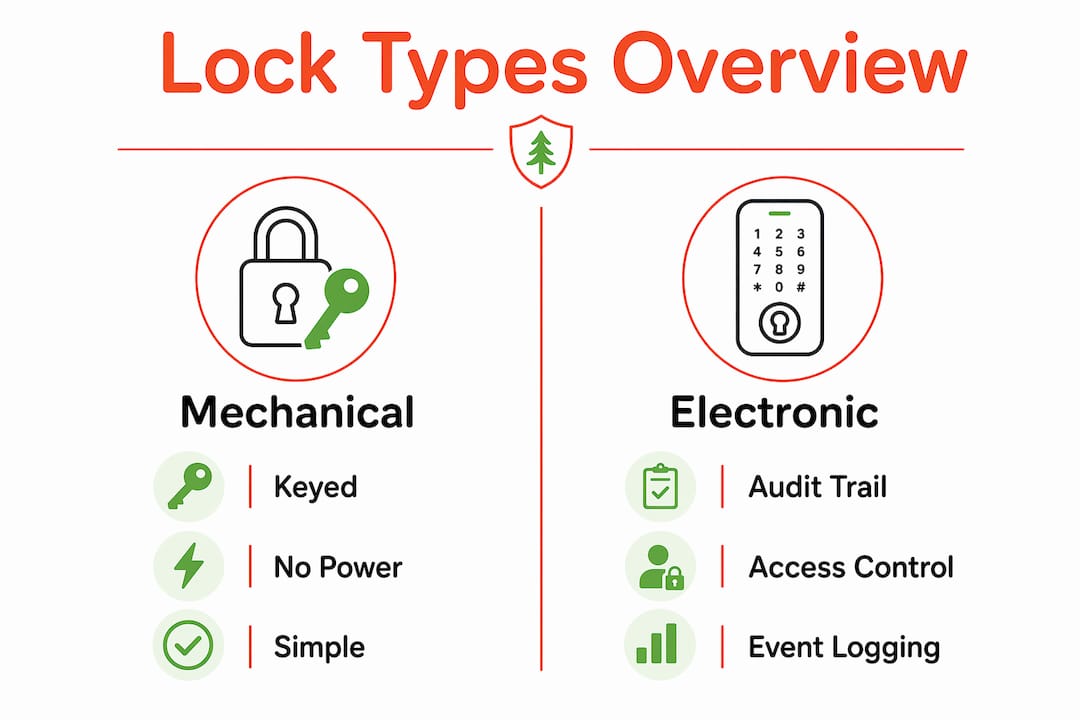
Mechanical keyed locks are the simplest option. They require no power source, no software, and no network connection. For a small clinic with one or two staff members accessing a single cabinet, a quality mechanical lock is often sufficient. The limitation is accountability. A keyed lock cannot tell you who opened the cabinet or when.
Electronic locking systems
Electronic locks solve the accountability problem directly. Modern electronic cabinet locks can store up to 3,000 events on the lock itself and 6,000 on smart keys, creating an immutable audit trail for federal compliance. That data is retrievable during a DEA audit and can identify exactly who accessed a cabinet at any given time. For high-traffic areas like hospital pharmacies or emergency departments, this level of detail is not optional.
Audit-trail-enabled locks
Audit-trail locks combine electronic access control with event logging. They assign individual credentials to each staff member, so every access event is attributable to a specific person. DEA inspectors prioritize the entire security and access control system over the brand or type of lock used. A facility with a modest lock and a complete audit trail performs better in inspections than one with an expensive lock and no access records.
Pro Tip: When evaluating electronic locks, ask the vendor how long event data is stored and whether it exports to your existing compliance software.
| Lock type | Best environment | Key advantage | Main limitation |
|---|---|---|---|
| Mechanical keyed | Small clinics, low-traffic storage | Simple, no power needed | No audit trail |
| Electronic with PIN or card | Mid-size facilities | Individual access control | Requires power source |
| Smart key with audit trail | Hospital pharmacies, ERs | Full event log, DEA-ready | Higher upfront cost |
| Retrofit electronic cylinder | Legacy cabinets | Upgrades existing hardware | Limited to compatible cabinets |
What security vulnerabilities exist in medical storage?
Most security failures in medical storage arise from human error, not mechanical lock defeat. Propped-open doors, shared key sets, and borrowed credentials are the real threats. A facility can install the best lock on the market and still suffer a diversion event because a staff member left the cabinet unlocked during a busy shift.
The human factor is the hardest part of medical storage security to control. Shared credentials are especially dangerous. When two staff members use the same PIN or key, there is no way to attribute a specific access event to one person. That breaks the audit trail and creates a compliance gap that inspectors will flag immediately.
Role-based access control addresses this directly. Each staff member receives individual credentials tied to their job function. A pharmacy technician gets access to the dispensing cabinet. A maintenance worker does not. When a staff member leaves the facility, their credentials are revoked immediately. That revocation step is where many facilities fail. Delayed revocation after a termination or role change is a documented source of diversion incidents.
- Propped-open cabinet doors are the most common physical security failure.
- Shared keys or PINs eliminate individual accountability and break audit trails.
- Delayed credential revocation after staff changes creates unauthorized access windows.
- Routine auditing of access logs catches anomalies before they become incidents.
- Secure locking paired with enforced policies reduces both theft risk and liability exposure.
Technology alone does not close these gaps. A facility needs written policies, regular training, and a clear process for responding to access anomalies. When an audit log shows a cabinet opened at 3:00 AM by a staff member who was not scheduled, that event needs a documented response. The log is only useful if someone reviews it.
How do you integrate secure locking into a full storage security plan?
A complete medical storage security plan combines the right lock type, the right cabinet design, trained staff, and a documented incident response process. No single element works without the others. Locks best serve their purpose when integrated with controlled procedures, staff training, and electronic audit trails.
-
Assess your medication risk profile. Categorize your controlled substances by diversion risk and access frequency. High-risk, high-frequency items need electronic locks with full audit trails. Lower-risk items in low-traffic areas may be adequately protected by mechanical locks.
-
Match cabinet design to workflow. A cabinet that slows down legitimate access gets propped open. Choose a design that staff can open quickly with their credentials so there is no incentive to bypass the lock.
-
Implement role-based access from day one. Assign individual credentials to every staff member who needs access. Document who has access to what, and review that list quarterly.
-
Set up audit log reviews. Designate a staff member or compliance officer to review access logs weekly. Define what an anomaly looks like and what the response protocol is.
-
Train staff on secure storage policies. Training is not a one-time event. Run refreshers when policies change, when new staff join, and after any incident. Staff who understand why the policy exists are more likely to follow it.
-
Plan for retrofitting existing cabinets. Retrofitting electronic locking systems into existing cabinets delivers compliance and audit features without costly cabinet replacements or new wiring. This is the most practical upgrade path for facilities with legacy storage infrastructure.
Incident response deserves its own documented protocol. When an access anomaly appears in the log, the facility needs a clear chain of action: who investigates, what gets documented, and when to escalate to the DEA. Facilities that have this process written down before an incident occurs handle audits far better than those that improvise.
Key Takeaways
Secure locking in medical storage requires the right lock type, individual access credentials, active audit log review, and enforced policies working together to meet federal standards and prevent diversion.
| Point | Details |
|---|---|
| Federal anchoring requirement | Safes under 750 pounds must be physically anchored per 21 CFR 1301.75 guidance. |
| Audit trails over lock brand | DEA inspectors prioritize access logs and individual accountability over lock model or price. |
| Human error is the top risk | Most diversion incidents trace back to shared keys, propped doors, or delayed credential revocation. |
| Retrofit electronic locks | Existing cabinets can be upgraded with electronic cylinders without new wiring or cabinet replacement. |
| Policy and technology together | Locks without enforced access policies and regular log reviews leave compliance gaps. |
Treelockbox’s take on where secure locking is heading
The conversation about secure locking in healthcare has shifted. Five years ago, facility managers asked, “Is the cabinet locked?” Now the question is, “Who opened it, when, and was that access authorized?” That shift reflects a maturing understanding of what security actually means in a clinical environment.
What I see most often is facilities investing in high-end locks while ignoring the access management layer. A $2,000 electronic lock with shared credentials is less secure than a $300 mechanical lock with a strict key control policy. The lock is not the security system. The security system is the lock plus the policy plus the audit process plus the training. Remove any one of those and the whole structure weakens.
The trend toward retrofit electronic cylinders is genuinely useful for facilities that cannot justify full cabinet replacement. The ability to add an audit-ready locking system to existing infrastructure without rewiring changes the cost calculation entirely. Facilities that were previously priced out of electronic access control now have a practical path forward.
The next frontier is real-time alerting. Audit logs reviewed weekly catch problems after the fact. Systems that push an alert when a cabinet is accessed outside scheduled hours catch problems in real time. That capability exists now and will become standard in high-risk storage environments within the next few years. Facility managers who build their access control infrastructure with that future in mind will not need to replace everything again when it arrives.
— Tree Lock Box
Secure locking solutions from Treelockbox
Treelockbox builds lockable storage solutions designed around the principle that secure access should never require a trade-off between speed and accountability. The product line includes lockable boxes with durable construction, secure closures, and designs that hold up under daily use. For facility managers evaluating storage upgrades, Treelockbox offers options that prioritize both physical security and practical workflow. Whether you are securing a single storage point or building out a broader access control setup, the right lockable enclosure is the starting point. Explore the full range at Treelockbox to find a solution that fits your facility’s security requirements and daily operations.
FAQ
What does 21 CFR 1301.75 require for controlled substance storage?
21 CFR 1301.75 requires controlled substances to be stored in a securely locked, substantially constructed cabinet. Safes under 750 pounds must also be anchored to prevent physical removal from the facility.
Why do DEA inspectors focus on audit trails rather than lock brands?
DEA inspectors prioritize the security ecosystem, meaning individual attributable access and event logs, over the specific lock model. A complete audit trail demonstrates accountability in a way that a high-end lock without access records cannot.
What is the most common cause of medical storage security failures?
Security failures most often result from human factors like shared keys, propped-open doors, and delayed credential revocation, not from mechanical lock defeat. Policy enforcement and staff training are the most effective countermeasures.
Can electronic locks be added to existing medical cabinets?
Yes. Retrofit electronic lock cylinders can be installed on existing cabinets to add audit trail and access control features without new wiring or cabinet replacement. This is the most cost-effective upgrade path for facilities with legacy storage infrastructure.
How often should access logs for medical storage be reviewed?
Access logs should be reviewed at least weekly by a designated compliance officer or manager. Any access event outside normal hours or by an unexpected credential should trigger a documented investigation.