

30 Second Test: Pick Combination or Key Locks for Personal Storage
Pick a keyed lock when you need the strongest mechanical resistance and only one or two people need access. Pick a combination lock when convenience and shared access matter more than raw resistance, like a gym locker or a shared shed. A cheap version of either type will fail faster than a well-rated one, so the badge on the package matters as much as the mechanism itself.
TL;DR:
- High-security rated keyed locks outperform low-quality combination locks in resisting forced entry and picking, making them better for high-value storage.
- Combination locks with larger code ranges, such as five-wheel models offering up to 100,000 options, are significantly more resistant to brute-force attacks than basic three-wheel versions.
- Electronic locks with audit capabilities or remote code management are ideal for frequent access changes, especially in shared or rental settings.
- Always look for certified ratings like CEN, Sold Secure, or UL, and verify construction details such as hardened shackle material and solid body design before purchasing.
- Regular maintenance, including lubricating mechanisms and replacing batteries early, extends the lifespan and security of both keyed and combination locks.
Table of Contents
- Combination Lock vs Key Lock: A Side-by-Side Look
- How Do Attackers Actually Defeat These Locks?
- Which Lock Fits Your Everyday Situation?
- How Do You Actually Choose the Right Lock?
- How Do You Keep a Lock Working for Years, Not Months?
- The Publisher’s Take: Matching Mechanism to Real Storage Habits
- Where to Find Lockable Storage Built Around These Principles
- Sources
- FAQ
Combination Lock vs Key Lock: A Side-by-Side Look
Neither mechanism is universally “better.” Each carries a distinct set of trade-offs that show up the moment you actually use the thing every day.
Combination locks give you:
- No keys to carry, lose, or fumble for in the dark
- Resettable codes, which makes them ideal for households or teams where access changes often
- Simple shared access. Hand out a code instead of cutting duplicate keys
Combination locks cost you:
- Wear patterns. On cheap dials, the numbers you use most develop a slightly different feel, and that is exactly what an experienced manipulator looks for
- Limited combinations on entry-level models. A basic three-wheel padlock offers only 1,000 possible combinations, while a five-wheel unit can offer up to 100,000
- Electronic versions add battery dependency, which is one more thing that can fail at the worst time
Keyed locks give you:
- Strong mechanical resistance when the lock carries a real security rating
- Tighter single-user control. There is no code to accidentally repeat to a roommate
- Faster operation once you know which key goes where. No spinning a dial three times
Keyed locks cost you:
- Lost keys mean you are locked out, full stop, unless you planned ahead with a spare
- Duplication risk. Anyone who copies your key has permanent access until you rekey or replace the lock
- Rekeying after a lost key or a breakup with a roommate usually costs more than resetting a combination
The pattern that emerges is: combination locks trade some mechanical toughness for flexibility, and keyed locks trade some flexibility for toughness, assuming you buy a decent one either way.
How Do Attackers Actually Defeat These Locks?
The real-world weak points of each lock type are more specific than “someone breaks it.” Understanding the actual attack methods tells you what to look for on a product label.
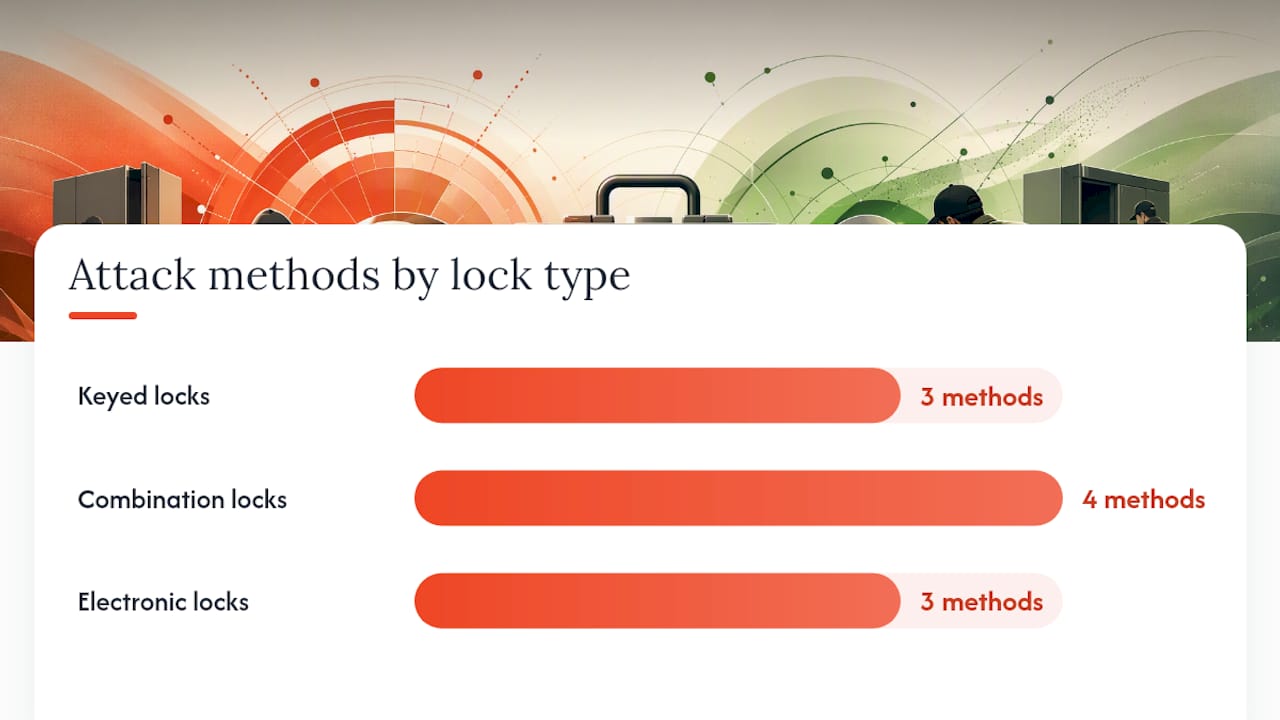
Keyed padlocks face three main threats: picking, where a locksmith or thief manipulates the pins without the key; bumping, a fast technique that jolts pins into alignment; and destructive attacks, meaning bolt cutters, saws, or brute force against the shackle. Warded and pin-tumbler mechanisms vary enormously in resistance. A cheap warded lock can be opened with a bent paperclip, while a high-quality pin-tumbler design with tight tolerances resists picking for much longer.
Combination and electronic locks face a different set of risks: code-guessing (people try birthdays and repeated digits far more than they should), shoulder-surfing in shared spaces like gyms, wear-pattern analysis on mechanical dials, and brute-force attempts against low-combination models. That gap between a 1,000-combination lock and a 100,000-combination lock is not a small detail. It is the difference between a lock a bored teenager can crack in an afternoon and one that takes specialized tools.
Independent ratings exist precisely to cut through marketing claims. CEN (the European Committee for Standardization) and Sold Secure grade padlocks and other security hardware against real attack testing, not just advertised toughness. UL performs a similar function in North America for certain lock and safe categories. A lock carrying one of these ratings has been tested against actual break-in methods, not just rated by the manufacturer’s own marketing copy. The construction and certification of a lock usually matters more than whether it uses a key or a dial.
When you’re checking a product page or the lock itself, look for:
- Shackle material (hardened steel resists cutting far better than standard steel)
- Solid body construction with no visible seams that could be pried
- An actual rating badge, not just words like “heavy duty” with no certification behind them
- A recodable mechanism for combination locks, so a compromised code does not mean buying a new lock
- Audit capability for electronic combos, letting you see who accessed what and when
Which Lock Fits Your Everyday Situation?
Matching the lock to the situation solves more security problems than obsessing over which mechanism is theoretically stronger.
- Shared spaces favor combination locks. Gyms, school lockers, and short-term rentals all involve people cycling in and out. Handing someone a four-digit code beats cutting a spare key you will never see again.
- High-value, single-user storage favors keyed locks. A home safe, a locked cabinet with important documents, or long-term storage you rarely open all benefit from the tighter mechanical control a rated keyed lock provides.
- Travel gear needs resettable combinations. Luggage and backpacks do better with small, TSA-compatible combination locks, since checked bags sometimes need inspection and a resettable code beats losing a key mid-trip.
- Frequent access changes favor programmable electronic locks. Electronic locks let you issue temporary codes and revoke them remotely, which is genuinely useful for short-term guests, cleaning crews, or shared storage where the roster of people changes monthly.
The honest takeaway from most locksmiths and lock manufacturers is that convenience wins for everyday shared access, while a properly rated mechanism wins for anything insurance-sensitive or high-value. Match the lock to how the space actually gets used, not to which mechanism sounds more secure on paper.
How Do You Actually Choose the Right Lock?
Before buying anything, run through a short mental checklist. It takes thirty seconds and saves you from buying the wrong lock twice.
- Threat model: Are you deterring casual snooping or protecting against a determined thief with tools?
- Number of users: One person, a household, or a rotating group of employees or guests?
- Required rating: Does your insurance policy, landlord, or workplace specify a minimum standard?
- Weather exposure: Will this lock live outdoors, where corrosion and ice become real problems?
- Reset or rekey needs: How often will access change, and how painful is it to update?
- Serviceability: Can you actually get parts, batteries, or support if something breaks?
When you’re evaluating a specific product, ask the seller or check the spec sheet for these exact answers:
- “What is the CEN, Sold Secure, or UL rating?”
- “Is the combination recodable, and what is the process?”
- “What material is the shackle, and how is it hardened?”
- “If it’s electronic, what is the expected battery life and what happens when the battery dies?”
Watch for red flags: no rating listed anywhere, no clear explanation of how to reset a code, or sealed electronics with no backup access method if the battery dies at the worst possible time.
Pro Tip: If a product page cannot answer “what happens if the battery dies” or “how do I reset this,” treat that silence as your answer. A well-designed lock explains its own failure modes up front.
How Do You Keep a Lock Working for Years, Not Months?
Locks fail slowly, then all at once. A little routine care prevents most of the emergencies people associate with locks.
- Lubricate keyed mechanisms periodically. Dry pins bind and eventually stop turning smoothly.
- Protect outdoor locks from corrosion, and check rubber seals on weatherproof models every season.
- Replace batteries on electronic locks before they die completely, not after you’re locked out.
- Keep a backup key or a written record of your combination somewhere secure but separate from the lock itself.
If you do get locked out, a locksmith or a backup key solves most keyed-lock problems, while a documented reset procedure solves most combination lockouts. Forced entry should always be the last resort, since it usually destroys the lock and sometimes the thing it was protecting.
Replace a lock when you notice visible wear on the dial or keyway, rust that won’t clean off, intermittent electronics, or repeated failed recoding attempts. Those are not cosmetic issues. They are early warnings that the mechanism is losing its resistance.
The Publisher’s Take: Matching Mechanism to Real Storage Habits
Most guides treat this as an abstract security debate. In practice, the right choice depends on what’s inside the box and who else needs to reach it. A rated keyed lock makes sense for internal compartments holding anything you would not want a roommate or guest opening on impulse. A resettable mechanical or electronic combination makes more sense on outer compartments or lids that multiple people in a household might need to access.
That thinking shapes how lockable storage products get built for personal use. The goal isn’t picking a side in the combination-versus-key debate. It’s recognizing that different compartments inside the same box often deserve different locking logic, and a well-designed product should let you apply both.
— Tree Lock Box
Where to Find Lockable Storage Built Around These Principles
Tree Lock Box carries lockable stash boxes built with both keyed and combination mechanisms, depending on the product line, so you can pick the version that fits your access needs rather than settling for whatever a generic container happens to include. Portable storage units often use compact, travel-ready locking systems, while larger stationary boxes typically favor sturdier keyed mechanisms for long-term home storage. Product listings often describe the locking hardware used, so you can compare specs such as rating, material, and reset options. Browse the full shop to compare current options side by side, and choose a rated lock that actually matches how you plan to use it, not just the one that looks the most secure on a thumbnail.
Sources
- Which is Best - Combination or Keyed Padlocks — Insight Security
- Combination padlock vs keyed padlock — Locks Direct
- Key | Lock device, types, uses & benefits — Britannica
- What are the benefits of electronic locks? — iLOQ
FAQ
What Is Safer, a Key Lock or a Combination Lock?
Neither is inherently safer. A CEN or Sold Secure rated keyed padlock typically resists forced entry better than a cheap combination lock, but a high-end combination or electronic lock with a large code range can outperform a low-quality keyed lock.
Why Is a Code Lock Better Than a Key Lock in Some Cases?
Combination and code locks eliminate the risk of lost or duplicated keys and let you reset access instantly, which is why shared spaces like gyms and rental properties often prefer them over issuing physical keys.
Is a Key or a Code Lock Safer for High-Value Storage?
For high-value or insurance-sensitive storage, a properly rated keyed lock is usually the stronger choice, since single-key control limits who has access and rated mechanical designs resist picking and forced entry better than most entry-level combination models.
What Type of Lock Is Most Secure?
The most secure option is whichever lock carries an independent rating like CEN, Sold Secure, or UL and matches solid shackle and body construction, since certification testing against real attack methods matters more than whether it uses a key or a dial.
Should I Use a Combination or Key Lock for a Stash Box?
For a personal storage box with multiple compartments, a rated keyed lock works well for the most sensitive internal section, while a resettable combination suits any compartment other household members occasionally need to open.