

The Role of Durability in Dispensary Products
Durability in dispensary products is defined as the packaging’s and storage system’s ability to prevent oxygen, light, moisture, and temperature fluctuations from degrading cannabis quality over time. The role of durability in dispensary products extends far beyond keeping a product intact on a shelf. It directly controls cannabinoid potency, terpene profiles, microbiological safety, and the consumer experience from the moment a product leaves the facility to the last use. Packaging technologies like nitrogen flushing, aluminum laminate barrier films, amber glass jars, and humidity packs are the primary tools the industry uses to operationalize durability. For both consumers and dispensary operators, understanding how these mechanisms work is the difference between a product that performs as labeled and one that disappoints.
How does durability affect chemical stability in cannabis flower and concentrates?
Durability directly controls the rate at which THC, THCA, and terpenes degrade after harvest and processing. Cannabis compound stability is driven by four environmental factors: oxygen, light, moisture, and temperature. Packaging that fails to block any one of these factors accelerates degradation in ways that are measurable within weeks.
For dry flower, the data is specific. Stability studies using PET/ALU/PE packaging with nitrogen flushing show only 7.3%–9.4% THC degradation after three months at 25°C and 60% relative humidity, with THCA decarboxylation half-lives of roughly 21 to 28 months. That means well-packaged flower can realistically maintain label-accurate potency for 12 to 24 months. Products in substandard packaging lose potency far faster, often before they even reach the consumer’s hands.
Concentrates face a different but equally serious durability challenge. Terpene profiles in concentrates degrade 15%–20% within 90 days under LED lighting, while dark-stored controls retain over 95% of their terpene content. This is not a minor sensory difference. A 20% terpene loss changes the flavor, aroma, and entourage effect of the product in ways consumers notice immediately.
THC and THCA degradation also follow nonlinear kinetics. Oxidative degradation and decarboxylation proceed at different rates, which means a product can lose sensory quality before it loses measurable potency, or vice versa. Dispensaries that rely solely on potency testing to assess shelf life are missing half the picture.
Pro Tip: When evaluating flower freshness, smell the product before you look at the THC percentage. Terpene loss is often the first sign of packaging failure, and it happens before potency numbers drop significantly.
What are the best materials and packaging technologies for durable cannabis products?
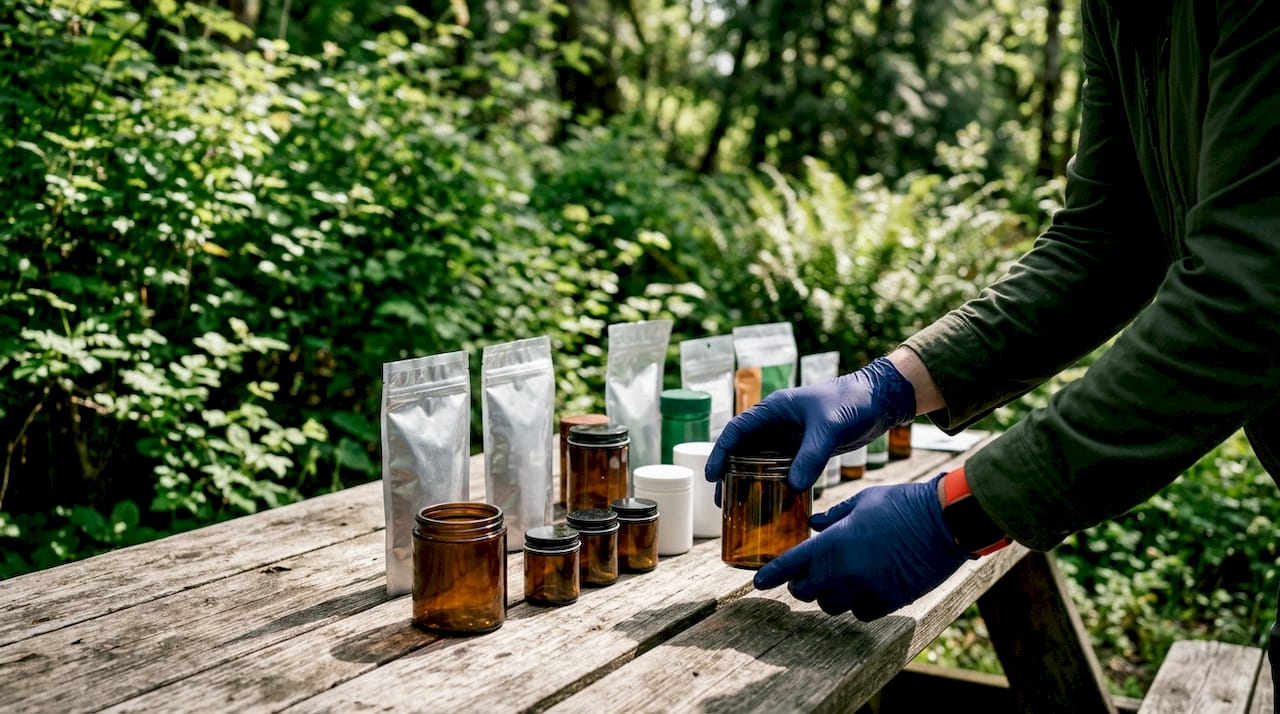
The packaging material is the single most controllable variable in product durability. Glass and aluminum laminate dominate the high-durability tier for good reason.
| Packaging Type | Oxygen Barrier | Light Blocking | Chemical Inertness | Best For |
|---|---|---|---|---|
| Amber/violet glass | Excellent | High (UV-blocking) | Non-reactive | Concentrates, long-term storage |
| Aluminum laminate bags (N₂-flushed) | Excellent | Complete | Non-reactive | Flower, bulk storage |
| HDPE plastic jars | Moderate | None | Low (leaching risk) | Short-term, rapid turnover |
| Clear plastic containers | Poor | None | Low | Not recommended for quality products |
Nitrogen-flushed aluminum laminate bags outperform HDPE jars for flower preservation, with all nitrogen-filled samples remaining within specification up to nine months in comparative studies. The combination of an inert headspace atmosphere and a high-barrier film addresses both oxygen ingress and moisture transfer simultaneously. That dual-purpose design is what separates functional durability engineering from basic packaging.
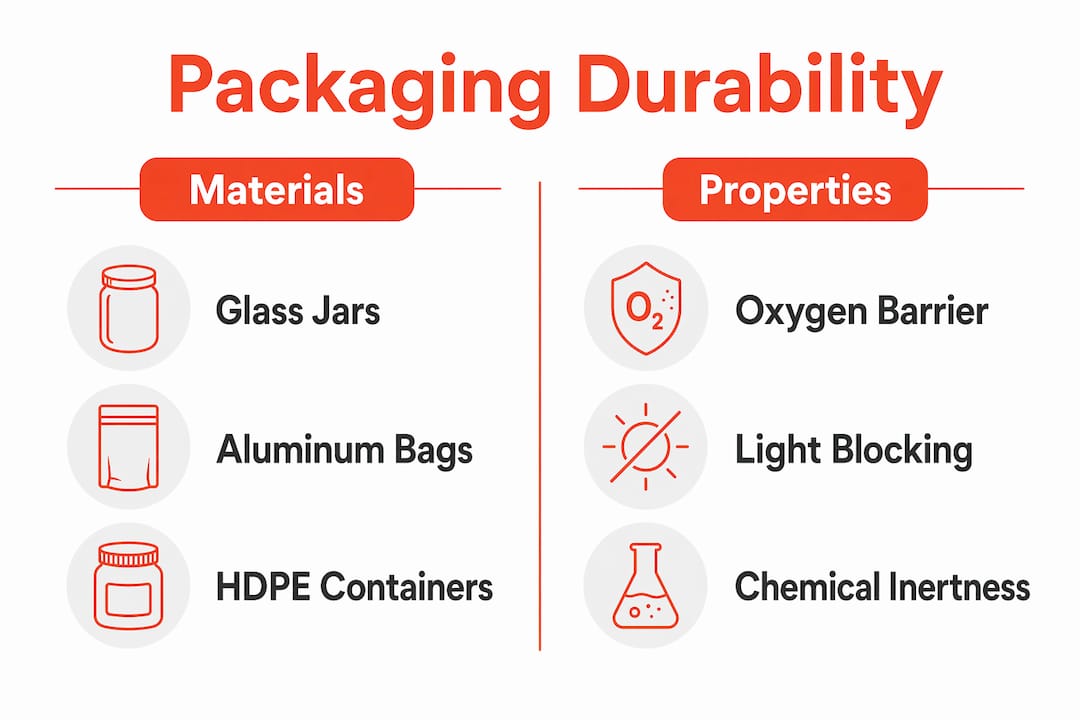
For concentrates, glass containers provide airtight seals and chemical inertness that preserve terpene profiles and potency for 12 months or more. Plastic containers are appropriate only for rapid-turnover products because their oxygen permeability and potential for chemical interaction with concentrate compounds make them unreliable for extended shelf life.
Seal and closure integrity matters as much as the container material itself. Zipper repeatability, seal strength, and odor barrier performance must be documented through compliance testing to meet regulatory standards and ensure batch-to-batch consistency. A premium container with a failing seal delivers zero durability benefit.
Key factors to evaluate when selecting packaging for durable cannabis products:
- Oxygen transmission rate (OTR): Lower is better. Aluminum laminates and glass are the top performers.
- Moisture vapor transmission rate (MVTR): Critical for flower. High humidity causes mold; low humidity causes terpene evaporation.
- UV and visible light blocking: Amber and violet glass filter the wavelengths most damaging to cannabinoids and terpenes.
- Closure integrity: Resealable zippers and airtight lids must maintain performance across multiple open-and-close cycles.
- Chemical inertness: The packaging must not leach plasticizers or other compounds into the product.
Pro Tip: For concentrates stored at home, choose a container sized as close to the product volume as possible. Excess headspace means more oxygen in contact with the product, even in a sealed container.
How can consumers and dispensaries apply durability principles for best product preservation?
Knowing the science of durability only helps if you act on it. Both consumers and dispensary operators have specific, practical steps that translate packaging durability into real product longevity.
For consumers, the storage environment after purchase is the primary variable. Amber glass jars with airtight seals combined with humidity packs maintaining 58%–62% relative humidity achieve over 90% retention of cannabinoids and terpenes across six months. Stored cold and dark, the same setup supports product usability beyond 12 months. That is a meaningful shelf life for any consumer who buys in quantity or wants to preserve a specific batch.
Follow these steps to maximize product longevity at home:
- Transfer to an amber or violet glass jar with an airtight lid immediately after purchase if the original packaging is not resealable or is made of clear plastic.
- Add a calibrated humidity pack (Boveda or Integra Boost at 58%–62% RH) to the container to stabilize moisture levels without waterlogging the flower.
- Store in a cool, dark location. A drawer, cabinet, or dedicated storage box away from heat sources and windows is sufficient. Refrigeration works for concentrates; avoid it for flower unless the container is truly airtight.
- Minimize container opening. Every time you open a jar, you introduce fresh oxygen and allow terpenes to volatilize. Open only when needed and reseal immediately.
- Use the right container size. A half-full jar has more headspace oxygen than a full one. Downsize your container as you consume the product.
For dispensaries, the responsibilities extend to product rotation, packaging quality assurance, and consumer education. Products should be rotated on a first-in, first-out basis to prevent older stock from sitting behind newer inventory. Packaging integrity checks, including seal strength and closure performance, should be part of receiving and floor inspection protocols. Staff who can explain why durable storage matters to customers build trust and reduce post-purchase complaints about product quality.
Pro Tip: Dispensaries should track return and complaint rates by packaging type. If one SKU consistently generates freshness complaints, the packaging is the first variable to investigate, not the cultivation source.
What role does durability play in brand perception, regulatory compliance, and industry consistency?
Packaging durability is a strategic asset for cannabis brands that combines product preservation with regulatory compliance and competitive differentiation. Consumers associate premium packaging with premium product quality, and that perception is not irrational. A brand that invests in nitrogen-flushed aluminum laminate bags or UV-blocking glass is signaling that it takes product integrity seriously at every stage.
Batch-to-batch consistency is where durability becomes a quality control issue rather than just a marketing one. If seal performance varies between production runs, potency and terpene data at the point of sale may not reflect what the consumer actually receives. Regulatory bodies in states like California, Colorado, and Michigan require documented stability testing and packaging integrity validation as part of product approval processes. Brands that treat durability validation as a compliance checkbox rather than a genuine quality standard create liability for themselves and erode consumer trust over time.
The market is also moving toward durable, reusable, and sustainable packaging formats. Brands that offer refillable glass containers or packaging take-back programs are differentiating on durability and sustainability simultaneously. This matters to a growing segment of cannabis consumers who factor environmental impact into purchasing decisions.
Consumer confidence in a product’s labeled potency and terpene content depends entirely on the brand’s ability to demonstrate that its packaging maintains those values from production through purchase. Shelf stability studies, when conducted rigorously and published transparently, function as proof of durability. Brands that can point to documented stability data earn credibility that marketing alone cannot buy. The connection between CPG brand differentiation and packaging quality is well established across consumer goods categories, and cannabis is no exception.
Key takeaways
Durability in dispensary products is the packaging system’s ability to block oxygen, light, moisture, and heat, and it directly determines whether a product delivers on its label from production through the final use.
| Point | Details |
|---|---|
| Chemical stability depends on packaging | Nitrogen-flushed aluminum laminate bags limit THC degradation to under 10% over three months at standard conditions. |
| Terpenes degrade faster than potency | Concentrates lose 15%–20% of terpene content within 90 days under light exposure, affecting flavor before potency drops. |
| Glass outperforms plastic for concentrates | Amber and violet glass provides UV blocking, chemical inertness, and airtight seals that plastic cannot match for long-term storage. |
| Consumer storage extends shelf life significantly | Airtight glass jars with 58%–62% RH humidity packs retain over 90% of cannabinoids and terpenes for six months or more. |
| Seal integrity drives regulatory compliance | Documented closure testing and consistent zipper performance are required for batch-to-batch compliance in regulated dispensary markets. |
Why durability is the most underrated variable in cannabis quality
Most conversations about cannabis quality focus on genetics, cultivation methods, or extraction techniques. After years of working with storage and accessories in this space, Treelockbox has seen firsthand how often those upstream investments get undone by poor packaging and storage decisions downstream.
The most common mistake is treating the original dispensary packaging as the final word on storage quality. Many products arrive in containers that are adequate for short-term retail display but not for the weeks or months a consumer might take to finish them. A flower that tested at 28% THC and was harvested with exceptional terpene expression can taste flat and perform weakly within three weeks of purchase if it sits in a clear plastic container on a warm shelf.
The industry is getting better at this. Nitrogen flushing and aluminum laminate packaging have moved from specialty medical products to mainstream retail formats. Amber glass is becoming a baseline expectation for premium concentrates rather than a differentiator. But the consumer side of the equation still lags. Most buyers do not know that opening a jar daily accelerates terpene loss, or that a half-empty container is significantly worse for preservation than a full one.
Treelockbox’s position is straightforward: the best product in the world needs a durable, controlled environment to stay that way. Packaging durability is not a finishing detail. It is part of the product itself.
— Tree Lock Box
Protect your investment with Treelockbox storage solutions
The science is clear: durable storage is what separates a product that performs from one that disappoints. Treelockbox designs its lockable stash boxes and storage accessories specifically to give consumers and enthusiasts the controlled environment that cannabis products need after purchase. From odor-controlling airtight containers to portable units built for on-the-go discretion, every product in the Treelockbox lineup is built around the same principle that drives professional packaging: keep oxygen, light, and moisture out. Browse the full cannabis storage and tools guide to find the right setup for your products and consumption habits.
FAQ
What does durability mean for dispensary cannabis products?
Durability refers to a packaging or storage system’s ability to block oxygen, light, moisture, and temperature changes that degrade cannabinoids and terpenes. Products in durable packaging retain potency and sensory quality significantly longer than those in standard containers.
How long does properly packaged cannabis flower stay fresh?
Dry flower in nitrogen-flushed aluminum laminate packaging shows less than 10% THC degradation after three months at standard conditions, with shelf life supported up to 12 to 24 months. Home storage in airtight amber glass with a humidity pack can maintain over 90% cannabinoid retention for six months or more.
Is glass or plastic better for storing cannabis concentrates?
Glass is the superior choice for concentrates intended for storage beyond a few weeks. Amber and violet glass blocks UV light, creates a chemically inert environment, and provides an airtight seal that plastic containers cannot reliably match. Plastic is acceptable only for rapid-turnover products consumed within days of purchase.
Why do terpenes degrade faster than THC in cannabis products?
Terpenes are volatile aromatic compounds that evaporate and oxidize more readily than cannabinoids under light and oxygen exposure. Concentrates stored under LED lighting lose 15%–20% of terpene content within 90 days, while dark-stored samples retain over 95%. This means sensory quality often declines before potency numbers change.
What storage practices extend the shelf life of dispensary products at home?
Store cannabis in an amber or violet glass jar with an airtight lid and a calibrated humidity pack at 58%–62% relative humidity, in a cool, dark location. Minimize how often you open the container and keep cannabis fresh longer by downsizing your container as you consume the product to reduce headspace oxygen.