

Compact Secure Storage Box Types: Your 2026 Guide
Compact secure storage boxes are defined as small, lockable containers designed to protect personal valuables from unauthorized access while remaining easy to carry or conceal. The best compact secure storage box types balance three factors: physical tamper resistance, a reliable locking mechanism, and a size that fits your life. Key construction benchmarks include 1.5mm steel door thickness and 10,000-combination 4-digit mechanical locks. Whether you need discreet cannabis storage, travel security, or home document protection, the right box type depends on your specific use case.
1. What are the main compact secure storage box types?
Compact secure storage boxes fall into five main categories. Each serves a different security need, and knowing the difference saves you from buying the wrong box.
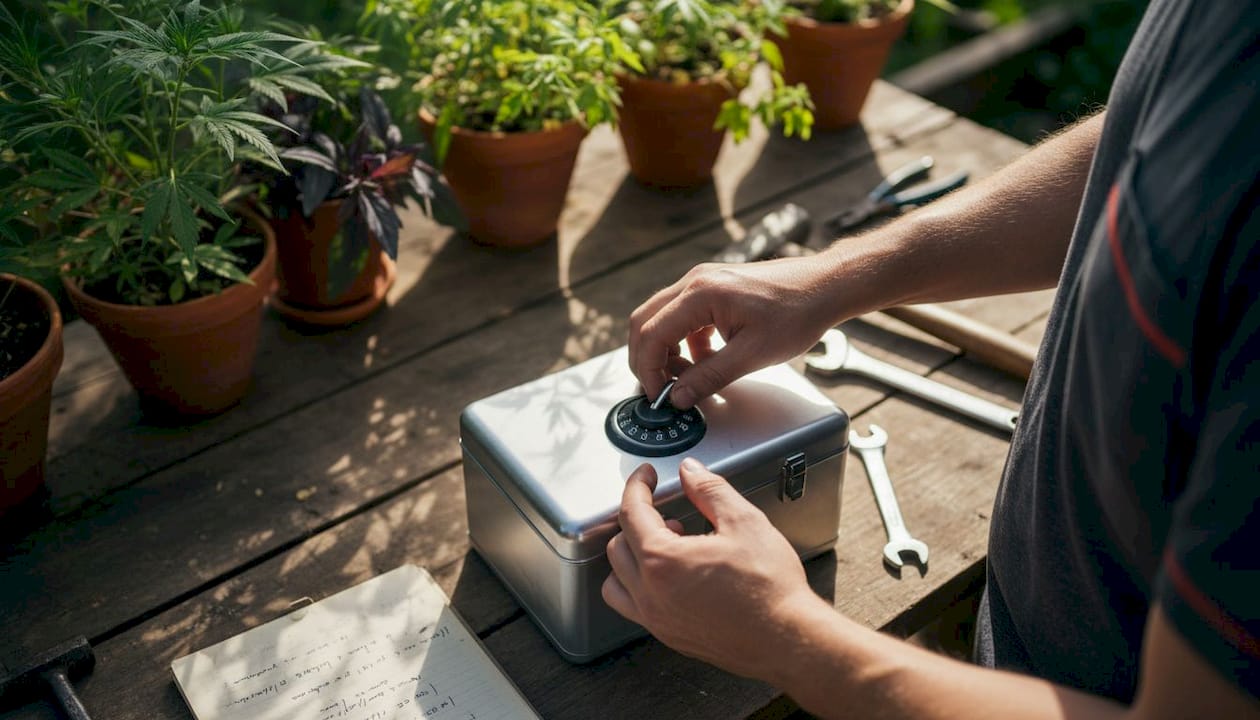
Mechanical combination lock boxes use a rotating dial or push-button pad with no batteries required. They are the most common entry point for personal storage and work well for everyday home use.
Key lock boxes secure access behind a physical key, often with a shackle or padlock mechanism. Wall-mounted key lock boxes are the most popular version, frequently used to store spare house keys or small valuables near an entryway.
Electronic keypad lock boxes use a PIN code entered on a digital pad. They open faster than mechanical dials but depend on battery power to function.
Biometric lock boxes read a fingerprint to grant access. Biometric locks provide the fastest access for urgent situations but typically offer smaller interior capacity and weaker fire protection than other types.
Portable compact safes with tether cables are designed for travel. They combine a lockable body with a steel cable that anchors to a fixed object, like a hotel bed frame or car seat rail.
Pro Tip: Before buying, measure the items you plan to store. A box that fits your phone and wallet may not fit a standard passport, and most product listings show interior dimensions separately from exterior ones.
2. How do locking mechanisms differ and what should you consider?
The locking mechanism is the single most important factor in a compact storage box. Getting it wrong means either losing access to your own box or giving a thief an easy way in.
Mechanical combination locks
Mechanical dials have no electronics and no batteries. Mechanical dials provide superior long-term reliability over electronic locks because they eliminate battery failure and electronic malfunction as failure points. The tradeoff is slower access. You must spin or press a sequence, which takes 5–15 seconds longer than a biometric scan.
Mechanical combination locks eliminate lockout risk from dead batteries, but they require you to memorize the code or store it securely elsewhere. Writing the code on a sticky note inside the box defeats the purpose entirely.
Electronic and biometric locks
Electronic keypad boxes open quickly and let you change the PIN without tools. The critical weakness is battery dependency. Electronic locks need a mechanical override key to prevent a complete lockout when the battery dies. Always confirm a backup key comes with the box before purchasing.
Lock type selection depends on your use case. Biometric locks are best for fast access situations like home defense or quick retrieval. Mechanical combination locks are the better choice for long-term storage where reliability over years matters more than speed. If you need both, look for a box that offers dual-mode access.
3. How do material and build quality affect security and portability?
Material choice determines how much punishment a box can take before it fails. Thicker steel resists prying. Lighter alloys reduce carry weight. Plastic with a lock offers privacy, not real security.
| Material | Typical Thickness | Weight | Best For |
|---|---|---|---|
| Steel | 1.5mm+ | Heavy | Home use, fixed mounting |
| Aluminum alloy | 1.0–1.5mm | Light | Travel, portable use |
| Reinforced plastic | Varies | Very light | Low-risk privacy storage |
Steel is the standard for any box claiming real theft resistance. A 1.5mm steel door is the recognized minimum for tamper-resistant compact boxes. Aluminum alloy cuts weight significantly, which matters for travel, but it dents and bends more easily under force.
Weight is a double-edged consideration. A heavier box is harder to carry off, but a light box with a tether cable can outperform a heavy box sitting loose on a shelf. Portable safes with tethering cables offer better theft prevention than relying on box weight or material thickness alone. A steel cable anchored to a fixed structure turns a portable box into a semi-permanent fixture.
Weather resistance matters for outdoor placement. Wall-mounted lock boxes are often weatherproof and rust-resistant, with anti-pry designs suited for home entryways, rental properties, and outdoor key storage. If you plan to mount a box outside, confirm it carries an IP rating or explicit weatherproof certification.
Pro Tip: Check whether the mounting hardware is included and rated for the wall type you have. A box bolted into drywall with no anchor is easier to rip off than one secured into a stud or masonry.
4. What are the best use cases for each storage box type?
Matching the box type to the situation is where most buyers go wrong. The right box for a cannabis enthusiast looks very different from the right box for a traveler or a homeowner storing documents.
Cannabis and personal item storage
Cannabis enthusiasts need boxes that are discreet, lockable, and odor-contained. Compact storage boxes for cannabis emphasize discretion, locking security, and odor containment as the three core requirements. A plain exterior with no branding, a combination or key lock, and a sealed interior lining are the features to prioritize. Treelockbox specializes in exactly this category, offering lockable stash boxes built for organized, discreet personal storage. If you want a full breakdown of options, the cannabis stash box guide covers the main types in detail.
Travel use
Portable compact safes with tether cables are the clear choice for travel. The cable anchors to a fixed point in a hotel room or rental car, preventing grab-and-go theft. Aluminum alloy construction keeps the carry weight manageable. Look for a box that fits inside a carry-on bag and has TSA-recognized locks if you plan to check luggage.
Home use
For home storage, the choice comes down to wall-mounted versus free-standing. Wall-mounted boxes keep the unit out of sight and permanently anchored. Free-standing boxes with tether cables offer more flexibility in placement. Security depends heavily on mounting. An unanchored small safe provides only privacy, not real theft resistance.
Document and valuables protection
Fireproof and waterproof portable safes protect documents from environmental damage. Fireproof and waterproof portable safes are useful but may sacrifice some theft security because the fire-resistant lining adds weight and bulk, which limits anchoring options. For documents you rarely need to access, a bank safe deposit box is the most secure alternative. Safe deposit boxes range $25–$300 annually depending on size and institution, which makes them cost-effective for irreplaceable documents but impractical for daily-access items.
- Cannabis and personal items: combination or key lock box with odor-sealed interior
- Travel: portable aluminum safe with tether cable and TSA lock
- Home entryway: wall-mounted weatherproof key lock box
- Documents: fireproof portable safe or bank safe deposit box
- Quick-access valuables: biometric lock box mounted near the point of need
For a deeper look at what security features to check before buying, the secure storage features checklist from Treelockbox walks through each criterion clearly.
Key Takeaways
The most effective compact secure storage box combines a mounting or tethering system, a lock type matched to your access speed needs, and steel construction at or above 1.5mm for real tamper resistance.
| Point | Details |
|---|---|
| Match lock type to use case | Use biometric for fast access, mechanical combination for long-term reliability. |
| Mounting beats material alone | A tethered or wall-mounted box resists theft better than a heavy unanchored one. |
| Steel thickness matters | Look for at least 1.5mm steel doors as the minimum for tamper resistance. |
| Cannabis storage needs discretion | Prioritize odor containment, plain exteriors, and a reliable lock for personal items. |
| Electronic locks need a backup | Always confirm a mechanical override key is included before buying a keypad box. |
What I’ve learned from years of thinking about compact storage
Most buyers focus on the lock and ignore the mounting. That is the single most common mistake. A beautiful biometric box sitting loose on a nightstand is one grab away from being gone. The lock only matters if the thief cannot simply walk off with the entire box.
The second mistake is buying for the worst-case scenario instead of the daily-use scenario. A fireproof, waterproof, 30-pound safe sounds impressive. But if it sits in a closet because it is too heavy to move and too inconvenient to open, it is not protecting anything. The box you actually use consistently is more secure than the one you avoid.
My honest preference is a mechanical combination lock on a steel box with a tether cable for anything portable, and a wall-mounted unit for anything that stays in one place. Biometric locks are genuinely useful for fast-access situations, but I would not rely on one as the only lock on a box I care about. Battery failure at the wrong moment is a real problem, not a theoretical one.
The emerging trend worth watching is dual-mode locks that accept both a PIN and a fingerprint. They solve the speed-versus-reliability tradeoff without forcing you to choose. Expect these to become standard on mid-range compact boxes within the next few years.
— Tree Lock Box
Treelockbox has the lockable storage you need
Treelockbox builds lockable stash boxes and prep tools specifically for cannabis enthusiasts and anyone who takes personal storage seriously. Every product in the Treelockbox shop is selected for secure locking, discreet design, and durable construction. Whether you need a portable box for travel, a lockable home stash box, or a full set of prep tools, the catalog covers the full range. American craftsmanship, fast shipping, and custom engraving options make Treelockbox a practical choice for anyone who wants storage that actually works.
FAQ
What is the most secure type of compact storage box?
A steel box with at least 1.5mm door thickness, anchored by a tether cable or wall mount, provides the strongest theft resistance. The mounting method matters as much as the lock type.
Do biometric lock boxes have a backup if the battery dies?
Quality biometric boxes include a mechanical override key for exactly this situation. Always confirm a backup key is included before purchasing any electronic lock box.
What compact storage box works best for cannabis?
A lockable box with an odor-sealed interior, plain exterior, and a combination or key lock is the standard choice for cannabis storage. Treelockbox offers several options built specifically for this use case.
Are wall-mounted lock boxes weatherproof?
Many wall-mounted key lock boxes carry weatherproof and rust-resistant ratings, making them suitable for outdoor entryways and rental properties. Confirm the IP rating or weatherproof certification before mounting one outside.
How do portable safes prevent theft if they are lightweight?
A steel tether cable anchored to a fixed structure, like a bed frame or pipe, prevents grab-and-go theft regardless of the box’s weight. Tethering provides more theft resistance than relying on box weight alone.