

Less Wrist Strain: Ergonomic Grinders with Rounded Teeth for Patients
Yes, ergonomic cannabis grinders reduce wrist strain, cut prep time, and deliver a more consistent grind than standard models. Medical patients with arthritis and limited dexterity see the biggest gains in independence, while retailers and frequent users save real time on high-volume prep. Brands like Treelockbox build these advantages directly into grip shape, tooth geometry, and torque reduction.
TL;DR:
- Ergonomic grinders with larger, contoured lids and rounded tooth geometry require less force, significantly reducing wrist and hand strain, especially for users with arthritis.
- They deliver faster prep times and more consistent particle sizes, which promote even burning, heating, and better terpene and THC preservation.
- High-quality materials like anodized aluminum and tight machining tolerances ensure long-lasting smooth operation, benefiting frequent users and commercial retailers.
- For medical users and those with limited grip strength, lower-torque designs can mean the difference between independent prep and needing assistance.
- Regular cleaning every one to two weeks helps maintain ease of use and prevents buildup that can degrade ergonomic benefits over time.
Table of Contents
- What Are the Real Benefits of an Ergonomic Grinder?
- Which Design Features Actually Reduce Strain?
- Who Actually Benefits Most From an Ergonomic Grinder?
- How to Choose the Right Ergonomic Grinder
- Keeping Your Grinder Easy to Use Over Time
- The Treelockbox Take on Ergonomic Prep Tools
- Shop Ergonomic Grinders Built for Real Hands
- Sources
- FAQ
What Are the Real Benefits of an Ergonomic Grinder?
Ergonomic grinders solve a problem most people don’t think about until their hands start aching halfway through breaking down a bud: standard grinders demand a lot of twisting force from small, awkward surfaces. Fix that mechanical problem, and a handful of benefits show up almost immediately.
- Less wrist and hand strain. Wider grip surfaces and better leverage mean you’re not pinching a tiny lid between two fingers and cranking with your wrist joint.
- Faster prep, every time. Less resistance means less time spent grinding, which matters if you’re prepping a session for yourself or filling a dozen pre-rolls for a shop counter.
- More consistent particle size. A uniform grind burns more evenly in a bowl and heats more evenly in a vaporizer, according to product testing from Wirecutter, which found mill-style designs reduce resistance while producing an evener texture.
- Better terpene and trichome preservation. Gentler tooth geometry separates plant material instead of tearing it apart, which keeps more of the aroma and potency intact.
- Cleaner handling. Sealed chambers and smoother transfer points mean less mess on your hands, your counter, or your product tray.
- More independence for medical users. A grinder that doesn’t require a strong twisting motion means patients with arthritis or reduced grip strength can prep their own medicine without help.
The terpene point deserves a closer look, because it’s not marketing fluff. According to an explainer from Stache, micro-rounded teeth separate herb along its natural seams rather than shearing through trichomes, and manufacturer-cited lab tests showed higher terpene and THC retention compared to sharp-tooth designs. Less mechanical damage to the plant material also means less force is needed to break it apart, which is exactly the kind of dual benefit that makes ergonomic design worth paying attention to.
Which Design Features Actually Reduce Strain?
Marketing copy loves the word “ergonomic,” but the benefits come from specific, measurable design choices. Knowing what to look for separates a genuine upgrade from a repackaged standard grinder.
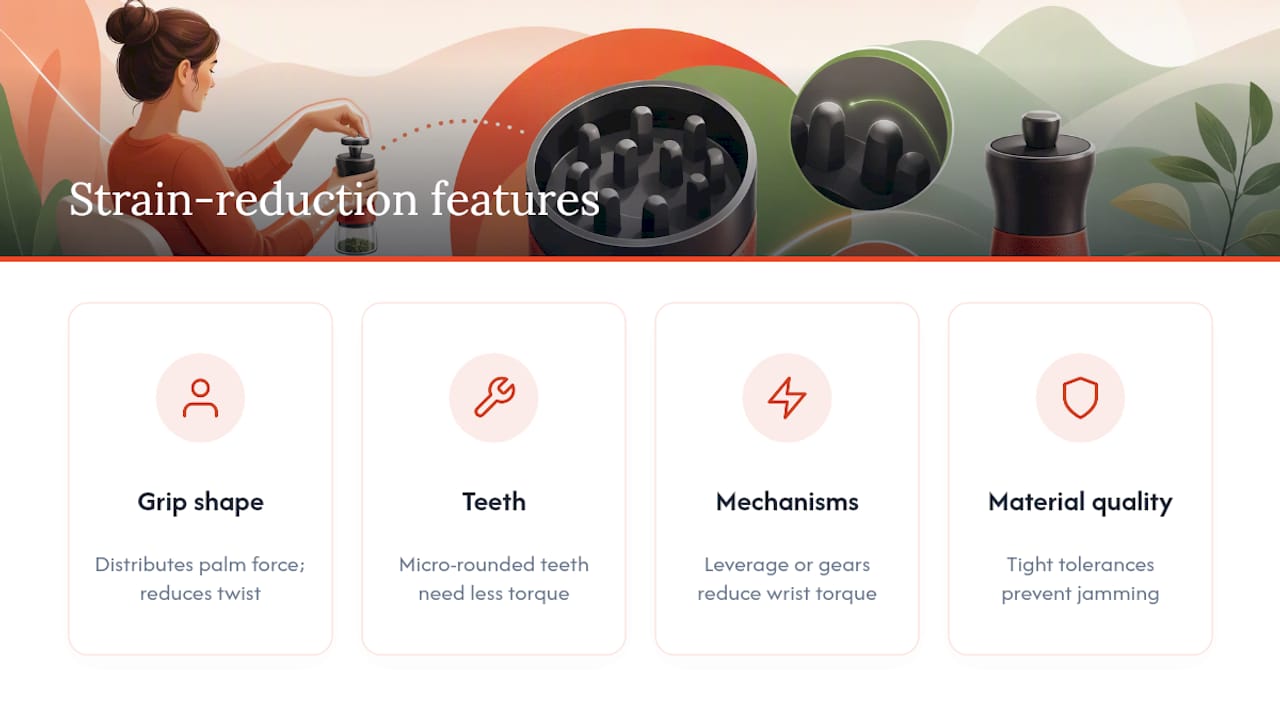
Grip shape and lid design matter more than most buyers expect. Contoured or square lids with beveled edges give your palm more surface area to push against, distributing force instead of concentrating it in your fingertips. Product reviews of grinders like the Krush Kube point to square, well-finished lids as a direct driver of easier grip and reduced twisting effort, though that particular model is a UK product worth using as a design reference rather than a purchase target.
Tooth and milling geometry is the second lever. Sharp, pointed teeth cut through material and require more torque to force through dense buds. Micro-rounded teeth and mill-plate designs need less force for the same result, which is why they show up in most higher-end ergonomic models.
Effort-reduction mechanisms vary by budget and need. Large-diameter lids multiply leverage the same way a longer wrench handle does, letting you apply less wrist torque for the same grinding work, a tradeoff Wirecutter’s testing highlights when comparing manual designs. Geared or crank-assisted mechanisms take that further, and electric mills remove manual effort entirely, which matters most for users with severe grip limitations or retailers processing large volumes daily.
Materials and machining quality determine whether those benefits last. Anodized aluminum with tight tolerances and smooth threading resists jamming far longer than cheaper composite builds, keeping the grinder easy to twist months after purchase instead of just on day one.
Who Actually Benefits Most From an Ergonomic Grinder?
Not every user needs the same features, but a few groups see outsized returns on switching from a standard grinder.
- Medical patients with arthritis or limited dexterity gain the most, since a lower-torque design can mean the difference between prepping their own medicine and needing help every time.
- Retailers and pre-roll producers benefit from speed and repeatability. Grinding the same texture batch after batch matters more to a shop counter than to a solo user grinding once a day.
- Frequent recreational users and hosts notice less hand fatigue during longer sessions, especially when grinding for a group.
- Caregivers handling prep for someone else appreciate a cleaner, lower-effort process that doesn’t turn a routine task into a chore.
- Consumption method matters too. Vaporizer users typically want a finer, more uniform grind, while bowl smokers can tolerate a slightly coarser texture, and that affects which tooth geometry and chamber design fits best.
As Treelockbox’s own guide to ergonomic tools for limited-dexterity users points out, the right fit depends less on brand name and more on matching torque and grip design to the user’s actual hand strength.
How to Choose the Right Ergonomic Grinder
Buying on marketing language alone is how people end up with a grinder that’s “ergonomic” in name only. Work through a short checklist instead.
- Grip design. Look for contoured or square lids with beveled edges, not a flat disc you have to pinch.
- Torque required. Ask how much force the tooth geometry and lid diameter demand. Larger lids and rounded teeth mean less twisting.
- Tooth geometry. Sharp teeth shred; rounded or milled teeth separate. The second option preserves terpenes and reduces effort.
- Capacity and chamber count. More chambers add convenience but also add bulk. A smaller, lower-resistance grinder can beat a large one that demands a strong twist, a tradeoff Treelockbox’s best ergonomic tools guide flags specifically for medical users.
- Materials and finish. Anodized aluminum with smooth threading outlasts cheaper composite builds.
- Warranty and return policy. A company confident in its machining will back it with a real warranty.
Before buying, ask the seller directly about motor assistance (if electric), replacement part availability, and shipping and return terms. Electric mills remove effort almost entirely but add noise, upkeep, and cost. Manual designs stay portable and quiet but rely more on lid diameter and tooth shape to keep torque low.
Pro Tip: Spin the grinder’s lid a few times in the store or check return policy language before buying online. Rough threads, rattling internals, or teeth that snag instead of glide are red flags no amount of “ergonomic” branding can fix.
Keeping Your Grinder Easy to Use Over Time
Even the best ergonomic design degrades if you skip maintenance. Resin and kief buildup are the main culprits behind a grinder that used to spin smoothly and now fights you at every turn.
- Clean your grinder every one to two weeks with regular use, more often for daily high-volume prep.
- Use a soft brush or isopropyl alcohol for teeth and threads, and avoid harsh solvents that can degrade seals or anodized coatings.
- If you lubricate moving parts, Treelockbox recommends just two to four drops of a food-safe lubricant, applied sparingly.
- Store your grinder closed and dry to prevent kief from hardening into a paste that clogs threads.
- Watch for stripped threads, loose bearings, or teeth that no longer bite cleanly. These are signs it’s time to repair or replace, not just clean harder.
Routine care preserves both hygiene and the smooth operation that makes a grinder ergonomic in the first place, a point Treelockbox’s own grinding guide covers step by step for readers who want a maintenance routine that actually sticks.
The Treelockbox Take on Ergonomic Prep Tools
Treelockbox builds ergonomic grinders and no-touch prep tools around one idea: reducing hand strain shouldn’t mean sacrificing grind quality. Pair that with the grinding techniques covered in our how-to guide, and prep becomes less about effort and more about consistency.
— Tree Lock Box
Shop Ergonomic Grinders Built for Real Hands
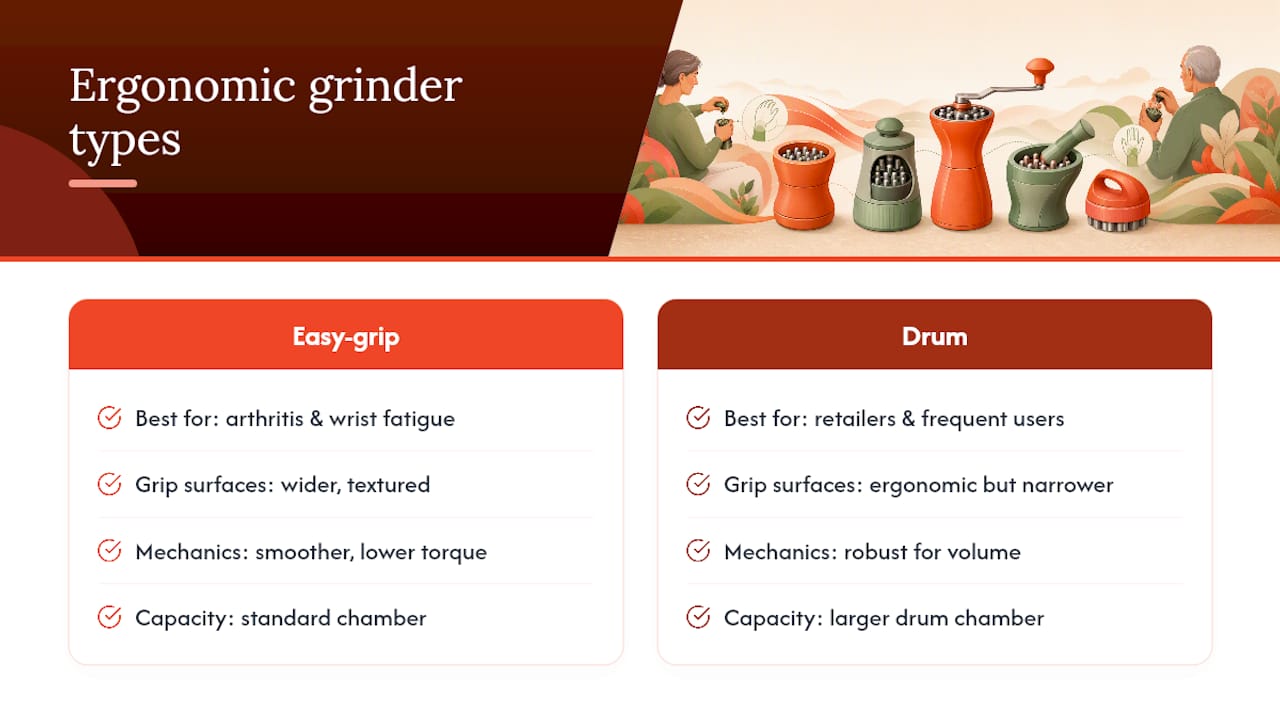
Treelockbox designs its ergonomic grinders around the same principle covered throughout this guide: lower torque, better grip, cleaner results. If arthritis, wrist fatigue, or high-volume prep has made grinding a chore, the easy-grip ergonomic grinder is built with wider grip surfaces and smoother mechanics specifically for that problem. Retailers and frequent users who need more capacity per load can compare the ergonomic drum grinder for a different chamber setup. Every product ships with secure checkout and American craftsmanship behind it. Browse the full lineup on the Treelockbox shop to find the grip, capacity, and price point that fits how you actually prep.
Sources
FAQ
Do Ergonomic Grinders Really Reduce Wrist Pain?
Yes. Wider grips, larger lid diameters, and rounded tooth geometry lower the torque needed to grind, which directly reduces strain on the wrist and fingers.
Are Ergonomic Grinders Worth It for Occasional Users?
If you grind more than a few times a week, the reduced effort and faster prep typically justify the cost, though occasional users may not notice as much difference as daily users or retailers.
What Grinder Features Matter Most for Arthritis?
Look for contoured or square grips, large-diameter lids, and rounded teeth. Treelockbox’s ergonomic herb grinder targets exactly this combination for users with limited dexterity.
How Often Should I Clean My Grinder?
Every one to two weeks with regular use, and more frequently for daily high-volume prep, since resin buildup increases resistance and undoes ergonomic benefits over time.
Is Electric or Manual Better for Limited Hand Strength?
Electric mills remove manual effort entirely and suit severe grip limitations, while a well-designed manual grinder with rounded teeth and a large lid can still be plenty comfortable for moderate strain concerns.