

Avoid Uneven Burns: Grinder Tooth Design for Consumers & Dispensaries
Diamond and pyramid teeth cut flower into a fine, even texture and remain the most versatile choice for most consumers, while shark fin and blade profiles tear out coarser, less consistent pieces better suited to pipes than cones. Square peg teeth mostly crush rather than slice, so output varies from grind to grind. For most buyers, a well-machined aluminum grinder of medium size with diamond-cut teeth delivers the best balance of consistency, kief yield, and durability.
TL;DR:
- Diamond and pyramid teeth offer the most consistent, fine grind suitable for cones, pre-rolls, and pipes, with hourglass variants improving airflow.
- Tooth shape affects particle size, burn quality, and kaief yield, with slicing shapes providing more uniform particles and higher trichome preservation.
- CNC-machined, anodized aluminum enhances durability and maintains sharpness longer than stamped or molded softer metals, especially with sticky flower.
- More teeth increase grind fineness but require proper spacing to prevent clogging and ensure effective cutting, particularly for solo or group use.
- Regular maintenance, including freezing and gentle cleaning, extends tooth lifespan, with sharp angles and proper material choice crucial for long-term performance.
Table of Contents
- What Are the Main Grinder Tooth Designs?
- How Tooth Shape Changes Texture, Kief, and Burn Quality
- Material, Machining, and Keeping Your Teeth Sharp
- Matching Tooth Design to Your Packing Method
- How Precise Machining Shapes Tooth Performance
- Which Tooth Shapes Actually Hold Up Over Time
- Why Tooth Angle and Sharpness Change How Hard You Have to Twist
- Ergonomic Considerations Beyond the Cutting Edge
- What’s New in Tooth Shape and Material
- Why Treelockbox Builds Around Diamond-Cut Teeth
- Ready to Upgrade Your Grinder?
- Sources
- FAQ
What Are the Main Grinder Tooth Designs?
Every grinder tooth design comes down to one of three basic mechanics: slicing, tearing, or crushing. The shape stamped, cast, or machined into the grinding chamber decides which one you get, and that decision shows up the moment you twist the lid.
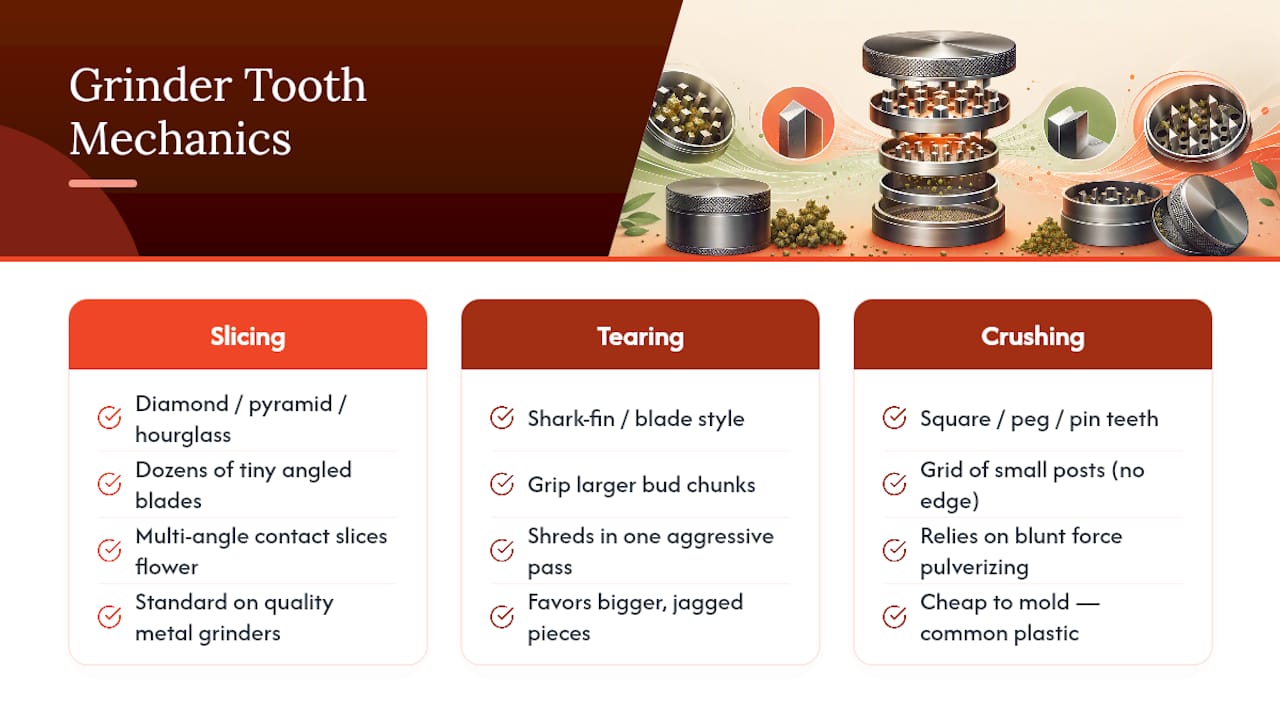
Diamond, pyramid, and hourglass teeth work like dozens of tiny angled blades. Each raised point slices flower as the chamber rotates, cutting from multiple directions instead of just smashing down on it. That multi-angle contact is why diamond-cut teeth show up as the standard on nearly every quality metal grinder on the market. Hourglass variants, a tapered version of the same idea, tend to move air more freely between the teeth, which cuts down on clogging on premium models.
Shark fin and blade-style teeth grip larger chunks of bud and shred them in one aggressive pass. The geometry favors bigger, jagged pieces over uniform particles, which is exactly why this profile tends to produce a coarser, chunkier grind.
Square, peg, or pin teeth rely almost entirely on blunt force. There’s no cutting edge to speak of, just a grid of small posts that pulverize whatever gets caught between them. It’s a cheap shape to mold, which is why it shows up so often in plastic and acrylic grinders, and it explains why the grind coming out the bottom rarely looks the same twice.
Some manufacturers now blend elements from two or three of these families, adding curved relief channels or staggered rows to cut clogging and improve airflow without sacrificing the slicing action that makes diamond and pyramid shapes reliable.
How Tooth Shape Changes Texture, Kief, and Burn Quality
The mechanical action of a tooth shape doesn’t just change how the grinder feels in your hand. It changes what comes out the bottom and how that flower behaves once it’s packed and lit.
Cutting shapes like diamond and pyramid produce a tighter particle-size range because every piece gets sliced by roughly the same number of edges on the way through. Crushing shapes like square peg produce a wider spread, some pieces powdered, others barely broken, because force gets applied unevenly across the chamber. That inconsistency matters more than people expect:
- Even burn: uniform particle size means airflow moves consistently through a packed bowl or joint, so it burns at a steady rate instead of canoeing on one side.
- Trichome preservation: slicing action tends to shear trichomes off cleanly into a kief screen rather than knocking them loose and scattering them, which is one reason cutting-style teeth generally outperform crushing designs on kief yield.
- Pre-roll machine reliability: automated pre-roll equipment is calibrated for a specific particle range, and grind that’s too coarse or too inconsistent jams feed mechanisms or leaves gaps in the cone.
- Tooth count and spacing: more teeth generally means a finer grind, but spacing and geometry carry just as much weight as raw tooth count, since tightly packed teeth without enough clearance just compact flower instead of cutting it.
Dense, sticky flower behaves differently than dry, brittle flower under the same tooth design, which is why packing method and flower type both belong in the decision, not tooth shape alone.
Material, Machining, and Keeping Your Teeth Sharp
Tooth geometry only performs as designed when the material and machining behind it hold up. A diamond-cut pattern stamped into thin, soft aluminum or molded into acrylic dulls fast and starts crushing instead of slicing within a few months of regular use. That’s why a well-machined CNC aluminum grinder generally outperforms a cheaper unit even when the cheaper one advertises a fancier-looking tooth pattern. Precision matters more than the shape on the spec sheet.
Sticky, resinous flower is harder on teeth than dry flower, since resin coats the cutting edges and accelerates wear on softer metals faster than on hardened, anodized aluminum. Tight-spaced or narrow-throat tooth designs clog fastest under resin buildup and need more frequent attention, a pattern that shows up consistently with close-set tooth geometry.
Keeping teeth performing well takes three simple habits:
- Freeze the grinder for 20 to 30 minutes, then tap it firmly over a paper towel to loosen dried resin without touching a brush to sticky material.
- Soak metal components in isopropyl alcohol for stubborn buildup, then scrub gently with a nylon brush and rinse thoroughly before reassembly.
- Check the teeth every few months for rounded tips or a duller edge. If the grind starts coming out uneven or noticeably coarser than it used to, the teeth have likely worn past their effective life.
Pro Tip: Never use metal brushes or sharp picks to scrape resin off teeth. Metal-on-metal contact rounds off cutting edges faster than resin buildup ever would.
Matching Tooth Design to Your Packing Method
The right tooth shape for grinders depends far more on what you’re packing than on which shape looks the most advanced in a product photo. The smartest approach is matching geometry to your actual routine rather than chasing novelty.
- Hand-packing cones or using a pre-roll machine: diamond or pyramid teeth are the clear fit, since these shapes are consistently recommended for the fine, even consistency cones and machines both need.
- Pipes, bowls, and loose-pack sessions: shark fin or blade teeth work fine here, since a coarser grind burns slower in an open bowl and doesn’t need the precision that a rolled paper demands.
- Avoid square peg teeth for cones: the inconsistent output tends to leave gaps or clumps that burn unevenly once rolled.
On tooth count and spacing, more teeth generally sharpen the grind, but only if spacing leaves enough clearance for flower to actually pass through and get sliced rather than just compacted against the wall. A 50mm grinder suits solo users who grind small amounts often; 63mm suits anyone prepping for multiple sessions or sharing among a group.
The trade-offs are straightforward: finer grinds need more frequent cleaning since compacted material clogs tighter tooth spacing faster, and grinders with strong kief catchers usually cost more upfront but pay that back over months of accumulated kief. Pricing expectations should track build quality, not tooth pattern alone, a distinction covered in more depth in Herb Grinder Price Range.
How Precise Machining Shapes Tooth Performance
Cutting a diamond or pyramid tooth pattern into a metal grinder chamber is a precision manufacturing job, not a casual stamping process. CNC machining cuts each tooth to a tolerance measured in fractions of a millimeter, which keeps every point at the same height and angle around the entire chamber. That consistency is what lets the teeth interlock cleanly when the grinder twists, so every rotation slices flower the same way instead of missing spots or over-crushing others.
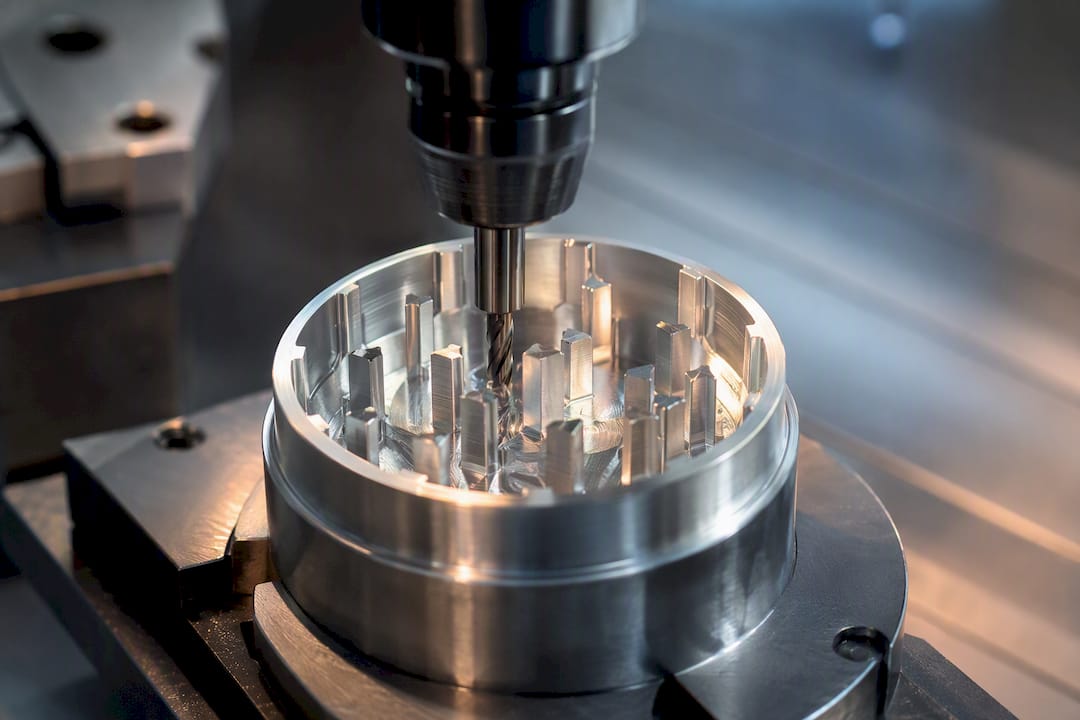
Cheaper manufacturing methods, like injection molding plastic or die-casting soft metal alloys, can’t hold that same tolerance. Molds wear down after repeated use, so later production runs often have slightly duller or less uniform teeth than the first batch off the line. That’s part of why two grinders with an identical tooth pattern on paper can perform noticeably differently once you actually load flower into them.
Anodizing adds another manufacturing step that matters more than most buyers realize. The process hardens the aluminum surface, which helps the cutting edges resist the rounding and pitting that resin and repeated twisting cause over time. A grinder that skips this step, even with a well-cut tooth pattern, tends to dull faster under regular use.
Tighter tolerances also affect how well the three chamber pieces align when assembled, since misaligned teeth between the top and bottom grinding plates create gaps that let larger chunks slip through unground.
Which Tooth Shapes Actually Hold Up Over Time
Durability tracks more closely with material and manufacturing than with tooth shape on its own, but shape still plays a real role once you’re grinding several times a week for months or years.
Diamond and pyramid teeth distribute cutting force across many small points rather than concentrating it on a few edges, which spreads wear more evenly across the chamber. Shark fin and blade teeth concentrate stress on fewer, larger cutting surfaces, so those edges tend to show visible dulling sooner under heavy, repeated use, especially with sticky flower that coats and grinds down the edge faster.
Square peg and pin teeth hold up differently because they were never meant to cut in the first place. Blunt posts don’t dull the way an edge does, but they can bend, chip, or snap off entirely under repeated stress, particularly on cheaper plastic and acrylic units where the material itself fatigues over time.
Anodized aluminum with diamond-cut teeth generally outlasts unanodized metal or plastic alternatives by a wide margin, since the hardened surface resists the microscopic rounding that eventually turns a sharp tooth into a dull nub. Grinders that see daily use in a busy household or a retail demo setting will show that wear pattern faster than one used a few times a week, which is worth factoring in for dispensaries stocking display units or loaner grinders.
Why Tooth Angle and Sharpness Change How Hard You Have to Twist
The angle cut into each tooth determines how much force it takes to shear through flower, and that difference is noticeable the first time you switch between grinder types. A sharper, more acute angle slices with less resistance, so the lid turns smoothly even when the chamber is packed tight. A blunter angle, common on crushing-style square peg teeth, needs more downward pressure and more twisting force to break flower apart, since there’s no real edge doing the work.
That difference isn’t just about comfort. Grinders that require more effort tend to get used less consistently, and flower ground under uneven, forced pressure comes out with worse particle consistency than flower cut with a sharp, well-angled tooth. Dense or slightly under-cured flower makes this gap more obvious, since a dull or blunt tooth angle struggles to shear through denser plant matter and instead mashes it into clumps.
Sharpness fades with use regardless of angle, and a grinder that once turned with two fingers can start demanding a full-hand grip after months of resin buildup rounds off the cutting points. That’s one more argument for the maintenance habits covered earlier: a clean, sharp tooth edge keeps the twisting effort low, while a neglected one turns every grind into a small workout.
Ergonomic Considerations Beyond the Cutting Edge
Tooth design affects more than what happens inside the chamber. It changes how much resistance your hand feels with every twist, which matters more than people assume during a quick daily grind. Sharper, angled teeth like diamond and pyramid cut with less resistance, so the lid turns smoothly with light pressure. Blunter crushing teeth demand a firmer grip and more torque, which adds up for anyone grinding multiple times a day or dealing with hand strain, arthritis, or limited grip strength.
Grinder diameter interacts with tooth design here too. A wider chamber with well-spaced diamond teeth spreads resistance across more surface area, so each twist feels lighter than a narrow chamber packed with the same amount of flower. That’s part of why an ergonomic grinder built with easy-grip features pairs a cutting-style tooth pattern with a wider grip surface, reducing the twisting force needed for anyone who grinds frequently or has reduced hand mobility.
Weight and material also factor in indirectly. A well-machined aluminum grinder with sharp diamond teeth requires fewer rotations to finish a grind than a dull, blunt-toothed plastic alternative, meaning less total hand strain per session even though the metal unit is heavier to hold.
What’s New in Tooth Shape and Material
The most active area of grinder tooth engineering right now isn’t inventing new shapes from scratch. It’s refining airflow and anti-clog geometry around the proven diamond and pyramid patterns. Hourglass profiles, a tapered evolution of the diamond cut, are gaining traction because the narrowing shape improves airflow between teeth and reduces the resin bridging that causes clogs on tighter-spaced designs.
Titanium coatings are showing up more often on mid-tier and premium grinders, since a titanium-coated cutting edge resists dulling longer than bare anodized aluminum, particularly with sticky, high-resin flower that wears down softer edges faster. Some manufacturers are also experimenting with staggered, multi-row tooth layouts that combine a coarser first pass with a finer second pass in the same chamber, aiming to cut flower progressively rather than relying on a single uniform tooth pattern throughout.
None of these innovations replace the fundamentals. A well-angled, precisely machined diamond or pyramid tooth on quality aluminum still outperforms a novel-shaped tooth cut into cheap material. The trend is refinement around a proven design, not a replacement for it.
Why Treelockbox Builds Around Diamond-Cut Teeth
Diamond-cut teeth on well-machined aluminum grinders are among the preferred options for delivering an even, fine grind suitable for hand-packed cones and everyday sessions.
For readers comparing formats, Top 5 Weed Grinder Options breaks down real product choices, while How to Grind Weed Properly covers technique that pairs with the right tooth geometry.
— Tree Lock Box
Ready to Upgrade Your Grinder?
If the guidance above pointed you toward a diamond-cut aluminum grinder, Treelockbox carries options built around exactly that specification, including an ergonomic drum grinder designed for consistent tooth spacing and easy kief collection. For anyone who wants a lower-contact routine alongside a sharper grind, the No-Touch Cannabis Prep Guide walks through pairing a quality grinder with tools that keep your hands off the flower entirely. Maintenance questions, from cleaning frequency to spotting worn teeth, are answered in the Cannabis Tools FAQ. Browse the full lineup on the Treelockbox shop page and pick a grinder sized for how often you actually pack.
Sources
- A 2026 Guide to Choosing the Right Cannabis Grinder | The Purple Leaf
- Weed Grinder Teeth Types: Shapes, Grind, And Durability – Green Blazer
- Why Do Herb Grinders Have Different Tooth Shapes? Teeth Explained – Bongs Mart AU
FAQ
What Is the Best Tooth Shape for Most Grinders?
Diamond and pyramid teeth suit most users best because they slice flower into a fine, even texture that works for cones, pipes, and pre-roll machines alike.
Do More Teeth Always Mean a Finer Grind?
Generally yes, but spacing and geometry matter just as much as raw count, since packed-too-tight teeth compact flower instead of cutting it.
How Often Should I Clean My Grinder’s Teeth?
Clean metal teeth every few weeks with a freeze-and-tap method, and do a deeper isopropyl soak every few months if you notice slower turning or visible resin buildup, a routine detailed further in the Cannabis Tools FAQ.