

Herb Grinder Price Range: What to Spend and Why
Herb grinders in the U.S. run from about $6 for a bare-bones acrylic piece up to $150 or more for precision-machined titanium. For most buyers, the right answer lands in the $25–$50 range: an anodized aluminum 4-piece with diamond-cut teeth, a kief catcher, and threading that won’t strip after a month. Here’s how the full grinder price range breaks down:
- Budget ($10–$30): Zinc alloy or acrylic construction, 2-piece or basic 3-piece, no kief catcher, short lifespan (6–12 months with daily use)
- Entry/Mid ($30–$70): CNC-machined aluminum, 4-piece with kief catcher, stainless screen, solid magnet, 2–5 years of reliable use
- Premium ($70–$130): Aerospace-grade 6061-T6 aluminum, stainless steel, or titanium; tighter tolerances, superior anodization, 5+ years
- Specialty/Electric ($30–$150+): Toothless mills, electric grinders, or engraved custom pieces; price depends heavily on material and mechanism
Most buyers should spend $25–$50. That band gets you a genuinely durable tool without paying for a brand premium that adds little to daily function.
Key Takeaways
The $25–$50 anodized aluminum 4-piece is the right grinder for most U.S. buyers: durable, kief-catching, and priced without a brand premium.
| Point | Details |
|---|---|
| Sweet spot price band | $25–$50 buys a CNC-machined aluminum 4-piece with a kief catcher and stainless screen. |
| Materials to avoid | Zinc alloy and acrylic shed or crack; stick to anodized aluminum, stainless, or titanium. |
| When to spend premium | Daily heavy use or medical patients benefit from $50–$100 stainless; longevity justifies the cost. |
| Wholesale baseline | Mid-tier grinders wholesale at roughly $12–$30/unit with MOQs typically starting at 24–50 units. |
| Treelockbox recommendation | The ergonomic model suits medical and accessibility needs; the standard 4-piece fits most daily users. |
Table of Contents
- What does each price level actually get you?
- What actually drives the price up?
- Which price band fits your situation?
- What should dispensaries and retailers expect to pay wholesale?
- How to buy a grinder without regretting it
- How long should a grinder last, and when should you replace it?
- Treelockbox grinder options worth considering
- The case for spending in the middle
- Treelockbox grinders: built for daily use and dispensary shelves
- Sources
- FAQ
What does each price level actually get you?
The jump from $15 to $35 is the most consequential in the whole grinder price range. Below $20, you’re typically looking at zinc alloy or acrylic. Zinc alloy can shed microscopic metal shavings over time; acrylic cracks under cold or pressure. Neither is a material you want near flower you’re about to consume.
Cross into the $30–$70 band and the picture changes. CNC machining becomes standard, which means threads that glide instead of catch, teeth that stay sharp, and a magnet strong enough to hold the lid through a bag toss. Mid-range grinders at this level typically use anodized aluminum, which resists corrosion and doesn’t react with resin buildup the way raw metal does. A stainless mesh screen in the kief chamber is the other key upgrade: it holds its shape through cleaning cycles instead of warping or tearing.
Premium grinders offer improved longevity and tactile experience, with materials like titanium and stainless steel being harder to damage and tighter machining tolerances. Hands-on testing of grinders priced $6–$130 confirms that the tactile difference between a $40 aluminum grinder and a $120 titanium one is real and obvious in person. Whether that difference justifies three times the price depends entirely on how often and how hard you use it.
Toothless mills occupy their own lane. Instead of metal teeth, they use ridged plates that tumble flower rather than shear it. The result is a fluffier, more aromatic grind that preserves trichomes better. Aluminum mill options start around $30, with stainless versions closer to $75, making them a specialty mid-range buy rather than a luxury.
Material quick-reference:
- Acrylic: Cheapest, cracks easily, avoid for daily use
- Zinc alloy: Common under $20, shedding risk, short lifespan
- Anodized aluminum: Best value, corrosion-resistant, 2–5 years
- Stainless steel: Heavier, very durable, 5–10 years
- Titanium: Lightest strong option, longest lifespan, highest cost
What actually drives the price up?
Manufacturing process is the biggest lever. A grinder cut on a CNC lathe from a single aluminum billet costs more to produce than one cast from zinc alloy in a mold, and it shows in thread quality and tooth sharpness. Aerospace-grade 6061-T6 aluminum is the material benchmark: it machines cleanly, anodizes well, and doesn’t corrode or shed.
After material and machining, the factors that add cost include:
- Screen quality: Stainless mesh holds calibration; cheap nylon or thin metal warps and clogs
- Tooth design: Diamond-cut teeth stay sharper longer than stamped or cast teeth
- Anodization depth: Thicker anodizing resists scratching and resin adhesion
- Magnetic lid: A strong rare-earth magnet costs more than a friction fit but prevents spills
- Plate design: Interchangeable grinding plates or clear acrylic windows add assembly cost
- Electric motors: Battery-powered grinders add $20–$60 to base price depending on motor quality
Pro Tip: Before paying for a premium feature, ask whether it solves a real problem you have. A clear window is nice; a stainless screen that survives weekly isopropyl cleaning is necessary. Prioritize the latter.
Which price band fits your situation?
| Use Case | Recommended Price | Material | Key Features | Expected Lifespan |
|---|---|---|---|---|
| Casual/occasional | $10–$25 | Aluminum or quality zinc | 2-piece or 3-piece, basic magnet | 1–3 years |
| Daily recreational | $25–$50 | Anodized aluminum | 4-piece, kief catcher, stainless screen | 3–5 years |
| Heavy/medical daily | $50–$100 | 6061-T6 aluminum or stainless | 4-piece, tight tolerances, strong magnet | 5–8 years |
| Trichome preservation | $30–$75 | Aluminum or stainless mill | Toothless mill design, fluffy grind | 3–7 years |
| Gifting/display | $40–$100 | Anodized aluminum, custom engraving | Engraved lid, premium finish | 5+ years |
| Arthritis/ergonomic needs | $35–$60 | Anodized aluminum | Wide grip, easy-turn drum design | 3–5 years |
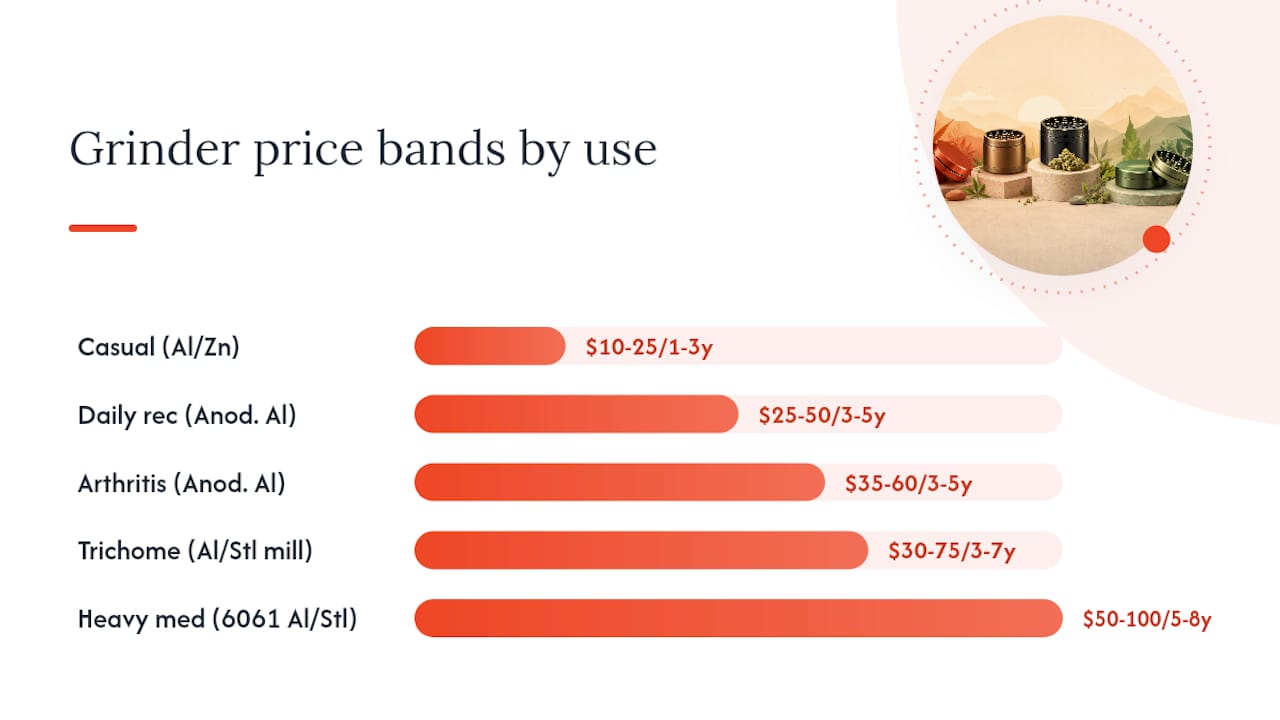
For medical patients who grind multiple times daily, the $50–$100 range pays off through durability alone. A $20 grinder replaced every six months costs more over two years than a $60 grinder that runs for five.
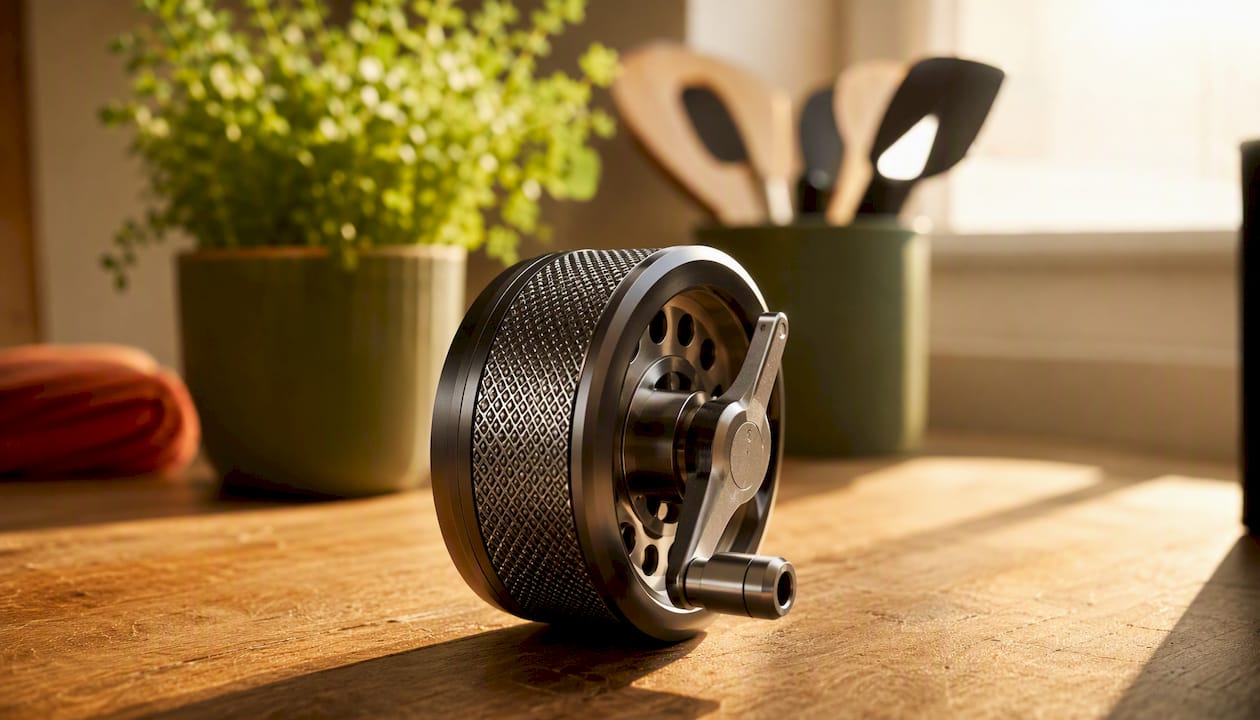
Pro Tip: If arthritis or limited hand strength is a factor, look specifically for a drum-style ergonomic grinder with a wide, textured grip surface. The wider the diameter, the less torque your wrist needs to apply.
What should dispensaries and retailers expect to pay wholesale?
Wholesale pricing follows the same tier logic, compressed. Premium grinders retailing at $70–$120 often wholesale at $30–$55 per unit.
Typical wholesale structure by tier:
- Budget tier (retail $10–$30): Wholesale $5–$14/unit, MOQ often 50–100 units
- Mid-tier (retail $30–$70): Wholesale $12–$30/unit, MOQ typically 24–50 units
- Premium tier (retail $70–$130): Wholesale $30–$60/unit, MOQ often 12–24 units
A simple example: a mid-tier grinder at $18 wholesale, sold at $45 retail, yields a $27 gross margin per unit. At a 24-unit MOQ, that’s a $432 initial investment returning roughly $648 in retail revenue before other costs.
Pro Tip: Ask suppliers for lead time commitments in writing before placing a wholesale order. A 4–6 week lead time is standard for American-made or quality-controlled products; anything faster from an unknown source warrants scrutiny on QC.
Dispensaries should also confirm whether the supplier offers custom engraving or branded packaging at wholesale, since branded accessories drive repeat recognition at the display case.
How to buy a grinder without regretting it
- Check the material first. If the listing doesn’t specify aluminum grade or says “metal alloy” without detail, treat it as zinc alloy until proven otherwise.
- Read the threading description. Look for “CNC-machined” or “precision-threaded.” Vague listings often mean cast threads that strip quickly.
- Verify screen specs. A stainless mesh screen is worth the extra few dollars. Avoid grinders that don’t mention screen material.
- Look for a real warranty. A 30-day return window is a minimum; a satisfaction guarantee or replacement policy signals the brand stands behind build quality.
- Buy from a source with clear specs. Marketplaces with third-party sellers often mix quality tiers under identical listings. Buying direct from a brand or a verified U.S. retailer gives you recourse if the product doesn’t match the description.
- Bundle when it makes sense. Pairing a grinder with a lockable stash box often saves money versus buying separately, and it solves storage at the same time.
Pro Tip: Holiday sales (Black Friday, 4/20) are the best windows for buying premium grinders at mid-range prices. Set a price alert or check brand sites directly rather than marketplace aggregators, where “sale” prices are often inflated baselines.
How long should a grinder last, and when should you replace it?
Aluminum grinders cleaned monthly with isopropyl alcohol and a brush last 3–5 years under daily use. Stainless and titanium extend that to 7–10 years with the same care. Wood grinders need dry brushing only; liquid cleaners raise the grain and warp the fit.
Routine cleaning by material:
- Aluminum: Freeze for 30 minutes to harden resin, then brush; monthly isopropyl soak for deep cleaning
- Stainless/titanium: Isopropyl soak, rinse, air dry; can tolerate more frequent cleaning without surface damage
- Wood: Dry brush only after each session; never soak
Signs it’s time to replace or repair:
- Threads feel loose or cross-thread on closing
- Visible metal shavings in the grinding chamber
- Screen has tears, holes, or permanent clogging that cleaning won’t fix
- Magnet no longer holds the lid securely
- Teeth are visibly rounded or broken
A higher upfront spend pays off precisely here. A $20 grinder showing stripped threads at 8 months is a replacement cost; a $50 grinder with the same issue at 4 years has already delivered its value many times over.
Treelockbox grinder options worth considering
Treelockbox offers two grinder SKUs built for the mid-range sweet spot, both backed by clear specs and wholesale availability.
-
Tree Lock Box Ergonomic Herb Grinder (Easy-Grip): Designed specifically for users who need a wider, easier-to-turn grip, including those managing arthritis or limited hand strength. The drum-style body provides more surface contact than a standard cylinder, reducing the torque needed per grind. Available at Treelockbox’s ergonomic grinder page with specs, pricing, and wholesale inquiry options. Best fit: medical patients, daily users with accessibility needs, and dispensaries stocking for a medical customer base.
-
Tree Lock Box Herb Grinder (standard model): A 4-piece anodized aluminum grinder with a kief catcher, sitting in the $25–$50 mid-range band. Solid threading, magnetic lid, and American craftsmanship. Best fit: daily recreational users and dispensaries looking for a reliable mid-tier SKU with margin room.
Both models are available for wholesale inquiry through the Cannabis Tools FAQ page, which also covers care, storage pairing, and prep tool guidance for buyers and retailers.
The case for spending in the middle
The conventional advice to “buy the best you can afford” misses something specific to grinders: the performance ceiling arrives early. A well-machined $40 aluminum grinder produces a grind that’s functionally indistinguishable from a $120 titanium one for most users. What the premium buys is longevity and feel, not a meaningfully different result in the bowl.
Where spending up genuinely matters is ergonomics and accessibility. A user who struggles with a standard grinder’s narrow grip isn’t getting a luxury upgrade with an ergonomic model; they’re getting a tool that actually works for them. That’s a different calculation than chasing titanium for its own sake.
Treelockbox’s position is straightforward: mid-range aluminum with clear specs, a real warranty, and wholesale support is the right answer for most buyers. The ergonomic model extends that to users who need it. Neither requires a premium price to deliver real value.
Treelockbox grinders: built for daily use and dispensary shelves
Treelockbox’s grinders land exactly where this article’s research points: mid-range price, American craftsmanship, and specs you can actually verify before buying. The standard 4-piece aluminum grinder fits the $25–$50 sweet spot that outperforms budget options without the markup of premium tiers. The ergonomic model fills a gap most brands ignore entirely, giving medical patients and accessibility-focused buyers a tool designed around their grip, not an afterthought. Both are available for individual purchase or wholesale inquiry. Browse the full lineup and check current pricing at the Treelockbox shop, or go straight to the ergonomic grinder if accessibility is the priority.
Sources
External references:
- Herb Grinder Guide: Types, Materials & How to Use
- The Best Cannabis Grinder
- Best Cannabis Grinders: The Complete Buyer’s Guide – Camouflet
- Best Cannabis Grinders 2026: From Budget to Premium | Learn | This Is Why I’m High
- What Are Grinders? Cannabis Grinder Guide - Social Dispensary
- The Best Cannabis Grinder — Business Insider
Treelockbox pages:
FAQ
What is the typical grinder price range in the U.S.?
Herb grinders run from about $6 for basic acrylic up to $150 for premium titanium. Most buyers find the best value between $25 and $50 for a 4-piece anodized aluminum grinder with a kief catcher.
Is a $20 grinder worth buying?
At $20 or below, most grinders use zinc alloy or acrylic, which can shed material or crack under regular use. Spending $30–$35 gets you a meaningfully better build with CNC machining and a stainless screen.
What grinder works best for arthritis or limited hand strength?
A drum-style ergonomic grinder with a wide, textured grip reduces the torque needed to grind. Treelockbox’s ergonomic model is designed specifically for this use case and sits in the $35–$60 range.
How much do grinders cost at wholesale for dispensaries?
Mid-tier grinders (retail $30–$70) typically wholesale at $12–$30 per unit, with MOQs starting around 24–50 units. Premium tiers wholesale at $30–$60 per unit with lower MOQs.
Does a kief catcher justify a higher price?
For daily users, yes. A kief catcher recovers trichome-rich material that would otherwise be lost, and that recovered concentrate adds up quickly enough to offset the modest price difference between a 2-piece and a 4-piece grinder.