

Cannabis Users: Clean Your Grinder First, Lubricate Only 2–4 Drops
Cleaning is the correct first move for a sticky grinder, not lubricant. Resin buildup, not friction, causes the grinding plates to jam, and a proper soak or scrape solves that almost every time. If you still want smoother turning after cleaning, a specialty grinder lubricant applied in very small amounts at the outer rim can help, but only if you wipe away every trace of excess before loading flower again.
TL;DR:
- Resin buildup, not lubrication, causes grinder jams; freezing followed by tapping and scraping is the most effective cleaning method.
- Specialty grinder lubricants are meant for quick touch-ups and should be used sparingly only after a thorough clean and never as a primary solution.
- Using cooking oils, WD-40, or industrial greases damages the grinder and can contaminate the flower, so only food-safe or cannabis-specific lubricants are recommended.
- Regular cleaning after each session and periodic deep cleans every 1 to 4 weeks prevent resin buildup and maintain optimal grinding performance.
- A grinder that is easy to disassemble encourages regular cleaning, reducing the need for lubricants or aggressive maintenance.
Table of Contents
- How to Clean a Weed Grinder Before You Even Think About Oil
- What Are Specialized Grinder Lubricants, and Do They Actually Work?
- What Not to Put in Your Grinder (and Why It Backfires)
- How Do You Apply Grinder Lubricant Without Contaminating Your Flower?
- How Often Should You Clean a Weed Grinder?
- Our Take: Clean First, Lubricate Only as a Last Resort
- Gear That Makes Grinder Maintenance Easier
- Sources
- FAQ
How to Clean a Weed Grinder Before You Even Think About Oil
A grinder that grinds slower than it used to almost always has a resin problem, not a lubrication problem. Cannabis resin is sticky at room temperature and turns brittle when cold, which is exactly why the freezer trick works so reliably.
Here’s the sequence that actually gets a jammed grinder spinning freely again:
- Freeze it. Put a metal grinder in the freezer for 30 to 60 minutes. Cold makes resin brittle instead of gummy.
- Tap and scrape. Remove it, tap it firmly on a towel-covered counter, then use a wooden toothpick, plastic scraper, or old toothbrush (never metal) to knock loose the flakes.
- Soak for stubborn residue. Disassemble the grinder and submerge metal parts in 90% or higher isopropyl alcohol for 5 to 15 minutes.
- Scrub and rinse. Use a small nylon brush to work alcohol into the grooves, rinse with warm water, and let every piece air-dry completely before reassembly.
A few notes worth knowing before you start:
- Skip the alcohol soak on grinders with painted, anodized, or plastic components. Alcohol can strip finishes and cloud plastic.
- Boiling or simmering works as an alternative for all-metal grinders, though it’s a slower process than an alcohol soak.
- Keep screws and small springs in a labeled dish while you work. Losing a spring mid-cleaning is the most common reason people give up halfway through.
Pro Tip: Drop your grinder pieces into a mason jar with just enough alcohol to cover them, seal the lid, and shake for 30 seconds instead of scrubbing by hand. The agitation does most of the work.
What Are Specialized Grinder Lubricants, and Do They Actually Work?
Specialty grinder lubricants sold for cannabis tools aren’t mechanical lubricants in the traditional sense. They’re formulated to soften and cut through resin at the lid and rim, the same job that isopropyl alcohol does, just in a smaller, more targeted dose meant for quick touch-ups between full cleanings.
That distinction matters for expectations. These products aren’t designed to coat gears or reduce metal-on-metal friction the way a machine lubricant would, because a hand grinder doesn’t have gears grinding against each other under load. It has flat teeth cutting through plant material.
Realistic application amounts, based on typical usage, involve applying a few drops to the outer rim, adjusted for grinder size and use frequency.
- Reapplication: only after the grinder starts sticking again, not on a fixed schedule.
Treat a specialty lubricant as a short-term smoothness fix, not a substitute for periodic cleaning. If you’re reaching for the bottle every session, that’s a sign your grinder needs a real soak, not another drop of oil.
What Not to Put in Your Grinder (and Why It Backfires)
Reaching for whatever’s in the kitchen or garage feels convenient, but the wrong lubricant creates worse problems than the sticking it was supposed to fix.
- Cooking oils (olive, coconut, vegetable): These go rancid over time, and rancid oil smells and tastes nothing like cannabis. Worse, oils attract dust and plant debris, which speeds up clogging rather than preventing it.
- WD-40 and similar penetrating oils: These contain solvents and additives never meant for anything you’ll eventually smoke or vape. Residue left behind can carry a genuinely unpleasant flavor into your flower.
- Industrial or high-speed tool greases: Formulations built for die grinders and angle grinders are engineered to perform under thousands of RPMs inside a gearbox, a completely different mechanical environment from a hand-cranked herb grinder. Manufacturer testing on these greases focuses on heat tolerance and gear wear, not food-contact safety.
A grinder contaminated with the wrong lubricant doesn’t just taste off. Leftover solvent residue can transfer into the flower you grind, and that residue is exactly what you’d be inhaling. If a lubricant isn’t labeled food-safe or made specifically for cannabis tools, leave it on the shelf.
How Do You Apply Grinder Lubricant Without Contaminating Your Flower?
If cleaning alone hasn’t solved the sticking and you decide to try a specialty lubricant, precision matters more than the product itself.
- Disassemble fully. Take the grinder apart and lay every piece on a clean paper towel or cloth.
- Gather your tools. A dropper (most products come with one), a cotton swab, and a lint-free cloth are all you need.
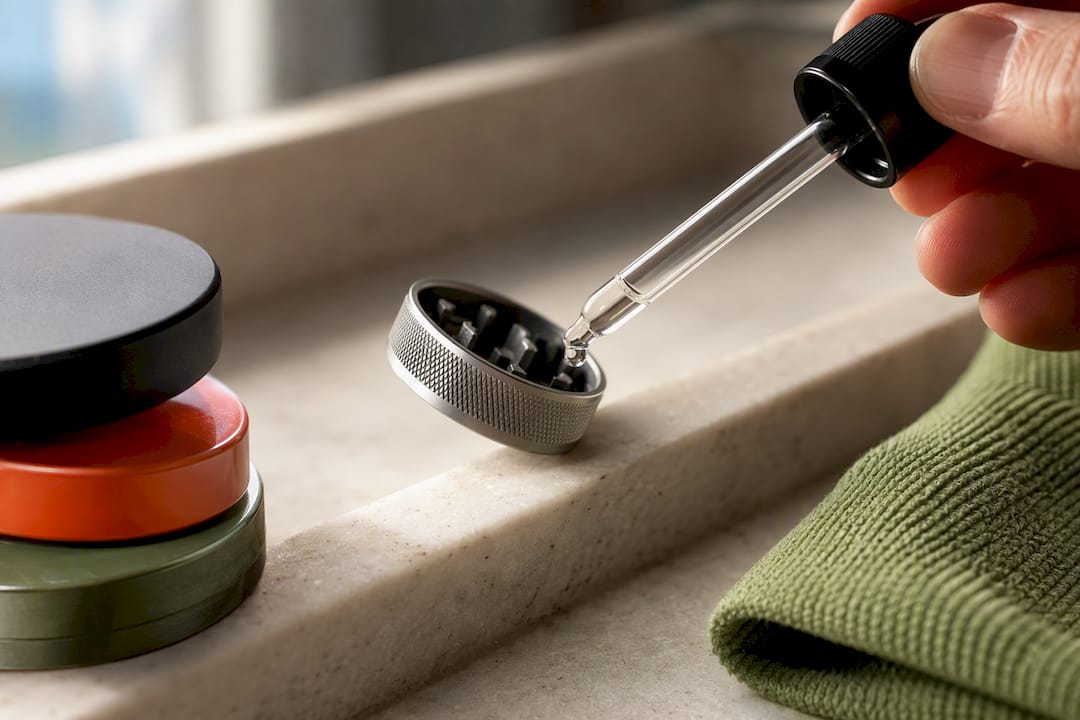
- Apply sparingly. Place 2 drops on the outer rim for smaller grinders, up to 4 for larger ones. Never drip lubricant directly into the grinding chamber or teeth.
- Rotate and wipe. Reassemble and turn the grinder several full rotations to work the lubricant into the seam, then wipe every visible trace from the teeth and inner chamber with your cloth.
- Test before you trust it. Grind a small pinch of flower and smell it. If anything seems off, discard that batch and give the grinder another full cleaning.
Pro Tip: Run one dry pinch of cheap or shake flower through the grinder first after applying lubricant. It’ll pick up any leftover residue before your good flower does.
Skip lubricant entirely on plastic grinders, painted finishes, or older porous metal you can’t fully wipe clean. If you can’t guarantee the excess is gone, it doesn’t belong near anything you’re going to smoke.
How Often Should You Clean a Weed Grinder?
A workable cadence keeps resin from ever building up enough to need aggressive fixes.
- After every session: A quick tap-out and a few strokes with a small brush across the teeth takes ten seconds and prevents most buildup.
- Every 1 to 2 weeks (frequent users): A full isopropyl soak or freezer-and-scrape session.
- Every 3 to 4 weeks (occasional users): The same deep clean, just on a longer interval.
Storage habits matter almost as much as the cleaning itself. Keep your grinder dry, stored somewhere cool, and away from sticky concentrates that transfer gum onto the plates. Before any long-term storage, clean it completely rather than putting away a dirty grinder and hoping it’ll still work months later.
One habit that saves a lot of maintenance headaches: tap ground flower directly into a container instead of forcing it through the teeth with your fingers. Forcing sticky material through is one of the fastest ways to jam a grinder that was working fine an hour earlier.
Our Take: Clean First, Lubricate Only as a Last Resort
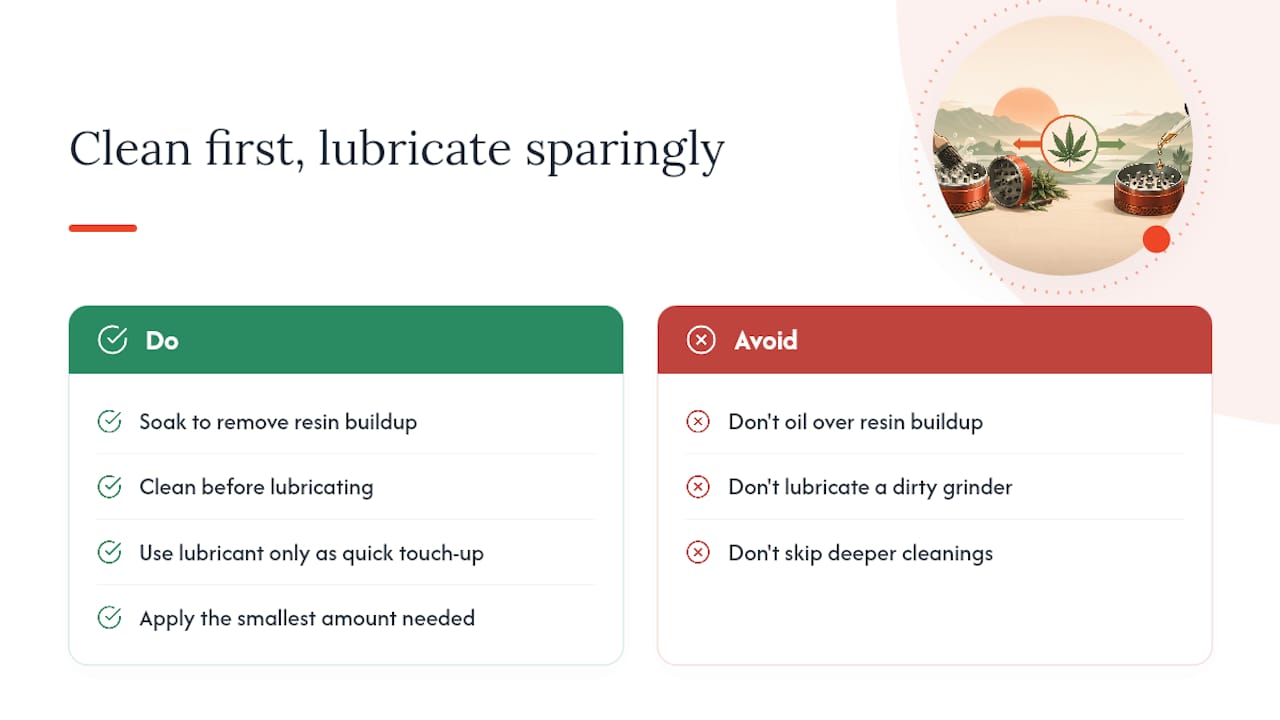
One company’s position on this is simple, because the mechanics back it up: a sticking grinder is a cleaning problem wearing a lubrication disguise. Resin, not friction between metal parts, is what slows a grinder down, and no amount of oil fixes a buildup problem the way a proper soak does.
Specialty lubricants have a narrow, legitimate use case, on a clean grinder that needs a quick touch-up between deeper cleanings, applied in the smallest amount that does the job. For the full step-by-step process, our cleaning and maintenance guide covers the technique in more depth, and our guide on grinding weed properly explains how grind consistency and clean equipment work together.
— Tree Lock Box
Gear That Makes Grinder Maintenance Easier
A grinder that’s easy to take apart is a grinder that actually gets cleaned regularly, which is why design matters as much as your cleaning routine. Our ergonomic herb grinder uses an easy-grip design that reduces strain during disassembly and scrubbing, a real difference if hand discomfort has ever made you skip a cleaning session. Beyond the grinder itself, we’ve put together detailed answers on storage, cleaning cadence, and prep tools in our cannabis tools FAQ, built specifically for questions like the ones covered here. If you’re ready to upgrade your setup or restock cleaning supplies, browse the full lineup on our shop page and find tools built to make the maintenance routine faster, not another chore you keep putting off.
Sources
- Do Cannabis Grinders Use Lubricant? Discover 7 Critical Facts
- What grease for die grinder? - Mechanics Stack Exchange
- Case Study: Power Tool Gear Grease | Nye Lubricants
FAQ
What oil can I use on my grinder?
Use only a specialty lubricant made specifically for herb grinders, applied in 2 to 4 drops at the outer rim. Cooking oils, WD-40, and general-purpose machine oils are unsafe because they go rancid, carry solvents, or leave residue that transfers into your flower.
What grease should you use for an angle grinder?
Angle grinders and other powered tools need greases engineered for high-speed gearboxes, a completely different product from anything appropriate for a hand-operated herb grinder. Never use tool-grade grease on cannabis equipment.
Is there a food-safe lubricant equivalent for weed grinders?
The closest equivalent is a specialty grinder lubricant marketed specifically for cannabis tools, since these are formulated to be safer near flower than kitchen oils or industrial products. Even these should be used sparingly and wiped clean before grinding flower again.
How often should you clean your weed grinder?
Give it a quick brush or tap after every session, and a full isopropyl alcohol soak or freezer-and-scrape treatment every 1 to 4 weeks depending on how often you use it. Heavier users should lean toward the shorter end of that range.
Can I use isopropyl alcohol on any grinder?
Isopropyl alcohol works well on all-metal grinders but can damage painted finishes or cloud plastic components. For those materials, stick to dry methods like the freezer-and-scrape technique or a soft brush.